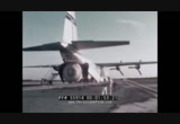
VELA NUCLEAR RADIATION DETECTION SATELLITE MISSION REPORT TITAN IIIC 55914
Industrial and advertising
Clips are not offered for this film: no licence or public-domain mark is recorded for it.
Low resolution (640×360): this is the archive's own copy.
Parts
About
Made by the U.S. Air Force's Eastern Test Range, this rarely seen film shows the launch of the special Vela satellite designed to detect radiation from nuclear tests. The film shows the Titan IIIC launch vehicle used in the program with a specific focus on the C-18 / Vela - VB mission. This was the last of the Vela satellites, launched on April 8, 1970. The Titan IIIC shown was the 100th launched at the Eastern Test Range. The Titan IIIC consisted of a two-stage Titan core and upper stage called the Titan Transtage, both burning hypergolic liquid fuel, and two large UA1205 solid rocket boosters.
Vela was the name of a group of satellites developed as the Vela Hotel element of Project Vela by the United States to monitor compliance with the 1963 Partial Test Ban Treaty by the Soviet Union.
Vela started out as a small budget research program in 1959. It ended 26 years later as a successful, cost-effective military space system, which also provided scientific data on natural sources of space radiation. In the 1970s, the nuclear detection mission was taken over by the Defense Support Program (DSP) satellites. In the late 1980s, it was augmented by the Navstar Global Positioning System (GPS) satellites. The program is now called the Integrated Operational Nuclear Detection System (IONDS).
The total number of satellites built was 12, six of the Vela Hotel design and six of the Advanced Vela design. The Vela Hotel series was to detect nuclear initiations in space, while the Advanced Vela series was to detect not only nuclear explosions in space but also in the atmosphere.
All spacecraft were manufactured by TRW and launched in pairs, either on an Atlas-Agena or Titan III-C boosters. They were placed in orbits of 118,000 km (73,000 miles),[1] well above the Van Allen radiation belts. Their apogee was about one-third of the distance to the Moon. The first Vela Hotel pair was launched on October 17, 1963,[2] one week after the Partial Test Ban Treaty went into effect, and the last in 1965. They had a design life of six months, but were actually shut down after five years. Advanced Vela pairs were launched in 1967, 1969 and 1970. They had a nominal design life of 18 months, later changed to 7 years. However, the last satellite to be shut down was Vehicle 9 in 1984, which had been launched in 1969 and had lasted nearly 15 years.
The Titan IIIC was an expendable launch system used by the United States Air Force from 1965 until 1982. It was the first Titan booster to feature large solid rocket motors and was planned to be used as a launcher for the Dyna-Soar and Manned Orbiting Laboratory, though both programs were cancelled before any astronauts flew. The majority of the launcher's payloads were DoD satellites, namely for military communications and early warning, though one flight (ATS-6) was performed by NASA. The Titan IIIC was launched exclusively from Cape Canaveral while its sibling, the Titan IIID, was launched only from Vandenberg AFB.
We encourage viewers to add comments and, especially, to provide additional information about our videos by adding a comment! See something interesting? Tell people what it is and what they can see by writing something for example: "01:00:12:00 -- President Roosevelt is seen meeting with Winston Churchill at the Quebec Conference."
This film is part of the Periscope Film LLC archive, one of the largest historic military, transportation, and aviation stock footage collections in the USA. Entirely film backed, this material is available for licensing in 24p HD, 2k and 4k. For more information visit http://www.PeriscopeFilm.com
Human-made No record of this work says a model made it. What this means.
- Archive
- Internet Archive, in Ephemeral films
- Licence or status
- The Internet Archive states none for this item.
- Language
- English
- Who can watch
- The archive gives no rating. Invisible Network shows it to Teens profiles and older, judged from its collection and subjects. How films are placed