1960s USAF NEWSREEL: B-58 HUSTLER BOMBER, PROJECT EXCELSIOR / JOSEPH KITTINGER, ATLAS MISSILE 55544
NewsIndustrial and advertising
Clips are not offered for this film: no licence or public-domain mark is recorded for it.
Low resolution (632×360): this is the archive's own copy.
Parts
About
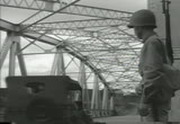
This black and white film "Tomorrow The Stars", narrated by broadcaster Lowell Thomas, covers five early 1960s Air Force topics: the B-58 Hustler, Project Excelsior, preparing pilots for future space travel, solar research, and the Atlas missile. The Conair B-58 Hustler, the world’s first supersonic bomber, is capable of Mach 2 flight with four General Electric J79 engines and a delta wing. It had a 20mm multi-barrel cannon in the tail and could carry five conventional or nuclear weapons: four on pylons under the wings and one under the fuselage. It’s first flight was November 11, 1956. It opens with the underside of a B-58 (:22) as its three crewmembers—a pilot, a navigator, and a defensive systems operator—climb into separate cockpits (:038-1:00) before taking off (1:01-1:25). In can be refueled in-air (1:26-1:33). The underside is shown during flight, making the five weapon pods clearly visible (1:35-1:50). Pilots study in an Air Force classroom (1:53). Airmen prepare planes as part of a composite air strike force deployment exercise (1:55-2:13). An overhead view of many planes on the field is shown (2:15). A pilot gets into the cockpit (2:18) and multiple planes taxi and take off (2:20-2:58) and are shown as a formation of 12 planes overhead (2:59). The “Welcome to the home of the 405th Fighter Wing” sign (3:15) is passed by B-58s (3:17). Project Excelsior’s Captain Joseph Kittinger Jr. suits up in a modified David Clark MC-3A partial pressure suit for the August 17, 1960 jump. He tested the Beaupre multi-stage parachute system for pilots to eject from high altitudes by jumping out of a helium balloon, as shown. He held the world’s record for the highest parachute jump, longest parachute drogue fall, and fastest speed by a human through the atmosphere until 2012 (3:30-5:05). To prepare pilots for future space travel, zero gravity weightlessness is tested by Air Force pilots in a modified C-130 at the Aerospace Medical Laboratory at Wright-Patterson Air Force Base (5:08-5:57). A pilot amusingly attempts to take a drink during zero gravity training (5:58-6:43). Air Force medical researchers suit up a pilot in a full-pressure suit with a closed-circuit oxygen system and load him into a heat chamber of 160 degrees to see the effects (6:45-7:34). A 30’ apparatus tests a pilot’s reaction to blast-off buffeting, weightlessness, and vertical acceleration (7:36-7:55). Another pilot is in a rocket sled (7:56-8:05). Pilots practice weightlessness again in the C-130 (8:07-8:18). Solar research is performed by Air Force scientists (8:23-8:29) using various equipment at the New Mexico Sunspot National Solar Observatory (8:30-8:46). A woman causes the coronagraph telescope to rotate to follow the sun (8:47-9:22). Another uses equipment to study solar flares (9:23-9:56). An Atlas missile is checked and readied for launch by members of the Strategic Air Command (10:00-11:19) and launched to orbit the earth (11:20-11:40).
We encourage viewers to add comments and, especially, to provide additional information about our videos by adding a comment! See something interesting? Tell people what it is and what they can see by writing something for example: "01:00:12:00 -- President Roosevelt is seen meeting with Winston Churchill at the Quebec Conference."
This film is part of the Periscope Film LLC archive, one of the largest historic military, transportation, and aviation stock footage collections in the USA. Entirely film backed, this material is available for licensing in 24p HD, 2k and 4k. For more information visit http://www.PeriscopeFilm.com
Human-made No record of this work says a model made it. What this means.
- Archive
- Internet Archive, in Ephemeral films
- Licence or status
- The Internet Archive states none for this item.
- Language
- English
- Who can watch
- The archive gives no rating. Invisible Network shows it to Teens profiles and older, judged from its collection and subjects. How films are placed