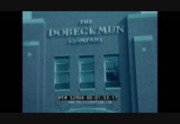
1930s CLEVELAND OHIO, DOBECKMUN CELLOPHANE BAG MANUFACTURING FILM 52904
Industrial and advertising
Clips are not offered for this film: no licence or public-domain mark is recorded for it.
Low resolution (640×360): this is the archive's own copy.
Parts
About
Made by Dobeckmun, a leading manufacturer of cellophane bags for the retail industry and one of the great companies of 1930s Cleveland, Ohio, MAKING DRESSING OF SHIMMERING TRANSPARENCY is a silent industrial film highlighting the company and the city in which it resides. This rare color film begins with images of downtown Cleveland from the air (actually, a skyscraper roof) before showing the city from a "motor car" (1:25). At 1:43 the Dobeckmun Company plant is seen, and then interior shots showing reception areas, the company switchboard, credit department, factory floor, dentist office and infirmary, and more.
Dobeckmun (short for Dolan, Becker and Munson -- the co-founders) made cellophane bags and cigar pouches, and you will see the steps to create them shown in the film (including a potato chip bag sample sent in the mail at 6:50). The company was the first in the USA to have a laminating process for cellophane, and had branch offices around the USA, and a second factory in Berkeley, California. The factory shown may have been the one located at 3301 Monroe Street in Cleveland. Dobeckmun was bought by the Dow Chemical Company, which owned the license of cellophane in the USA, in 1957.
Dobeckmun also developed a product called Lurex, a non-tarnishable metallic thread used in fabric, and zip tape, the cellophane strip used for opening packages of chewing gum and cigarettes. This may very well be what is seen at the 13:23 mark "threads of beauty".
Cellophane is a thin, transparent sheet made of regenerated cellulose. Its low permeability to air, oils, greases, bacteria, and water makes it useful for food packaging. "Cellophane" is in many countries a registered trade mark of Innovia Films Ltd based in Wigton, Cumbria, United Kingdom.
Cellophane was invented by Swiss chemist Jacques E. Brandenberger while employed by Blanchisserie et Teinturerie de Thaon. In 1900, inspired by seeing a wine spill on a restaurant's tablecloth, he decided to create a cloth that could repel liquids rather than absorb them. His first step was to spray a waterproof coating onto fabric, and he opted to try viscose. The resultant coated fabric was far too stiff, but the clear film easily separated from the backing cloth, and he abandoned his original idea as the possibilities of the new material became apparent. It took ten years for Brandenberger to perfect his film, his chief improvement over earlier work with such films being to add glycerin to soften the material. By 1912 he had constructed a machine to manufacture the film, which he had named Cellophane, from the words cellulose and diaphane ("transparent"). Cellophane was patented that year. The following year, the company Comptoir des Textiles Artificiels (CTA) bought the Thaon firm's interest in Cellophane and established Brandenberger in a new company, La Cellophane SA. In 1924, DuPont built the first cellophane manufacturing plant in the U.S. Cellophane saw limited sales in the US at first since while it was waterproof, it was not moisture proof—it held water but was permeable to water vapor. This meant that it was unsuited to packaging products that required moisture proofing. DuPont hired chemist William Hale Charch, who spent three years developing a nitrocellulose lacquer that, when applied to Cellophane, made it moisture proof. Following the introduction of moisture-proof Cellophane in 1927, the material's sales tripled between 1928 and 1930, and in 1938, Cellophane accounted for 10% of DuPont's sales and 25% of its profits.
We encourage viewers to add comments and, especially, to provide additional information about our videos by adding a comment! See something interesting? Tell people what it is and what they can see by writing something for example: "01:00:12:00 -- President Roosevelt is seen meeting with Winston Churchill at the Quebec Conference."
This film is part of the Periscope Film LLC archive, one of the largest historic military, transportation, and aviation stock footage collections in the USA. Entirely film backed, this material is available for licensing in 24p HD, 2k and 4k. For more information visit http://www.PeriscopeFilm.com
Human-made No record of this work says a model made it. What this means.
- Archive
- Internet Archive, in Ephemeral films
- Licence or status
- The Internet Archive states none for this item.
- Language
- English
- Who can watch
- The archive gives no rating. Invisible Network shows it to Tweens profiles and older, judged from its collection and subjects. How films are placed