THE LAST BOMB B-29 RAIDS ON JAPAN U.S. ARMY AIR FORCE WWII FILM 33574
WarIndustrial and advertising
Clips are not offered for this film: no licence or public-domain mark is recorded for it.
Low resolution (640×360): this is the archive's own copy.
Parts
About
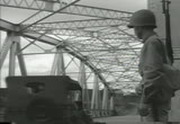
This official War Department film titled “The Last Bomb” and was photographed by Army Air Forces Combat Camera Units and special personnel of the AAF Motion Picture Unit. Filmed in Technicolor in 1945, it concentrates on the B-29 bombing raids on Japan in World War II. Striking from bases in Saipan, Tinian, and Guam, the Superfortresses traveled 3,000 miles roundtrip as part of long range bombardment operations in the final months of the war. Members of the XXI Bomber Command (a unit of the Twentieth Air Force headquartered on Guam) “planned the ultimate crushing defeat of Japan, down to the last bomb, Here was the beginning of the end of the road to Tokyo,” the viewer is informed at mark 01:00. The camera pans the shores of Guam as we are told that the island no longer looks ravished by war and that the natives had returned to their villages, “happy and smiling.” By adding paved roads, landing strips, and bases, the landscape of Guam had been changed by American forces. Under the command of General Curtis LeMay, the XXI Bomber Command had ground crews work around the clock to keep B-29 operational. “By July, LeMay’s bomber command is an efficient, well-oiled, well-trained, machine of destruction,” it is noted at mark 02:45. They also began low-altitude nighttime incendiary attacks on Japanese targets. (Because Japanese cities were largely constructed of combustible materials such as wood and paper, the resulting damage was extraordinary).
At mark 3:10, the audience is taken inside the war room at Guam to listen in on a planning session for an upcoming raid. After reviewing a weather report, LeMay is shown weighing his options before selecting his targets, including various locations around Tokyo. We see a “Details of Planning” checklist, as the narrator runs over each of the give points — navigation, bombing, flight engineering, radar, and air-sea rescue — and each is check off after the film covers each one. By mark 07:40, the Superfortresses are ready for take off and are shown taxiing down the runway on Guam. “To veteran crews it’s just another day’s work; one 1,500 mile haul up and down the ruddy Pacific,” we are told, as the 314th Bombardment Wing is shown taking off in one-minute intervals. Two more B-29 wings are shown taking off from Tinian at mark 09:42 — the 58th Bombardment Wing and the 313th Bombardment Wing — while the 73rd Bombardment Wing roars into the sky from Saipan. At mark 12:12, they pass over Iwo Jima, the island that is now home base to the P-51 Mustangs that will launch and serve as bomber escorts for the mission, and Brigadier General Ernest M. Moore is shown reviewing flight plans for members of his 7th Fighter Command.
As bad weather approaches at mark 14:15, the crews begin their respective checklists and the various wings prepare to gather at their rendezvous point. Dropping smoke markers at mark 15:20, the pilots form on their lead ships and continue their flight toward Japan. Met with flak bursts from enemy coastal batteries, the crews see Mount Fujiyama, about 60 miles southwest of Tokyo, at mark 16:26. Despite heavy flak and Japanese fighters, the bombers press forward. Tailgunners and Mustangs tangle with the Japanese fighters, until at mark 19:00 the pilots can see Tokyo through the clouds beneath them. In unison the bombers release their payloads as the film’s music swells. “Two Jap aircraft plants and an airdrome, 12,000 feet below, are about to receive 4,000 tons of destruction.” The successful first wave is followed by the next two waves who find their smoking targets.
The bombers turn and head for their home base, rejoined by the Mustang escorts who defend the planes from Japanese attack as spectacular dogfights fill the screen. The Mustangs also engage in strafing runs against Japanese military installations with deadly accuracy. They then regroup with the bombers and by mark 27:40 approach Iwo Jima once again. With a celebratory roll, the P-51s land on the dusty runways as the Superfortresses, all low on gas and some beat up by flak or battle scarred, follow them in. Those that are worthy of flight refuel and return to their home base. As the Marianas Islands appear on the horizon at mark 31:22, most of the bombers survive to turn into the landing patterns … and after a 14-hour journey, are home.
The film concludes with an explanation, at mark 34:07, of how the Allies were planning to increase their bombing raids on Tokyo. In August 1945, as forces gathered for a push against Japan, two B-29s — Enola Gay and Bocks Car — dropped two atomic bombs, bringing World War II to a close “and saved untold thousands of American lives.”
This film is part of the Periscope Film LLC archive, one of the largest historic military, transportation, and aviation stock footage collections in the USA. Entirely film backed, this material is available for licensing in 24p HD and 2k. For more information visit http://www.PeriscopeFilm.com
Human-made No record of this work says a model made it. What this means.
- Archive
- Internet Archive, in Ephemeral films
- Licence or status
- The Internet Archive states none for this item.
- Language
- English
- Who can watch
- The archive gives no rating. Invisible Network shows it to Teens profiles and older, judged from its collection and subjects. How films are placed