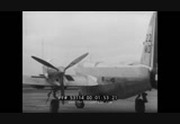
WWII AIRPLANE PROPELLER DESIGN PRINCIPLES AND TYPES INSTRUCTIONAL FILM 32824
WarEducationIndustrial and advertising
Clips are not offered for this film: no licence or public-domain mark is recorded for it.
Parts
About
“Airplane Propellers: Principles and Types” is a “restricted” World War II-era US War Department training film produced by the Signal Corps in collaboration with the Chief of the Air Corps. The film opens with a statement at mark 00:44 that “until the days of supersonic speed and jet propulsion of rocketships, the propeller is a relatively efficient method of moving our airplanes through the air.” A propeller size is dependent on the size of the engine, we’re told at mark 01:06, and we learn of the different uses for two-blade, three-blade, and four-blade propellers before being given a detailed tutorial on airfoil principles, including propeller velocity and airplane velocity, starting at mark 02:06. As it continues, the narrator explains the importance of the blade path and an aircraft’s angle of attack, and at mark 06:49 discusses a fixed pitch propeller and looks at the Hamilton Standard constant speed propeller at mark 09:35, and Hamilton hydromatic propellers that are used on larger, twin-engine aircraft (mark 10:35). We explore a Curtiss electric propeller at mark 12:05 before examininglng newer designs (mark 13:13). Various topics are summarized for the viewer starting at mark 14:55.
As seen in this film, rapid development of aircraft design in the 1930s required many related innovations, including propeller design. The hydromatic propeller by Hamilton Standard marked a significant advance over the counterweight-type, controllable pitch propeller. It played a distinguished role in allied combat aircraft in World War II. Its continuing development has incorporated many features used on later aircraft, including today's turboprop planes.
The hydromatic propeller was designed for larger blades, faster rate of pitch change, and wider range of pitch control than earlier controllable-pitch propellers. Improvements from a two-position controllable to the constant- speed type propeller were not equal to the demand of high-output engines or rapid airplane maneuvers. The variable-pitch aircraft propeller allowed the adjustment in flight of blade pitch, making optimal use of the engine's power under varying flight conditions. On multi-engined aircraft it also permits feathering the propeller--stopping its rotation--of a nonfunctioning engine to reduce drag and vibration.
We encourage viewers to add comments and, especially, to provide additional information about our videos by adding a comment! See something interesting? Tell people what it is and what they can see by writing something for example: "01:00:12:00 -- President Roosevelt is seen meeting with Winston Churchill at the Quebec Conference."
This film is part of the Periscope Film LLC archive, one of the largest historic military, transportation, and aviation stock footage collections in the USA. Entirely film backed, this material is available for licensing in 24p HD, 2k and 4k. For more information visit http://www.PeriscopeFilm.com
Human-made No record of this work says a model made it. What this means.
- Archive
- Internet Archive, in Ephemeral films
- Licence or status
- The Internet Archive states none for this item.
- Language
- English
- Who can watch
- The archive gives no rating. Invisible Network shows it to Teens profiles and older, judged from its collection and subjects. How films are placed