" TESTS OF RADIO CONTROLLED PLANES " U.S. NAVY WWII UAV PROGRAM TDN-1 TORPEDO DRONE 30792
PeriscopeFilm
WarIndustrial and advertising
Clips are not offered for this film: no licence or public-domain mark is recorded for it.
Parts
About
This WWII film, which has sound by the way only it's incredibly low, shows the U.S. Navy's experimental WWII weapon the TDN-1 drone. Built by the Naval Aircraft Factory, the TDN was an early unmanned combat aerial vehicle - referred to at the time as an "assault drone" - developed by the United States Navy's Naval Aircraft Factory during the Second World War. Developed and tested during 1942 and 1943, the design featured a television camera in the nose and could be flown by remote control by pilots aboard chase aircraft. The TDN-1 proved moderately successful, but it was expensive to build. A successor aircraft that could be built cheaply, the Interstate TDR-1, was eventually built and flown in combat against Japanese targets in the Pacific in 1944. The TDN-1 was relegated to second-line duties, and none were used in operational service.
One hundred production TDN-1 aircraft were ordered in March 1942. Despite being specifically designed to be a simple, low-performance aircraft, and despite proving promising in testing, the type was considered to be too complicated and expensive for use operationally. The improved Interstate TDR was selected for development as an alternative, the majority of TDN-1s being used in the test, liaison and training roles, with some being expended as aerial targets. The TDN-1 is often credited as the first US drone to take off from an aircraft carrier freely -- in this case the "Great Lakes Carrier" USS Sable. An Airspeed Queen Wasp had already been catapulted from HMS Pegasus in 1937. However the TDN-1 was a far more sophisticated aircraft than the British counterpart, in that it was equipped with television guidance.
The film describes a series of tests and operations involving radio-controlled drones used for military applications. It details the complex radio control systems, pre-flight checks, and takeoff procedures, including the role of ground operators and control planes. Various test flights are conducted from aircraft carriers such as the USS Sable and USS Charger to evaluate drone control, catapult launches, and bomb-carrying capabilities. Some takeoffs are successful, while others fail due to operational errors. A PB4Y control plane with an SG-3 radar is used to guide drones remotely via a television screen, allowing precise control over altitude and targeting. The final test involves a drone making a simulated attack run on a moving ship, demonstrating the feasibility of using these radio-controlled aircraft in combat scenarios.
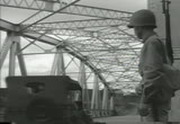
00:00 A television camera is in the aircraft, with radio control systems behind the cockpit, requiring extensive training. A ground truck and CDN drone are shown.
1:08: A ground operator and control box for drone bombs are displayed; fuses are checked and set.
1:28: The drone undergoes pre-flight checks with hand signals or walkie-talkie, taking off pilotless under radio control from ground or a control plane.
2:23: A side view shows the drone’s attitude during taxiing and takeoff.
2:57: The drone lands under radio control for practice.
3:10: In combat, a control plane at the runway’s end directs two drones (converted SNBs) and a TBF control plane taking off sequentially.
3:58: Two drones fly under radio control, turning simultaneously with altimeter maintaining altitude; up to four drones can be controlled at once.
4:44: Independent control is shown as one drone turns left while another flies straight before turning.
5:21: Tests on USS Sable show three radio-controlled takeoffs; the first climbs steeply.
Human-made No record of this work says a model made it. What this means.
- Archive
- Internet Archive, in Ephemeral films
- Licence or status
- The Internet Archive states none for this item.
- Credit
- PeriscopeFilm
- Who can watch
- The archive gives no rating. Invisible Network shows it to Teens profiles and older, judged from its collection and subjects. How films are placed