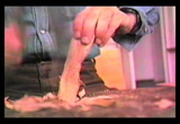
Napoleon Tiron 1986 Sala Dalles show documentary movie
Dan Paduraru & Titi Calist
Documentary
Clips are not offered for this film: no licence or public-domain mark is recorded for it.
Parts
About
"The output of one iteration becomes the input of another iteration, on and on and on" (Arthur C. Clarke)
NAPO (*nickname of Napoleon Tiron) is a Romanian artist born in 1935. This is one of the few, if not the only existing copy of an original VHS video documenting the work and ensuing major solo show by "Napo" from 1986 at the Sala Dalles Gallery in Bucharest/Romania. As a result of this show, his work got selected for the Romanian Pavilion at 1988 edition of the Venice Biennale, of which there is very few actual remaining documentation. After 1989 he became for a few years a professor at the art academy in Bucharest. He participated at numerous exhibitions, shows and symposiums throughout the years. Napoleon Tiron is considered one of the most important, if reclusive Romanian artists of the 20th century.
The final scaled-up result of his constructive work method consists in towering humanoid/quasi-humanoid shapes emerging out of a growing aggregate mass made up of very basic subunits - arm-length, rudimentary, modular pieces (usually 3) of plain chopped wood. At the low end, these subunits are composed of various spatial twists, meeting at various angles at the two joints. Each subunit contains two joints with only one of the pieces (the central wooden piece) ending in two separate joints. Such chained subunits are responsible for the growth of form. These subunits in turn, are the building blocks making up larger and larger sculptural macro-units that add up to larger and more complex organizational wholes. This labor-intensive and behind-the-scenes work of chopping and painstakingly reassembling the wooden elements is part of a additive process that is to be seen for the first time in this ~40 minute long, no comment, biopic. Napo's technique is deceivingly simple and low key, using the basic structure and proprieties of materials such as wood, strings of hemp and natural glue or cast plaster. Most of this focused work went on unsuspectingly and hidden behind doors away in his cramped atelier, in near isolation while the 1980s coincided with the harshest and most extreme years of the Ceauşescu regime in Romania. This is what came out of it.
Like a 1980 Mandelbrot set we may discover hidden, nested complexities where one least expects it, showing that even the most simple and basic (or just 'mere' multiplication and addition) equations can have far-reaching consequences, once obstinate reiteration does its ceaseless work. One is left out to speculate freely about how his wooden -Golem's- (Napo's term for these creatures) foreshadows a newly shaped humanity in a long string of monstrous 'homunculi' creations from the actual Prague Golem to Shelley's Frankenstein, Čapek R.U.R and beyond. Even further, it eerily parallels the constructivist tendency of life sciences to regard everything as a composite - as made up of "bricks", with the promise to remake life from within. Ignoring the cytoplasmic context, such a geno-centric view of genetics has reduced everything to nucleotide or amino acid composite subunits, to 'building blocks'. There are always unsuspected and even dangerous ways in which the preexisting, non-human structural requirements feedback into our obstinate tendency to reverse-engineer and built bottom-up organisms via Synthetic biology for example. This "bio-constructivist" (Frederic Neyrat) model informs and subtends the profit incentive of Gentech & Pharma product pipelines as well as our increasing capacity to permanently alter and modify future genomes or resuscitate and re-employ ancient, preexisting bacterial CRISPR/Cas9 gene splicing mechanisms.
Human-made No record of this work says a model made it. What this means.
- Archive
- Internet Archive, in The VHS Vault
- Licence or status
- The Internet Archive states none for this item.
- Credit
- Dan Paduraru & Titi Calist
- Language
- Romanian
- Who can watch
- The archive gives no rating. Invisible Network shows it to Tweens profiles and older, judged from its collection and subjects. How films are placed
More from The VHS Vault
 Documentary
Connections by James Burke (Seasons 1-3)
 Commercial
Farrah's Story (2009)
 Documentary
National Geographic—Amazon: Land of the Flooded Forest (1991)
 Documentary
National Geographic—Killer Whales: Wolves of the Sea (1993)
 Documentary
The Short Films of David Lynch
 Documentary
Return of the Ewok and Other Little Films
 Documentary
Hendrix Band of Gypsys Live at the Filmore East Documentary
 Documentary
The Gulf War
 Documentary
National Geographic—The Grizzlies (1987)
 Documentary
Secrets of Making Money
 Documentary
Terror in Space
 Documentary