Make a clip
Public domain · NASA Goddard
Up to 60 seconds, at most the picture size of the copy it is cut from. The clip carries the title, the credit, the licence and a link back here. It is made in this browser, and nothing is sent to this site.
Or send the moment itself: https://invisiblenetwork.ai/watch/archive/commons/96295853?play=1&t=0
Parts
About
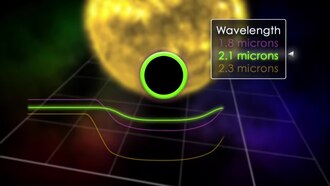
Since the early 1990's, astronomers have known that extrasolar planets, or \"exoplanets,\" orbit stars light-years beyond our own solar system. Although most exoplanets are too distant to be directly imaged, detailed studies have been made of their size, composition, and even atmospheric makeup - but how? By observing periodic variations in the parent star's brightness and color, astronomers can indirectly determine an exoplanet's distance from its star, its size, and its mass. But to truly understand an exoplanet astronomers must study its atmosphere, and they do so by splitting apart the parent star's light during a planetary transit.
This video is public domain and can be downloaded at: http://svs.gsfc.nasa.gov/goto?11428
Like our videos? Subscribe to NASA's Goddard Shorts HD podcast: http://svs.gsfc.nasa.gov/vis/iTunes/f0004_index.html
Or find NASA Goddard Space Flight Center on facebook: http://www.facebook.com/NASA.GSFC
Or find us on Twitter:
https://twitter.com/NASAGoddard
Human-made No record of this work says a model made it. What this means.
- Archive
- Wikimedia Commons, in Wikimedia Commons
- Licence or status
- Public domain, as the Wikimedia Commons states it.
- Rights statement
- Public domain
- Credit
- NASA Goddard
- Who can watch
- The archive gives no rating. Invisible Network shows it to Tweens profiles and older, judged from its collection and subjects. How films are placed
More from Wikimedia Commons
 Short
Curiosity's Seven Minutes of Terror
 Short
Launch Recap NASA and SpaceX fly Astronauts to the Space Station
 Short
Space Station Live - Cultivating Plant Growth in Space
 Short
STS-132 Liftoff Space Shuttle Atlantis
 Short
Narrated Distributed Water Balance of the Nile Basin
 Short
Moon Phase and Libration, 2020 South Up 4K UHD
 Short
NASA's Mars 2020 Perseverance Rover Landing Animations-rzmd7RouGrM
 Short
Alexander Gerst’s Earth timelapses (2017 reissue)
 Feature
Restored Apollo 11 Moonwalk - Original NASA EVA Mission Video - Walking on the Moon
 Short
First 8K Video from Space - Ultra HD VP9
 Cartoon
Galaxy Collision Animation- James Webb Space Telescope Science
 Short