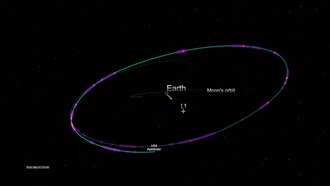
How LISA Pathfinder Detected Dozens of 'Comet Crumbs' CQeVHg4aA0s
NASA Goddard
Space
Make a clip
Public domain · NASA Goddard
Up to 60 seconds, at most the picture size of the copy it is cut from. The clip carries the title, the credit, the licence and a link back here. It is made in this browser, and nothing is sent to this site.
Or send the moment itself: https://invisiblenetwork.ai/watch/archive/commons/96294132?play=1&t=0
Parts
About
LISA Pathfinder, a mission led by ESA (the European Space Agency) that included NASA contributions, successfully demonstrated technologies needed to build a future space-based gravitational wave observatory, a tool for detecting ripples in space-time produced by, among other things, merging black holes. A team of NASA scientists leveraged LISA Pathfinder's record-setting sensitivity for a different purpose much closer to home — mapping microscopic dust shed by comets and asteroids.
Most of these particles, known as micrometeroids, have masses measured in micrograms, similar to a small grain of sand. But at speeds reaching 40,000 mph (64,000 kph), even micrometeoroids pack a punch.
The NASA team, led by Ira Thorpe at NASA's Goddard Space Flight Center in Greenbelt, Maryland, detected 54 impacts during the mission, which lasted from 2015 to 2017. Modeling the strikes allowed the researchers to determine what kinds of objects shed the dust. The findings are broadly consistent with existing ideas of what generates micrometeroids found near Earth. The dusty culprits are mostly short-period comets whose orbits are determined by Jupiter. Comets with longer periods, like Halley’s comet, also contributed dust that LISA Pathfinder sensed.
The new measurements could help refine dust models used by researchers in a variety of studies, from understanding the physics of planet formation to estimating impact risks for current and future spacecraft.
Read more: https://www.nasa.gov/feature/goddard/2019/how-lisa-pathfinder-detected-dozens-of-comet-crumbs
Music credit: \"Vibrating\" (Instrumental) and \"Treacherous Path\" (Instrumental) both from Universal Production Music
Credit: NASA's Goddard Space Flight Center Scott Wiessinger (USRA): Lead Producer Francis Reddy (University of Maryland College Park): Lead Science Writer Tom Bridgman (GST): Lead Visualizer James Ira Thorpe (NASA/GSFC): Scientist Walt Feimer (KBRwyle): Animator Scott Wiessinger (USRA): Narrator
This video is public domain and along with other supporting visualizations can be downloaded from NASA Goddard's Scientific Visualization Studio at: https://svs.gsfc.nasa.gov/13332
If you liked this video, subscribe to the NASA Goddard YouTube channel: https://www.youtube.com/NASAGoddard
Follow NASA’s Goddard Space Flight Center · Instagram http://www.instagram.com/nasagoddard · Twitter https://twitter.com/NASAGoddard · Twitter https://twitter.com/NASAGoddardPix · Facebook: http://www.facebook.com/NASAGoddard
· Flickr https://www.flickr.com/photos/gsfc
Human-made No record of this work says a model made it. What this means.
- Archive
- Wikimedia Commons, in Wikimedia Commons
- Licence or status
- Public domain, as the Wikimedia Commons states it.
- Rights statement
- Public domain
- Credit
- NASA Goddard
- Who can watch
- The archive gives no rating. Invisible Network shows it to Tweens profiles and older, judged from its collection and subjects. How films are placed
More from Wikimedia Commons
 Short
Curiosity's Seven Minutes of Terror
 Short
Launch Recap NASA and SpaceX fly Astronauts to the Space Station
 Short
Space Station Live - Cultivating Plant Growth in Space
 Short
STS-132 Liftoff Space Shuttle Atlantis
 Short
Narrated Distributed Water Balance of the Nile Basin
 Short
Moon Phase and Libration, 2020 South Up 4K UHD
 Short
NASA's Mars 2020 Perseverance Rover Landing Animations-rzmd7RouGrM
 Short
Alexander Gerst’s Earth timelapses (2017 reissue)
 Feature
Restored Apollo 11 Moonwalk - Original NASA EVA Mission Video - Walking on the Moon
 Short
First 8K Video from Space - Ultra HD VP9
 Cartoon
Galaxy Collision Animation- James Webb Space Telescope Science
 Short