Make a clip
CC BY-SA 4.0 · Deni Ingilizovski
Up to 60 seconds, at most the picture size of the copy it is cut from. The clip carries the title, the credit, the licence and a link back here. It is made in this browser, and nothing is sent to this site.
Or send the moment itself: https://invisiblenetwork.ai/watch/archive/commons/150306337?play=1&t=0
Parts
About
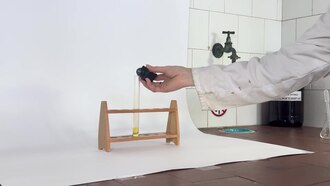
The xanthoproteic reaction is used to detect the presence of proteins that contain aromatic amino acids in their structure (e.g., tyrosine, tryptophan).
To a protein solution, concentrated nitric acid is added, and the test tube is heated. Then, concentrated ammonium hydroxide (or sodium hydroxide) solution is added to the test tube, and the heating is continued. A yellow-orange product is obtained, indicating a positive reaction.
The reaction is based on the nitration of the aromatic ring of the amino acid with concentrated nitric acid, resulting in the formation of nitro compounds with a characteristic yellow color. By adding ammonium hydroxide, the color changes to orange due to the formation of a salt of the tautomeric form of the nitro compound.
The experiment was performed by Prof. PhD Miha Bukleski. The planning of the experiment also included the Prof. Emeritus PhD Vladimir Petruševski, Prof. PhD Marina Stojanovska and the student Mihail Trajkov, Department of Chemistry, FNSM, Ss. Cyril and Methodius University, Skopje, Macedonia.
Human-made No record of this work says a model made it. What this means.
- Archive
- Wikimedia Commons, in Wikimedia Commons
- Licence or status
- CC BY-SA 4.0, as the Wikimedia Commons states it.
- Rights statement
- Creative Commons Attribution-Share Alike 4.0
- Credit
- Deni Ingilizovski
- Who can watch
- The archive gives no rating. Invisible Network shows it to Tweens profiles and older, judged from its collection and subjects. How films are placed
More from Wikimedia Commons
 Short
Curiosity's Seven Minutes of Terror
 Short
Properties of Hydrogen - Chemistry for All - FuseSchool
 Short
09. Гасење вар како силно егзотермен процес
 Cartoon
Galaxy Collision Animation- James Webb Space Telescope Science
 Short
Mars2020Rover-SampleCollectionStorage-20200206
 Short
YBCO video
 Short
Potassium plasma
 Short
Red weaver ants transporting a dead gecko, in Laos (video)
 Short
Lorentz сhaos as black hole
 Short
Деления инфузорий Colpidium
 Short
2019-10-13 fete-science-Mulhouse
 Short