Make a clip
CC BY 3.0 · UC Berkeley
Up to 60 seconds, at most the picture size of the copy it is cut from. The clip carries the title, the credit, the licence and a link back here. It is made in this browser, and nothing is sent to this site.
Or send the moment itself: https://invisiblenetwork.ai/watch/archive/commons/125636429?play=1&t=0
Parts
About
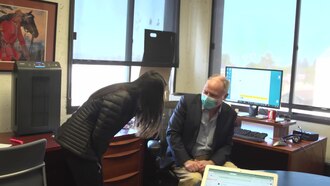
David Card, a labor economist and professor of economics at the University of California, Berkeley, has won the 2021 Nobel Memorial Prize in Economic Sciences.
(Note: At 1:42 in the video, the correct spelling of the student interviewed is: is Arlen Guarin Galeano.)
Prof. Card won the Nobel Prize for work that challenged orthodoxy and dramatically shifted understanding of inequality and the social and economic forces that impact low-wage workers. He was awarded half the prize, with the other half shared by economists Joshua Angrist of MIT and Guido Imbens of Stanford University.
Card is best known for pioneering studies in the 1990s that remain acutely relevant today, as they questioned the prevailing assumptions about the impact of immigration on native-born U.S. workers and the effect of minimum wage increases on domestic job growth.
Card, 65, a native of Ontario, Canada, is UC Berkeley’s sixth economist to win the Nobel Prize in economics and the campus’s 26th Nobel laureate overall. His predecessors are Oliver Williamson, (2009), George Akerlof (2001), Daniel McFadden (2000), John Harsanyi (1994) and Gérard Debreu (1983). Imbens, one of Card’s two co-winners, was a member of UC Berkeley’s faculty from 2002 to 2006, as a professor of economics and of agricultural and resource economics, before he left for Harvard University and then Stanford.
Announcing the award today in Stockholm, Sweden, the Economic Sciences Prize Committee at the Royal Swedish Academy of Sciences credited Card for his impact on policy debates over immigration, welfare reform and inequality.
Card’s work “helped to answer important questions for society,” said Peter Fredriksson, chair of the committee at a news conference in Sweden. Card’s work, he added, “challenged conventional wisdom, which led to new studies and additional insights.”
Taken together, the work by the three economists “revolutionized empirical work” in economics, the committee said.
Card learned of the award early Monday morning at his family’s home in Santa Rosa — and thought it was a practical joke being played by mischievous colleagues. He had just arrived after a day of travel from a family event near, Guelph, Ontario, in Canada. The initial call from the Nobel committee came to his family’s home in Berkeley, and a voice message was forwarded to Santa Rosa.
“The message said the call was coming from Sweden,” he said just after winning the award. “I have a couple of friends who would pull a stunt like that.”
He welcomed the news with a self-effacing assessment of his work and its impact.
My contributions are pretty modest,” he said. “It’s about trying to get more scientific tie-in and evidence-based analysis in economics.
Human-made No record of this work says a model made it. What this means.
- Archive
- Wikimedia Commons, in Wikimedia Commons
- Licence or status
- CC BY 3.0, as the Wikimedia Commons states it.
- Rights statement
- Creative Commons Attribution 3.0
- Credit
- UC Berkeley
- Subtitles
- English
- Who can watch
- The archive gives no rating. Invisible Network shows it to Teens profiles and older, judged from its collection and subjects. How films are placed
More from Wikimedia Commons
 Short
¿Qué es Wikipedia?
 Short
Curiosity's Seven Minutes of Terror
 Short
Wikilovesmonuments.org
 Short
OYME - Tyushtya's song
 Short
Lift Every Voice and Sing - United States Navy Band
 Cartoon
Steamboat Willie (1928) by Walt Disney
 Short
Elephants Dream (2006)
 Feature
Night of the Living Dead (1968)
 Short
MandelbulbRot 00000-10501 VP9 slow lossless
 Feature
The Man Who Laughs (1928)
 Feature
PENDATANG (2023) full movie
 Documentary