Podcasts · Paul Krugman Podcast
Jared Bernstein on Debt (Reposted with better transcript)
· 43 min
Episode Jared Bernstein on Debt (Reposted with better transcript)
For all my interviews and more, subscribe on YouTube.
Better transcript!
. . .
TRANSCRIPT: Paul Krugman in Conversation with Jared Bernstein
(recorded 8/20/26)
Paul Krugman: Hi everyone. Paul Krugman talking with Jared Bernstein, former chief economist, head of the Council of Economic Advisers under Joe Biden. Now a policy fellow at the Stanford Institute for Economic Policy Research and at the Center for American Progress, which is in DC.
Jared Bernstein: And I speak to you from Alexandria.
Krugman: Yeah, and the reason I want to talk with you is, you know, there’s a lot of headlines now about debt. Interest rates, particularly at the long end, are way up. You and I have both been Substacking about it. I think we mostly are on the same wavelength, but I’d like to go back and forth, and I want to talk about some work that you’ve done, particularly with Bobby Kogan. But what’s your take right now? I mean, we had all these headlines about forty trillion dollars of debt. This is very different from the way we were talking about debt a few years ago, so what’s your take?
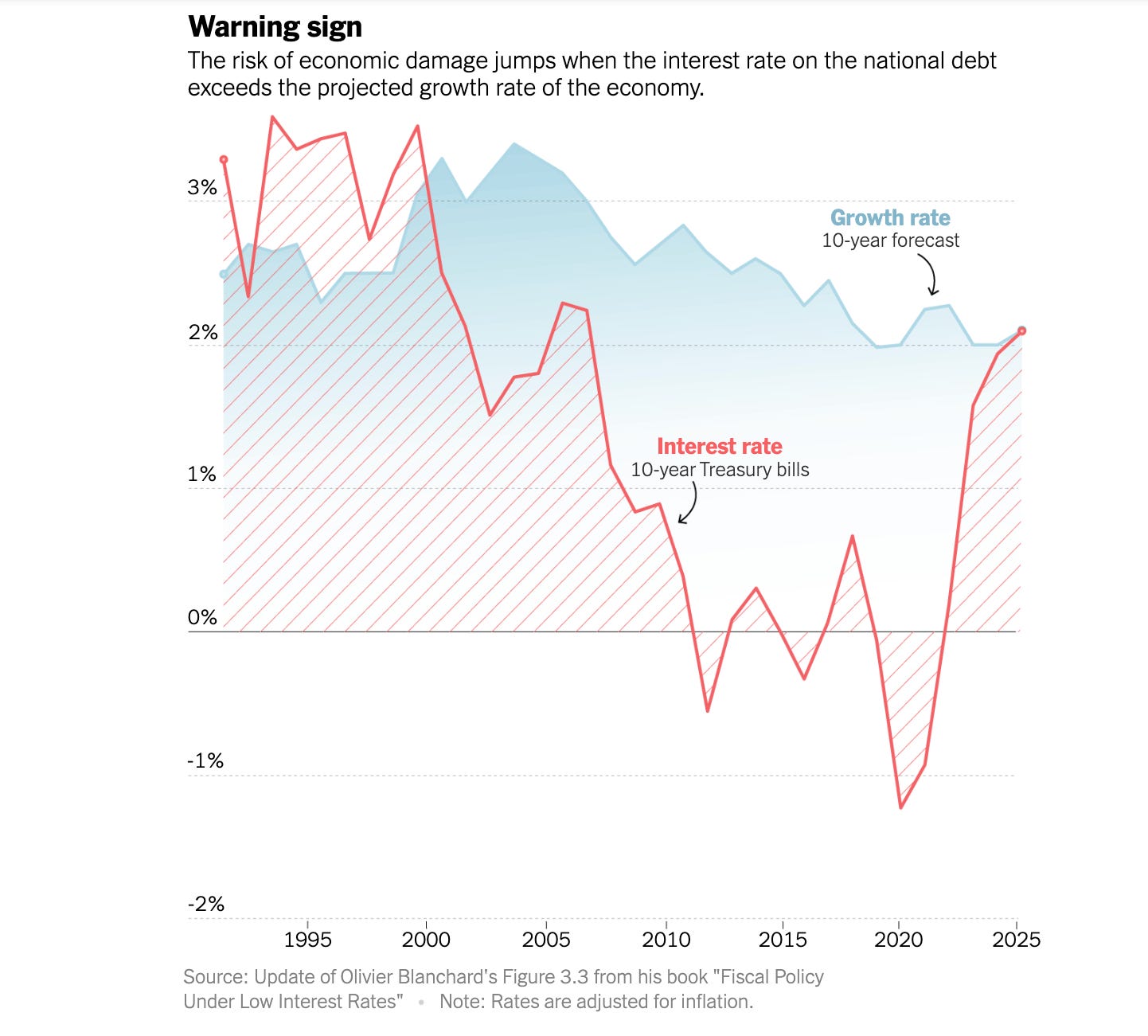
Bernstein: Well, Paul, like you, for many years I was pushing back on those whose hair was on fire about the urgency of the federal debt. I thought that that overheating was overheated, and that as long as the growth rate surpassed the interest rate and we sort of kept our deficits within kind of a normal range, we could service our debt without breaking a sweat. But a few years ago, I began to become more hawkish and less dovish for a couple of reasons. One, the budget math became less favorable; the growth rate looked a lot closer to the interest rate, and that was before this recent bump up in bond yields. But also, you know, I’ve been in government a lot lately, and it looked to me like neither side really cared much at all. The reaction function, as we say these days, seemed to have been kind of dead in a way that I thought was problematic.
Now, this is not a pox on both houses. And by the way, here’s an area where you and I may have slightly different views. The Republicans’ tax cuts—and Bobby and I have done a lot of work on this—are public enemy number one here. Exhibit A, in terms of why we’re in the mess we’re in. But you know, Democrats have largely endorsed those tax cuts and, in my view, have done some irresponsible stuff, too. So that’s kind of my first take.
Krugman: Okay. You’re talking about r-g, but that’s kind of an important point, right? Why do we think about interest and growth and debt? Lots of people are out there saying, “Look, the interest on the debt is now so huge,” but that’s not quite the whole story, but it’s closer to the story. Anyway, your version of it...
Bernstein: Yeah. For me, a lot of this comes from paying attention to Olivier Blanchard‘s work. He has kind of wedged into a lot of our heads this notion that when the growth rate surpasses the rate of interest, it is possible to keep rolling over that debt and not get into a kind of debt spiral because you’re generating enough growth and revenues and incomes to sustain the debt or to roll it over. Meaning, you know, replace some old debt with new debt without worrying about the debt getting on an unsustainable trajectory. As soon as r is bigger than g, that’s when you have the threat of a debt spiral.
That’s not all the math. It depends on the size of your deficits as well. But broadly speaking, for many years we had pretty good growth and pretty low interest rates. We can talk about how that growth was distributed—a lot of it didn’t reach working-class people—but the fact that g, the growth rate, was higher than the interest rate was one reason why I was less wound up about all this.
Krugman: Yeah, one of my favorite things is talking about the question of “How did we pay off the debt from World War II?” And the answer is we didn’t. The debt when John F. Kennedy was elected was about the same as it had been on V-J Day in dollar terms, but it was just vastly…
Links in the notes 12
- https://www.youtube.com/@PKrugman
- https://en.wikipedia.org/wiki/Jared_Bernstein
- https://econjared.substack.com/
- https://en.wikipedia.org/wiki/Olivier_Blanchard
- https://www.nytimes.com/2025/07/09/opinion/debt-deficit-economy-shock.html?eafs_enabled=false
- https://www.americanprogress.org/article/tax-cuts-are-primarily-responsible-for-the-increasing-debt-ratio/
- https://paulkrugman.substack.com/p/the-case-against-bond-market-panic
- https://econjared.substack.com/p/updating-our-ai-bubble-call
- https://www.linkedin.com/posts/on-this-episode-of-wall-street-week-yale-ugcPost-7450987967193702400-skvT/
- https://dannyyagan.com/research/
- https://www.americanprogress.org/article/why-the-national-debt-matters-more-than-it-used-to-and-why-we-should-not-count-on-ai-to-fix-the-problem/
- https://paulkrugman.substack.com/subscribe?utm_medium=podcast&utm_campaign=CTA_4
Shows are listed from Apple Podcasts' charts and directory, and Podcast Index where it is used. Every show and episode belongs to its publisher and plays from the publisher's own feed; this site hosts none of them. Explicit shows are for adult profiles only, and children’s profiles hear only children’s shows. More about this list.