Podcasts · Doomscroll with Joshua Citarella
The Online Marketplace of Ideas
· 1 h 04 min
Episode The Online Marketplace of Ideas
➡️ follow NEW MODELS
The Online Marketplace of Ideas (2026) is an expansive survey of the present and recent history of Internet culture. Today, alt-media has become quantitatively larger than legacy publications. As a result, any consensus or “mainstream” has fragmented into a chaotic digital landscape. The cultural and political fringe is now co-mingled with the establishment. Challengers have become incumbents and vice versa.
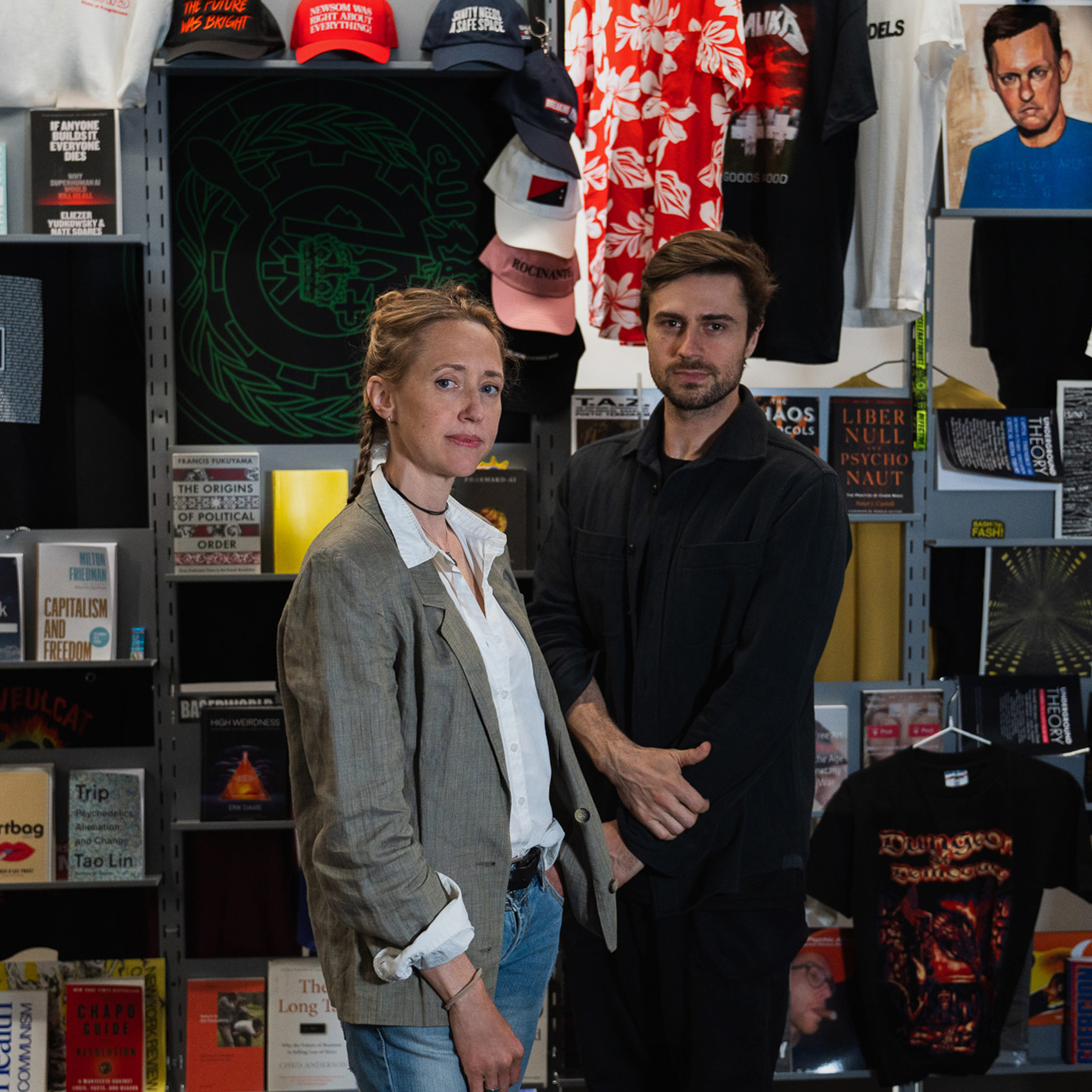
Within the exhibition, each carefully selected item has been purchased online and is shown without the knowledge of its creator or author. Contributors range from canonized artists to podcasters, influencers, bloggers, memers, musicians, and even politicians; each represents an accidental avant-garde for 21st century media.
Created by Joshua Citarella & NEW MODELS (Caroline Busta & Lil Internet) with architectural design by sub, The Online Marketplace of Ideas brings together traces of the digital layer into the physical world. The installation includes more than 400 pieces of creator merch (t-shirts, hats, and other drop-ship basics), printed matter (books, journals, zines), and ephemera (nicotine pouches, Modafinil blister packs, mewing gum, etc), plus a small number of artworks. A Call Her Daddy baby doll tee sits opposite a Joe Rogan Experience shirt, draped over Charlie Kirk’s MAGA Doctrine. Fanged Noumena shares a shelf with Abundance below a Chapo Trap House hat. The bazaar includes a broad canon of accelerationist writings and maps the vast memeplex of ideas that drive attention and ideology on social media. Shown together, these objects convey the cultural and political incoherence of the present moment; infinite consumer choice with limited or no political agency.
Viewed as a whole, The Online Marketplace of Ideas becomes greater than the sum of its individual parts. Similar graphic motifs emerge from disparate editorial voices. Colorways, typefaces and aesthetics flow seamlessly between opposing factions. Generic stockpiles of Gildan tee shirts or Yupoong hats are adorned with alternating logos through DTG printing or machine embroidery. These identical modes of on-demand production and just-in-time delivery evidence an unseen relay of logistics churning beneath the digital content layer. Across the political spectrum, the same physical warehouses (in Texas, Ohio and elsewhere) are linked to re-skinned e-Commerce storefronts. Within the exhibition, this wide gamut of political positions is contrasted against an underlying uniformity of material supply chains. While recent commentary has focused on the controversial opinions of online personalities, it has often overlooked the platform’s reorganization of work and materials in the world. Seen in totality, the installation points not toward a single dominant voice but toward an overarching hegemony of the market itself.
In an era defined by downward mobility and the digitization of culture, millennials are left with fewer cultural artifacts than previous generations. Where Boomers might have purchased property or other physical assets, today’s home prices are unaffordable and goods are increasingly disposable. Where Gen Xers might have accumulated a valuable record collection, Millennials have streaming subscriptions to cloud-based archives. Merch is where the immaterial experience of web 2 culture touches down into our lived human space. It is the physical precipitant of “the digital” into our material world. As an analogue display technology, it works to signal identity in social contexts where the screen cannot reach. These printed objects are worn by community members to signal proof of belonging and to represent the strength of their collective belief. For many of us, it is the only precious cultural artifact we might have.
The recent pole shifts between fringe and mainstream also signal a larger transformation that will soon shape the twenty-first-century; the slow emergence of new social institutions. Over the past decade,…
Links in the notes 4
Shows are listed from Apple Podcasts' charts and directory, and Podcast Index where it is used. Every show and episode belongs to its publisher and plays from the publisher's own feed; this site hosts none of them. Explicit shows are for adult profiles only, and children’s profiles hear only children’s shows. More about this list.