Podcasts · Stream of Subconsciousness
Learn to Be Smart (podcast)
· 22 min
Episode Learn to Be Smart (podcast)
“Nothing in all the world is more dangerous than sincere ignorance and conscientious stupidity.” — Martin Luther King, Jr.
It Starts with the Mind
I’m writing three related posts: “Learn to Be Smart,” “The Psychology of Culture,” and “A.I. Defeats Consultants.” They all have to do with how we take or lose control.
What comes first: controlling or having something to control? Regaining control after you’ve lost it, or losing control when you previously had it? Historically, losing control comes first. As Joni Mitchell sang, “You don’t know what you’ve got ‘til it’s gone.” So too, realizing you have something must happen before you can apply it or recover it.
We start by reacting, then learn by experience, and finally gain insight. Realizing our potential is like turning swords into plowshares; shifting from being defensive to productive. We should consider our abilities and find ways to apply them. Our basic human ability is being “smart.”
We often regret our decisions, feeling like we misjudged the situation or missed an opportunity. “Bringing a knife to a gunfight” may be an unnecessarily aggressive metaphor but I have resolved to be more assertive. The expression refers to situations you’re either underestimating or not taking seriously. Perhaps “showing up drunk for your drivers test” might be a better metaphor for how we approach self-awareness.
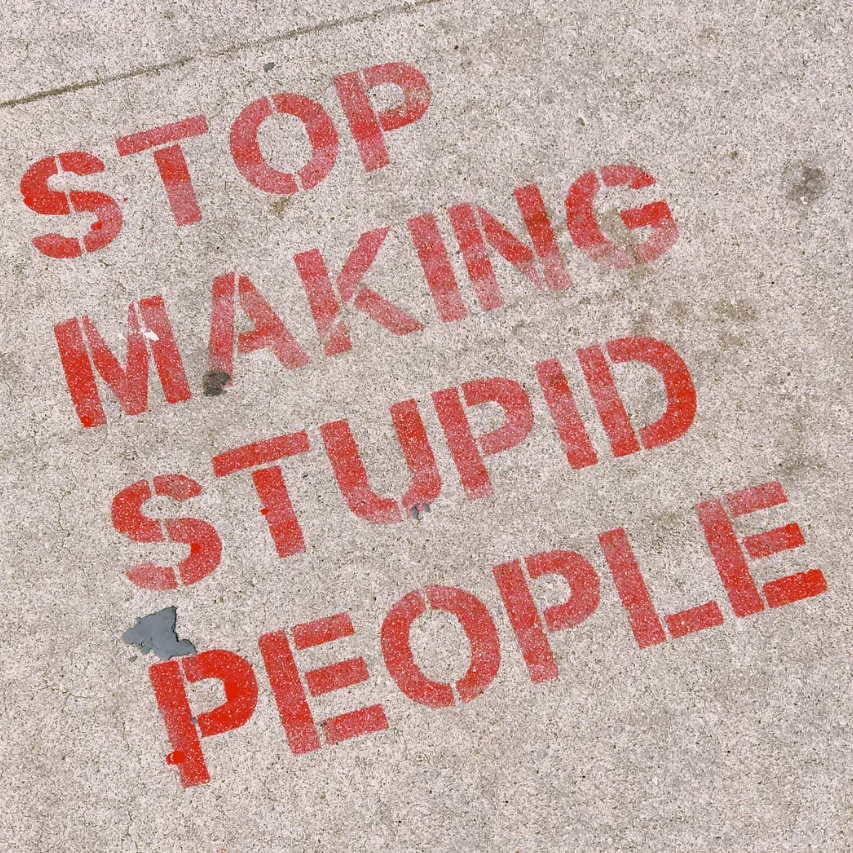
I’m tired of people who are indifferent to acting intelligently, which I call being stupid, and I’ve become more inclined to point it out. I want to call out bad thinking before it leads to bad conclusions. People normally disguise poor thinking with some plausible rationale, so if you get the whiff of bad thinking, you’re probably seeing through the disguise.
I made a pitch to speak with a podcaster interested in ecological conservation. I suggested we talk about why people are not more engaged with the environment. He responded, “My podcast is quite tightly focused on ecology, conservation, and human-wildlife interactions, and I don’t think your angle would be a strong fit for my audience.”
I told him he was being small minded and missing the real issue, which is not conservation. The real issue is the failure of people to be aware of their responsibility and to be stewards of the environment. I’m sure he’ll be offended, but offending people has become my litmus test: if I’m not offending anyone, then I’m not trying hard enough.
Another example is family partnerships that break up because one person is frustrated, doesn’t know how to change, and doesn’t know how to engage. From my experience as a counselor, the inability to problem solve lies at the root of most relationship struggles. It is more due to a lack of self-awareness and commitment than to the difficulty of the problem. I consider this being intentionally stupid. It’s also been called functional stupidity.
“Functional stupidity is the absence of reflection on the purpose or the wider context of a job. You do the job correctly, focusing on the technical details but stop searching for questions about the work. Three aspects characterize functional stupidity:
• Lack of reflexivity: You don’t think about your assumptions.• Lack of justification: You don’t ask why you’re doing something.• Lack of substantive reasoning: You don’t consider the consequences or wider meaning of your actions.
Wishful thinking, following leaders without scrutiny, unreasoning zeal for fads and fashions, senseless imitation of others and the use of clichés in place of careful analysis are examples of functional stupidity.” — David Wagner (2024), from The Stupidity Paradox
Smartness is Part of One’s Personality
Smartness is not an aptitude, it’s a choice. Each person certainly has aptitudes, but a lack of aptitude does not excuse a person’s bad decisions. You continue to be responsible for your decisions regardless of your ability. You’re obliged to know what you’re capable of.
I used to think that any person could be smart, and…
Links in the notes 2
Shows are listed from Apple Podcasts' charts and directory, and Podcast Index where it is used. Every show and episode belongs to its publisher and plays from the publisher's own feed; this site hosts none of them. Explicit shows are for adult profiles only, and children’s profiles hear only children’s shows. More about this list.