Podcasts · 80,000 Hours Podcast
What the hell happened with AGI timelines in 2026? – Rob Wiblin
· 49 min
Episode What the hell happened with AGI timelines in 2026? – Rob Wiblin
Last October, famed coder Andrej Karpathy called AI agents “slop.” Two months later he completely reversed his view, describing them as “alien tools” that are “rocking the profession.”
He was far from alone in his whiplash. Six months ago, host Rob Wiblin recorded a video explaining why so many AI experts had longer timelines to AGI than a year earlier. By the time he clicked publish, another huge vibe shift was well underway.
Evidence of AI acceleration has piled up since:
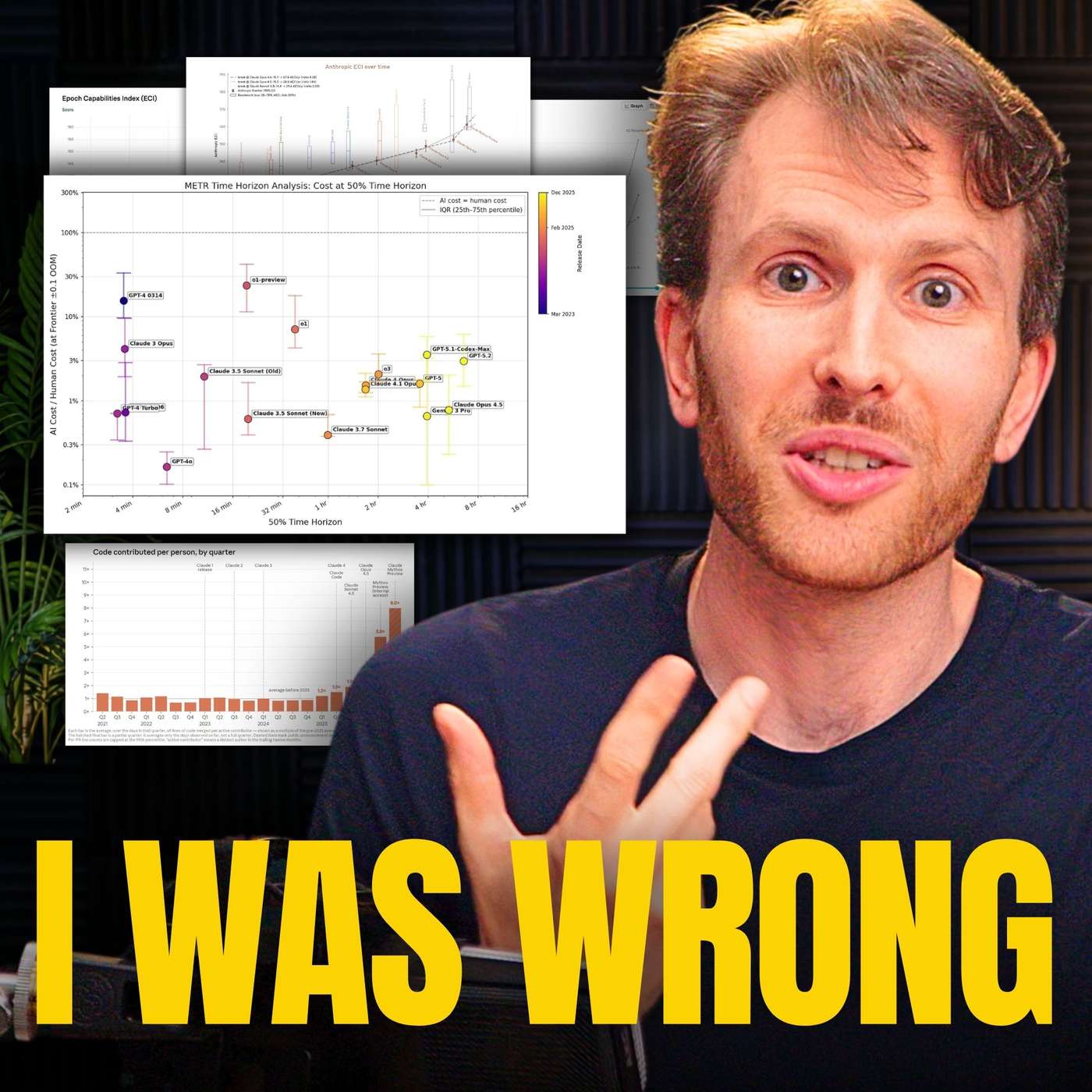
• Models now complete software engineering tasks that would take human professionals a full day — improving faster than our measurements can even keep up. • Anthropic’s revenue is growing at an annualised 8,400%, a trend so steep it would hit the whole world's GDP in 2028 if it continued. • AI models are making breakthroughs in famous mathematics puzzles. • And according to Anthropic, Claude now writes 80% of their code and is itself a key contributor to making itself smarter.
While legitimately impressive, Rob isn’t entirely sold. Going through each point carefully he finds this evidence is less decisive than it looks at first glance.
And key gaps remain, such as models struggling with complex, real-world tasks. He tours the odd experiments that remain our best attempts to measure that gap: vending machine simulators, an “AI Village” that organises live events, and a real cafe and shop where AI managers are left to do their best handling staff, suppliers, and government paperwork on their own.
Rob argues that the nature of the gap between clean and messy work is one of the four biggest unresolved questions in AGI forecasting.
In today's piece he explains that, the three other key disagreements between AGI bulls and bears, the seven big pieces of evidence we've gotten about AGI timelines in 2026, and his updated timelines to AGI.
Correction for those watching the video: The video clip shown at 02:10 was not vibe-coded by its creator and was included by our own error. You can watch the creator's full video and explanation here: https://www.youtube.com/watch?v=cyrocAOdXKw
Links to learn more, video, and full transcript: https://80k.info/2026-timelines
This episode was written and recorded before OpenAI’s AI agents hacked Hugging Face. You can read about the incident on our Substack.
This episode was recorded on July 3, 2026.
Chapters:
• What the hell happened? (00:00) • Vibe shift (01:17) • Exhibit 1: AI revenue explodes (04:33) • Exhibit 2: That METR graph (09:54) • Exhibit 3: AI capabilities jump, then flatten out (14:57) • Exhibit 4: AI starts to build itself… maybe (17:35) • Exhibit 5: AI still struggles to run a business (23:02) • Exhibit 6: OpenAI makes a maths breakthrough (33:48) • Exhibit 7: inference scaling wasn't as big as believed (38:19) • How does that all change timelines? (41:41) • Four reasons long timelines are still possible (44:26) • It's time to limit dangerous research practices (48:01)
Our production team includes:
• Video editors: Josh Alward, Dominic Armstrong, Jasper Luithlen, Milo McGuire, Luke Monsour, and Simon Monsour • Producers: Elizabeth Cox and Nick Stockton • Coordination and support: Katy Moore and Lou Moran • Camera operator: Dominic Armstrong • Music: CORBIT
Links in the notes 8
- https://youtu.be/BlVnGXEzFow?si=Cqp4xsNGRUnWwwCV&t=80
- https://x.com/karpathy/status/2004607146781278521
- https://80000hours.org/podcast/episodes/agi-timelines-in-2025/
- https://metr.org/time-horizons/
- https://www.youtube.com/watch?v=cyrocAOdXKw
- https://80k.info/2026-timelines
- https://80k.info/hugging-face-hack
- https://open.spotify.com/artist/4lWobp6IUcSZ7w5mhnU1c9
Chapters
Transcript
Shows are listed from Apple Podcasts' charts and directory, and Podcast Index where it is used. Every show and episode belongs to its publisher and plays from the publisher's own feed; this site hosts none of them. Explicit shows are for adult profiles only, and children’s profiles hear only children’s shows. More about this list.