Opening the book…
What you’ll learn to do: Use a probability distribution for a continuous random variable to estimate probabilities and identify unusual events.
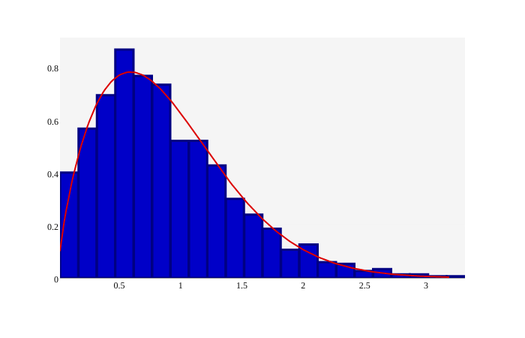
In the last section, we studied discrete (listable) random variables and their distributions. Now we explore continuous (decimal valued) random variables that can take on values anywhere in an interval. For example, a person’s exact weight without rounding is a continuous random variable. If rounded to the nearest pound, weight is a discrete random variable. Decimal valued numbers arise often in real life, often in measuring things such as weight or length. To best study real life data that has values lying all over an interval, we need to build a solid foundation in continuous probability distributions.
Contributors and Attributions
- Concepts in Statistics. Provided by: Open Learning Initiative. Located at: http://oli.cmu.edu. License: CC BY: Attribution
This page titled 6.21: Introduction to Continuous Probability Distribution was last modified on Mon, 07 Dec 2020 07:04:25 GMT and is shared under a CC BY 4.0 license and was authored, remixed, and/or curated by Lumen Learning.
The book could not be loaded just now.