14.5: What is the target phenomenon and what is its developmental trajectory?
Applied Developmental Systems Science · LibreTexts
0%
Contents
Text
Size
From LibreTexts, under CC BY-NC, as the source states it; its equations are written in TeX, which the PDF shows typeset. This page at LibreTexts.
14.5: What is the target phenomenon and what is its developmental trajectory?
Opening the book…
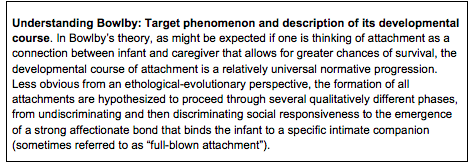
The target phenomenon of any theory is the heart or core of the theory, the central thing or construct around which the theory is formed. When getting straight on one’s own program of research, this target phenomenon often seems to be moving. We can shift our interest from attachment itself to the characteristics of the infant or caregiver or higher-order contexts that shape it, or from attachment itself to its short-term or long-term consequences. However, when understanding a theory, getting a bead on its central target is usually not too difficult. Typically theories are named for their target phenomenon—such as self-efficacy theory, emotional selectivity theory, transactional coping theory, and so on. In the case of Bowlby, the target phenomenon is “attachment.” One way to begin to graphically represent a theory is to place the target phenomenon is the middle of the drawing, as shown in Figure 3.2.
The developmental trajectory of the target phenomenon is the descriptive part of the theory—depicting (as presented in more detail in the previous chapter) the way that the phenomenon changes over age or time. From its description of development, one can already start to get a feeling for the assumptions underlying the theory. Does the description involve a single progressive quantitative trajectory of age-graded change? Does it involve qualitative shifts? Different pathways? Patterns of stability and continuity? Each of these kinds of descriptions of how the target phenomenon develops reveals the authors’ beliefs about the nature and course of development.