5.3: The social-emotional needs of the primary aged child
Trauma Informed Behaviour Support: A Practical Guide to Developing Resilient Learners (Ayre and Krishnamoorthy) · LibreTexts
0%
Contents
Text
Size
From LibreTexts, under CC BY-SA 4.0, as the source states it; its equations are written in TeX, which the PDF shows typeset. This page at LibreTexts.
5.3: The social-emotional needs of the primary aged child
Opening the book…
“Children living with trauma are brave, courageous and resilient. School days are often a struggle. Just being at school is testament to their fortitude.”
In the primary years of school, the child is adjusting to greater demands with academic tasks, forming friendships and experiencing failure (Snowden et al., 2009; Woolfolk & Margetts, 2013). Friendships become increasingly important and peer group pressure increases significantly. This is the age for ‘a best friend’. The primary school child begins to think of their sense of self in comparison to others. The views of key adults are important as is their belief in themselves to complete tasks in which they strive to be successful.
When supporting the primary school child with trauma (as with all children with trauma) teachers need to focus on what the individual child’s needs are. Teachers need to ask themselves what is the emotional age of the child? Most children who have experienced complex trauma and therefore have attachment difficulties, hide behind a confident façade that hides their need to be dependent on adults.
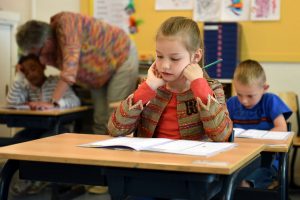
Children having their exam by Arthur Krijgsman licensed under CC0.
Strategies to help
Provide lots of praise (genuine and descriptive) and acknowledgement. Build the very fragile sense of self-worth that exists within the child with trauma.
Demonstrate your belief in the child by giving them opportunities to take on leadership-type roles in the classroom so they are ‘in-charge’.
Clear boundaries and high expectations.
Focus on connection not correction – relationships are everything.
References
Snowman, J., Dobozy, E., Scevak, J., Bryer, F., Bartlett, B., & Biehler, R. (2009). Psychology applied to teaching. Milton, Qld: John Wiley & Sons.
Woolfolk, A., & Margetts, K. (2013). Child development and adolescent learning (Custom Edition). Frenchs Forest, Sydney: Pearson.