17.3: Appendix 4: Feedback on Activity 7.5 Broadcast or communicative
Teaching in a Digital Age · LibreTexts
0%
Contents
Text
Size
From LibreTexts, under CC BY-NC, as the source states it; its equations are written in TeX, which the PDF shows typeset. This page at LibreTexts.
17.3: Appendix 4: Feedback on Activity 7.5 Broadcast or communicative
Opening the book…
From the list below:
a learning management system
a blog
online collaborative learning
Twitter
virtual worlds (e.g. Second Life)
a podcast
an open textbook
1. Determine which is a medium and which a technology, or which could be both, and under what conditions.
learning management system
either: technology as software, medium when used for course delivery
blog
medium (WordPress or other blog software is the technology)
online collaborative learning
medium
Twitter
either, but mainly a medium
Virtual worlds
medium
podcast
medium
open textbook
medium
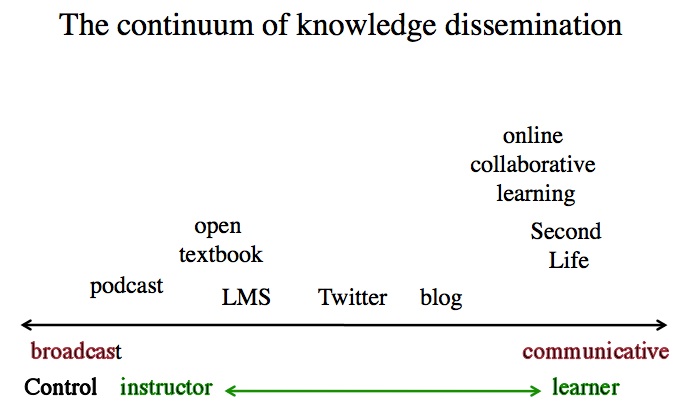
2. Decide where, from your experience, each medium or technology should be placed on Figure 6.4.3. Write down why.
3. Which were easy to categorize and which difficult?
Difficult:
online collaborative learning, because it is highly communicative but the teacher has a good deal of control over the medium
Twitter, because it is definitely under the control of the learner, but it is also as much a broadcast as a communicative medium.
With both these, I gave more importance to the broadcast/communicative dimension compared with the control dimension.
4. How useful?
Understanding where different media are likely to fit on the broadcast/communicative dimension will help in choosing media, depending on my epistemological position. If I want a high level of student activity and interaction I would tend toward more communicative media. If I am more concerned with information transmission and comprehension, I would tend to use more broadcast media. However, in most cases I would want a mix of both. Knowing where each medium ‘fits’ on this dimension is one component I could use in my decision-making.
 3. Which were easy to categorize and which difficult?