From LibreTexts, under CC BY-SA 4.0, as the source states it; its equations are written in TeX, which the PDF shows typeset. This page at LibreTexts.
13.5: Tribal Art
Opening the book…
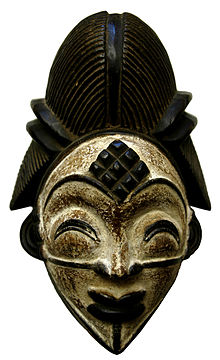
Figure \(\PageIndex{1}\) - A Punu tribe mask. Gabon West Africa
Tribal art is the visual arts and material culture of indigenous peoples. Also known as ethnographic art, or, controversially, primitive art,[2]tribal arts have historically been collected by Western anthropologists, private collectors, and museums, particularly ethnographic and natural history museums. The term “primitive” is criticized as being Eurocentric and pejorative.[3]
Figure \(\PageIndex{2}\) - Artwork in the Museum of Indian Terracotta, New Delhi, India.[1]
Description
Tribal art is often ceremonial or religious in nature.[4] Typically originating in rural areas, tribal art refers to the subject and craftsmanship of artefacts from tribal cultures.
In museum collections, tribal art has three primary categories:
African art, especially arts of Sub-Saharan Africa
Art of the Americas[5]
Oceanic art, originating notably from Australia, Melanesia, New Zealand, and Polynesia.
Collection of tribal arts has historically been inspired by the Western myth of the “noble savage”, and lack of cultural context has been a challenge with the Western mainstream public’s perception of tribal arts.[6] In the 19th century, non-western art was not seen by mainstream Western art professional as being as art at all.[3] The art world perception of tribal arts is becoming less paternalistic, as indigenous and non-indigenous advocates have struggled for more objective scholarship of tribal art. Before Post-Modernism emerged in the 1960s, art critics approached tribal arts from a purely formalist approach,[7] that is, responding only to the visual elements of the work and disregarding historical context, symbolism, or the artist’s intention.
Figure \(\PageIndex{3}\) - Congolese Nkisi Nkondi, a female power figure, with nails, collection BNK, Royal Tribal Art
Influence on Modernism
Major exhibitions of tribal arts in the late 19th through mid-20th centuries exposed the Western art world to non-Western art. Major exhibitions included the Museum of Modern Art’s 1935 Africa Negro Art and 1941 Indian Art of the United States.[7] Exposure to tribal arts provide inspiration to many modern artists,[8] notably Expressionists,[7] Cubists, and Surrealists, notably Surrealist Max Ernst.[9] Cubist painter, Pablo Picasso stated that “primitive sculpture has never been surpassed.”[3]
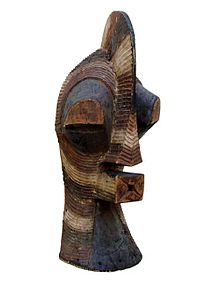
Figure \(\PageIndex{4}\) - A male Kifwebe mask. Songye tribe. D.R. Congo. Central Africa
Notes
Tales in terracotta: Set up in 1990, the Sanskriti Museum has contextualised and documented terracotta from all parts of the country, Indian Express, 15 May 2005.
Dutton, Denis, Tribal Art. In Michael Kelly (editor), Encyclopedia of Aesthetics. New York: Oxford University Press, 1998.
abc Perkins and Morphy 132
Folk and Tribal Art, Cultural Heritage, Know India.
Russel, James S. “Glass Cube Dazzles at Boston MFA’s $345 Million Wing: Review.” Bloomberg. 21 Nov 2010. Retrieved 11 Jan 2011.
Perkins and Morphy 136
abc Storr, Robert. “Global Culture and the American Cosmos.” Andy Warhol Foundation for the Visual Arts: Arts, Culture and Society. 1995. (retrieved 15 Nov 2011)
Perkins and Morphy 133
Perkins and Morphy 134
References
Morphy, Howard and Morgan Perkins, eds. The Anthropology of Art: A Reader. Malden, MA: Blackwell Publishing, 2006. ISBN 978-1-4051-0562-0.
External Links
Tribal Art Magazine
Paleobree — Tribal Art Information Service
Art Tribal Newsletter
Tribal art forgeries
Oceanic Art Society
This page titled 13.5: Tribal Art was last modified on Tue, 17 Nov 2020 09:31:02 GMT and is shared under a CC BY-SA 4.0 license and was authored, remixed, and/or curated by Lumen Learning via source content that was edited to the style and standards of the LibreTexts platform.