From LibreTexts, under CC BY-NC-SA 4.0, as the source states it; its equations are written in TeX, which the PDF shows typeset. This page at LibreTexts.
3.3: Gracile Australopiths
Opening the book…
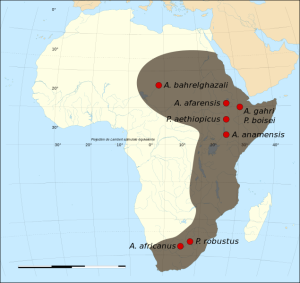
Australopith fossil sites. “Map of the fossil sites of the early hominids (4.4-1M BP)” by Kameraad Pjotr and Sting is licensed under CC BY-SA 3.0.
Genus Australopithecus (“southern ape”) was first used in 1924 by Raymond Dart for the “Taung Child,” a juvenile Au. africanus specimen from the quarry site of Taung, in South Africa. Au. anamensis, afarensis, africanus, and sediba (depending on the evolutionary schema of individual paleoanthropologists) are popularly known as gracile australopiths, due to their more gracile masticatory apparatus relative to the robust paranthropines.
An australopith outlook. By Keenan Taylor, CC-BY-NC-SA.
This page titled 3.3: Gracile Australopiths was last modified on Tue, 05 Dec 2023 20:45:10 GMT and is shared under a CC BY-NC-SA 4.0 license and was authored, remixed, and/or curated by Barbara Welker via source content that was edited to the style and standards of the LibreTexts platform.