5.1: Introduction to Primatology

Physical Anthropology · LibreTexts

0%

Contents

    Text

    Size
    100%
    Theme
    Typeface
    Line length
    Spacing

    From LibreTexts, under CC BY-NC-ND 4.0, as the source states it; its equations are written in TeX, which the PDF shows typeset. This page at LibreTexts.

    5.1: Introduction to Primatology

    We are primates. One way to learn about humans is to study them as a kind of primate. This works especially well to explain how we got the physical structure that we have. It works a little bit to explain a few of our behaviors. It doesn't work at all to explain our culture. The Darwin tubercle is a projection on the helix of the ear resulting from a thickening of the cartilage. The actual size of the tubercle varies. It is one of many vestiges of our primate ancestry.
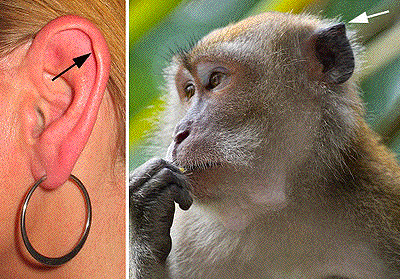
    image058.gif

    Figure \(\PageIndex{1}\) - http://en.Wikipedia.org/wiki/Darwin's_tubercle

    A broad research question in primatology is to compare and contrast primates to other mammals, and then compare and contrast primates to themselves.

    Note

    KATHRYN ORZECH'S INTRO: WHAT MAKES A PRIMATE A PRIMATE?

    Exercise \(\PageIndex{1}\): One goal of primatology is to use it to help us understand ourselves.

    REVIEW PRIMATE SKELETONS AND MORE PRIMATE SKELETONS

    • Jane Goodall is famous for studying chimpanzees. Watch this JANE GOODALL: WHAT SEPARATES US FROM CHIMPANZEES?
    • Skim the first chapter of Augustín Fuentes Race, Monogamy, and Other Lies They Told You Busting Myths about Human Nature

    This page titled 5.1: Introduction to Primatology was last modified on Tue, 17 Nov 2020 09:30:51 GMT and is shared under a CC BY-NC-ND 4.0 license and was authored, remixed, and/or curated by Arnie Daniel Schoenberg via source content that was edited to the style and standards of the LibreTexts platform.