Opening the book…
Exploring the Role of Physical Attractiveness
Physical attractiveness can also produce a halo effect: the tendency to assume that someone with one positive quality, such as attractiveness, also has other desirable qualities, such as intelligence, kindness, honesty, or competence. As a result, people perceived as attractive may receive social advantages in dating, employment, education, and even the legal system. In everyday language, this is sometimes called "pretty privilege."
Although people often say that "beauty is in the eye of the beholder," research suggests that some facial features are widely perceived as attractive. Ramsey et al. (2004), for example, found that even very young infants appeared to prefer certain facial features, while other studies show that symmetry and proportion are often rated as attractive (Ramsey, Langlois, Hoss, Rubenstein, & Griffin, 2004). At the same time, beauty standards are also culturally shaped and vary across societies and historical periods.
Research by Zebrowitz (1996) shows that people with youthful, or "baby-faced," features are often perceived as more likable, warm, honest, and approachable. Facial symmetry also plays an important role in perceived attractiveness, perhaps because it is associated with health and genetic fitness or because symmetrical faces are easier to process and feel more familiar (Winkielman & Cacioppo, 2001).
Research also suggests that people often prefer "average" faces—faces that blend many different features—over highly unusual or distinctive ones (Langlois, Roggman, & Musselman, 1994). In a classic study, Langlois and Roggman found that composite faces became more attractive as more individual faces were averaged together (Langlois & Roggman, 1990). One explanation is that average faces feel familiar, typical, and easier to recognize (Grammer, Fink, Juette, Ronzal, & Thornhill, 2002).
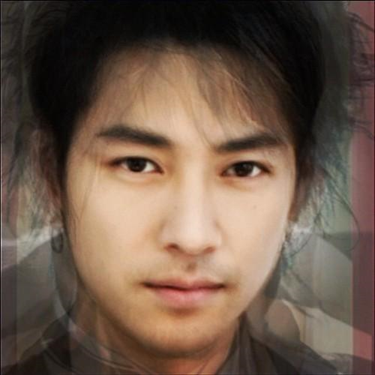
Taken together, this research shows that attraction is not simply a matter of personal taste or romantic feeling. While people often experience attraction as immediate or instinctive, it is shaped by a combination of social, cultural, cognitive, and biological processes. Ideas about beauty are influenced by media and cultural norms, but they are also connected to the ways people perceive familiarity, symmetry, youthfulness, and other visual cues. The following TED-Ed video, The Science of Attraction, builds on these ideas by examining how the brain and the five senses contribute to attraction, showing that romantic chemistry involves far more than “following the heart” (Maslar, 2014).
Duration: 4 minutes and 19 seconds.
Dawn Maslar’s TED-Ed video "The Science of Attraction" explains how attraction is shaped not only by romantic feelings, but also by the brain and the five senses as people assess potential partners (Maslar, 2014).
Gender, Sexual Orientation, and Attraction Preferences
You might wonder whether gender influences what people find attractive in a potential partner. Research suggests that it can, although—as with many gender differences—the similarities are often greater than the differences. Across genders and cultures, people commonly value physical attractiveness along with qualities such as kindness, humor, dependability, intelligence, and sociability (Li, Bailey, Kenrick, & Linsenmeier, 2002). Some gendered patterns have also been observed. Heterosexual men tend to place greater emphasis on a partner’s physical attractiveness, while heterosexual women also value attractiveness but are more likely to place greater emphasis on a partner’s social status or resources (Li et al., 2002).
Many of the same factors that shape sexual attraction among heterosexual people also appear to influence attraction among lesbian women and gay men. Research by Bailey and colleagues (1994) found that gay men tend to place a level of importance on physical attractiveness similar to heterosexual men, while lesbian women more closely resemble heterosexual women in placing relatively less emphasis on physical attractiveness when evaluating potential partners (Bailey, Gaulin, Agyei, & Gladue, 1994).
Age preferences show a similar pattern. Studies suggest that gay men are often attracted to younger men, much as heterosexual men are often attracted to younger women. Lesbian women, like heterosexual women, tend to prefer partners closer to their own age (Kenrick, Keefe, Bryan, Barr, & Brown, 1995).

Licenses and Attributions for The Role of Physical Attractiveness
Open Content, Shared Previously
Adapted by Sarah Earl-Novell from 8.3: Reasons for Attraction in Sexuality, the Self, and Society by Susan Rahman with Nathan Bowman, Dahmitra Jackson, Lushtak, Remi Newman, & Prateek Sunder, licensed under CC BY 4.0..
Modifications by Sarah Earl-Novell include remixing, editing, contextualization, and the addition of original content.
References
Bailey, J. M., Gaulin, S., Agyei, Y., & Gladue, B. A. (1994). Effects of gender and sexual orientation on evolutionarily relevant aspects of human mating psychology. Journal of Personality and Social Psychology, 66(6), 1081–1093.
Grammer, K., Fink, B., Juette, A., Ronzal, G., & Thornhill, R. (2002). Female faces and bodies: N-dimensional feature space and attractiveness. In G. Rhodes & L. A. Zebrowitz (Eds.), Facial attractiveness: Evolutionary, cognitive, and social perspectives (pp. 91–125). Ablex.
Kenrick, D. T., Keefe, R. C., Bryan, A., Barr, A., & Brown, S. (1995). Age preferences and mate choice among homosexuals and heterosexuals: A case for modular psychological mechanisms. Journal of Personality and Social Psychology, 69(6), 1166–1172.
Langlois, J. H., & Roggman, L. A. (1990). Attractive faces are only average. Psychological Science, 1(2), 115–121.
Langlois, J. H., Ritter, J. M., Roggman, L. A., & Vaughn, L. S. (1991). Facial diversity and infant preferences for attractive faces. Developmental Psychology, 27(1), 79–84.
Langlois, J. H., Roggman, L. A., & Musselman, L. (1994). What is average and what is not average about attractive faces? Psychological Science, 5(4), 214–220.
Li, N. P., Bailey, J. M., Kenrick, D. T., & Linsenmeier, J. A. W. (2002). The necessities and luxuries of mate preferences: Testing the tradeoffs. Journal of Personality and Social Psychology, 82(6), 947–955.
Maslar, D. (2014, May). The science of attraction [Video]. TED-Ed.
Ramsey, J. L., Langlois, J. H., Hoss, R. A., Rubenstein, A. J., & Griffin, A. M. (2004). Origins of a stereotype: Categorization of facial attractiveness by 6-month-old infants. Developmental Science, 7(2), 201–211.
Swami, V., Greven, C., & Furnham, A. (2007). More than just skin-deep? A pilot study integrating physical and non-physical factors in the perception of physical attractiveness. Personality and Individual Differences, 42(3), 563–572.
Winkielman, P., & Cacioppo, J. T. (2001). Mind at ease puts a smile on the face: Psychophysiological evidence that processing facilitation elicits positive affect. Journal of Personality and Social Psychology, 81(6), 989–1000.
Zebrowitz, L. A., Voinescu, L., & Collins, M. A. (1996). “Wide-eyed” and “crooked-faced”: Determinants of perceived and real honesty across the life span. Personality and Social Psychology Bulletin, 22(12), 1258–1269.
This page titled 7.4: The Role of Physical Attractiveness was last modified on Fri, 23 Oct 2026 20:02:03 GMT and is shared under a CC BY 4.0 license and was authored, remixed, and/or curated by Sarah Earl-Novell.
The book could not be loaded just now.