From LibreTexts, under CC BY-NC 4.0, as the source states it; its equations are written in TeX, which the PDF shows typeset. This page at LibreTexts.
12.3: Quantitative Restriction
Opening the book…
Governments in high income nations often subsidize agricultural producers. A price support is one public policy intended to increase producer surplus. The unintended consequence of the price support is a large surplus that is costly to either producers, the government, or both. Another policy intended to help producers is a quantitative restriction, also called output control or supply control. The idea of supply control is to decrease output in order to increase the price. The analysis of elasticity in Chapter One demonstrated that this policy would work only if the demand for the good is inelastic.
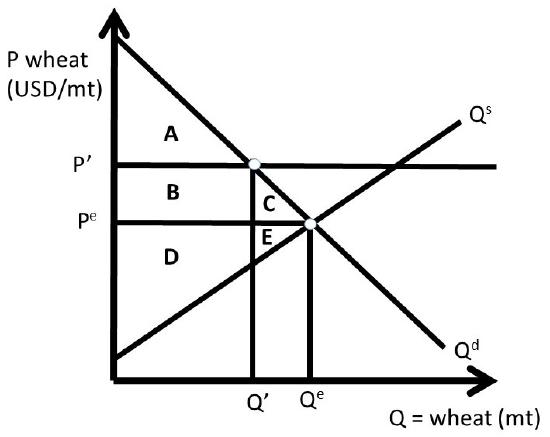
Figure \(\PageIndex{1}\): Quantitative Restriction in Wheat Market
A quantitative restriction in the wheat market is shown in Figure \(\PageIndex{1}\). Wheat output is restricted to \(Q’ < Q^e\), resulting in a higher price \(P’ > P^e\). The welfare analysis of this policy is identical to that of a price support: if wheat output is reduced by an amount that raises the price to P’, the policy is equivalent to Case One of the Price Support analyzed in the previous section. Therefore, the welfare analysis of the quantitative restriction in Figure \(\PageIndex{1}\) is:
\[ΔCS = – B – C,\nonumber\]
\[ΔPS = + B – E,\nonumber\]
\[ΔSW = – C – E,\nonumber\]
and
\[DWL = – ΔSW = C + E.\nonumber\]
The magnitudes of these welfare changes depend on the elasticities of supply and demand. Note that producers only gain if the demand curve is sufficiently inelastic. If wheat demand is sufficiently inelastic relative to the elasticity of supply, then \(B > E\), and the change in producer surplus is positive. However, if the demand is sufficiently elastic relative to the elasticity of supply, then \(B < E\), and producers lose. This result emphasizes one of the important agricultural policy conclusions of this course: in a global economy, the demand for agricultural goods is elastic due to global competition, and price supports and supply control will hurt producers more than they will help them. This was the result found in Section 1.4.9 above. The welfare analysis of the quantitative restriction highlights this important policy contribution.
The benefit of the quantitative restriction is the lack of a surplus, which is a costly weakness of price supports. One difficulty with supply control is administration and enforcement. Wheat producers will not be free to choose how much wheat that they produce. Instead, the government will allow only a certain amount of wheat produced by each farmer, called a quota. This quantitative restriction can be accomplished through acreage controls also, where wheat producers can only plant a percentage of their total acreage to wheat. This is an imperfect policy, since producers could increase yield per acre on the acres that they are allowed to plant. If the output is restricted, it is difficult to enforce the policy, and if overproduction occurs, it is difficult to remove the surplus.
Although government programs and policies are well intended, they often cause unintended consequences. Price supports and quantitative restrictions can help producers, but at the expense of consumers.
🟪 Compare the Policies: Price Support vs. Quantity Restriction
A price support and a quantitative restriction may both be intended to increase returns to producers, but they operate differently.
A price support directly establishes or maintains a higher price.
A quantitative restriction limits the amount that can be produced or sold, reducing market supply and potentially increasing the market price.
Think About It: Why might restricting production avoid some of the surplus created by a price support?
This is more useful pedagogically than treating 12.2 and 12.3 as unrelated topics.
This page titled 12.3: Quantitative Restriction was last modified on Mon, 21 Sep 2026 04:13:42 GMT and is shared under a CC BY-NC 4.0 license and was authored, remixed, and/or curated by Ivan Huerta via source content that was edited to the style and standards of the LibreTexts platform.