Opening the book…
TIPS FOR ACADEMIC SUCCESS
Plan
It is important to plan your time appropriately. Typically, one credit hour is equal to one contact hour per week. Meaning, if you are enrolled in 15 credits, you should expect to be in class approximately 15 hours per week. There are exceptions to the “credit hour = contact hour” guideline. For example, many of our science courses are 4 credits, yet they meet approximately 6 hours per week to accommodate time for lab work. It is important to note that if you attend classes full-time (12+ credit hours), then it is optimal to work only part-time (less than 25 hours per week). If you do need to work more hours, or even full time, it is best to enroll in part-time coursework to safeguard your academic progress.
Prepare
To be as academically successful as possible, allow 1.5–2 hours per credit hour per week to study, write papers, read textbooks, and prepare for class. It is your responsibility to learn much of the content presented in your classes in your own time. This often requires quite an adjustment for students
who either have not been enrolled in school for some time or those who recently have completed high school. For example, if you are enrolling in 15 credit hours, set aside 22–30 hours per week for class preparation. You may be one of many students who work while attending college; it is important that you plot your study and class preparation time into your weekly schedule.
Another important preparation tip is to walk into your first class meeting ready to learn. This means having appropriate tools such as books, writing utensils, paper, and folders. Because of financial concerns, students may wait to purchase their books. Unfortunately, this can cause further academic stress for students who often fall behind in their classes as a result. So whenever possible, make sure you have your books before classes begin.
Furthermore, all students should have access to key pieces of technology (email, portal, Canvas, etc.). If you do not have access to technology at home, there are several places at all three campus locations where you can access computers and other electronic devices.
Monitor
The need for self-accountability increases dramatically as students reach college. It is your responsibility to monitor your own academic success. For example, you may find that for some classes, only a few key assignments are graded. Therefore, if you miss a key assignment, it can have a dramatic impact on your final grade. Keeping track of assignments is key to earning the best grade possible. It also is important to understand that turning in assignments late and making up missed quizzes and tests is either not permitted or only permitted under unique circumstances. Do not assume that if you missed class, you have the option to turn in late work. Each instructor has their own policy regarding missing assignments, so it is critical to check the syllabus or verify with the instructor for each class in which you are enrolled to be sure.
Moreover, you will find that most instructors use our learning management system, Canvas, for grades and assignments; although, some will not. Therefore, it is extremely helpful to keep track of the points/grades you earn throughout the semester. This will help ensure there are no surprises about your final grade when it is too late to do anything to address it.
Initiate
There are several reasons why you may miss a class. Illness, transportation issues, and even unforeseen family emergencies potentially can impact your class attendance. By emailing your instructor prior to missing a class, you are letting them know you are invested in the class and your own academic progress. When emailing your instructor, it is critical to use your Moraine Valley student email to ensure your communication with your instructor is not missed due to a spam filter. Furthermore, if your coursework is negatively impacted because of academic struggles, you should take advantage of the college’s academic support services such as the Tutoring Center, Speaking and Writing Center, Library, Center for Disability Services, Counseling and Career Development Center, and Academic Advising. These resources are free to all enrolled students and, if used properly, can be truly effective in keeping you on track in working toward your goals.
Attending college can cause unforeseen stressors. Many students report they are surprised how stressful college is. If you are struggling personally or even financially, you have access to several personal support services such as personal counseling in the Counseling and Career Development Center, Student Support Services (TRIO), or the Job Resource Center.
One of the biggest stressors students report is not having a clear educational/career goal in mind while attending college. Not knowing where you are going or even why you are at Moraine Valley can boost feelings of unease and decrease motivation. Several educational planning services are available such as Academic Advising, the Counseling and Career Development Center, the Transfer Center, and Student Planner, which is located in the student portal.
What could stop a student from implementing these tips? A student may not truly understand that college can be difficult, deny they are struggling, fail to ask for help, etc. The faculty and staff at Moraine Valley are committed to helping you succeed, but the bulk of the responsibility is yours.
PERFORMANCE VS. LEARNING – IMPACT ON MINDSET
Much of our ability to learn is governed by our motivations and goals. Sometimes, hidden goals or mindsets can impact the learning process. In truth, we all have goals, even if we are not fully aware of them and if we are aware of them, we might not understand how they help us succeed. An illustration of this can be seen in comparison of a student who has performance-based goals to a student who has learning-based goals.
If you are a student with strict performance goals, your primary psychological concern might be to appear intelligent to others. At first, this might not seem to be a bad thing for college, but it truly can limit your ability to move forward in your own learning. Instead, you may tend to play it safe without even realizing it. For example, a student who is strictly performance-goal-oriented often will only say things in a classroom discussion when they think it will make them look knowledgeable to the instructor or their classmates. Likewise, a performance-oriented student might ask a question that they know is beyond the scope of the topic being covered. Rarely will they ask a question in class because they misunderstand the concept. Instead, they will ask questions that make them look intelligent to others or attempt to “stump the teacher.” When they do finally ask an honest question, it may be because they are more afraid that their lack of understanding will result in poor performance on an exam rather than simply wanting to learn.
If you are a student who is driven by learning goals, your interactions in classroom discussions are usually quite different. You see the opportunity to share ideas and ask questions to gain knowledge quickly. In a classroom discussion, you can ask for clarification immediately if you do not quite understand what is being discussed. If you are a person guided by learning goals, you are less worried about what others think since you are attending class to learn and you see learning as the most important goal.
Another example comparing these mindsets occurs in assignments and other coursework. If you are a student more concerned about performance, you may avoid challenging work. You will take the “easy A” route by relying on what you already know. You will not step out of your comfort zone because your psychological goals are motivated by external approval rather than motivated by learning.
This is very different from a student learning-based psychology. A student motivated by learning goals actively seeks challenging assignments and will put a great deal of effort into using assignments to expand what they already know. While getting a good grade is important, learning itself is most important.
If you find that you sometimes lean toward performance-based goals, do not feel discouraged. Many of the best students tend to initially focus on performance until they begin to see the ways it can restrict their learning. The key to switching to learning-based goals is often simply a matter of first recognizing the difference and seeing how making a change can positively impact your own learning.
The influence of the Fixed vs. Growth Mindset Model on learning was presented in 1988 by Carol Dweck (Dweck & Leggett). In Dr. Dweck’s work, she determined that a student’s perception about their own learning accompanied by a broader goal of learning had a significant influence on their ability to overcome challenges and grow in knowledge and ability. In this model, the performance-goal-oriented student is represented by the fixed mindset, while the learning-goal-oriented student is represented by the growth mindset.
In the following graphic, based on Dr. Dweck’s research, you can see how many of the components associated with learning are impacted by these two mindsets.
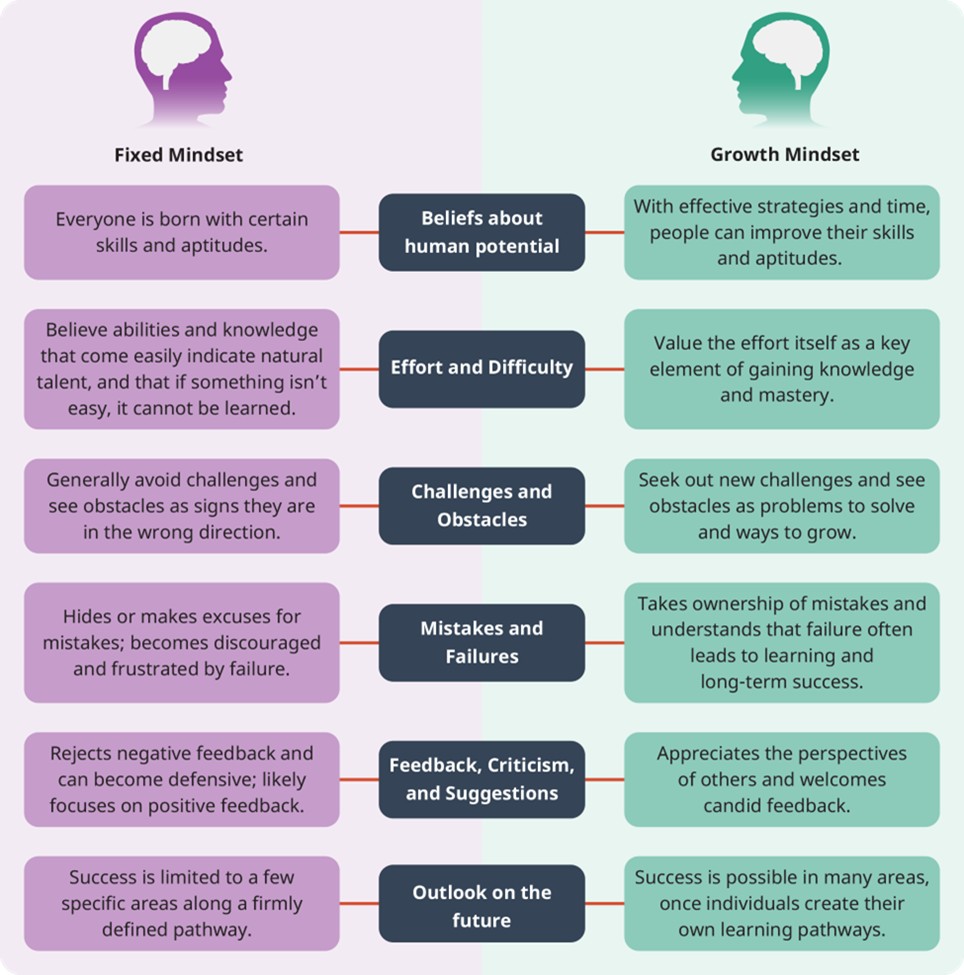
The differences between fixed and growth mindset are clear when aligned to key elements of learning and personality. (Credit: Based on work by Dr. Carol Dweck).
Very few people have a strictly fixed or growth mindset all the time. Often, we tend to lean one way or another in certain situations. For example, a person trying to improve their ability in a sport they enjoy may exhibit all the growth mindset traits and characteristics, but they find themselves blocked in a fixed mindset when they try to learn something in another area like computer programming or arithmetic.
THE GROWTH MINDSET AND LESSONS ABOUT FAILING
Something you may have noticed is that a growth mindset tends to give a learner grit and persistence. If learning is your goal, you normally would keep striving toward the goal, even if it takes multiple attempts. Additionally, if you learned more with each try, you would perceive each attempt as a success, even if you had not achieved mastery.
It should come as no surprise that Dr. Dweck found that people who believed their abilities could change through learning (growth vs. a fixed mindset) readily accepted learning challenges and persisted despite early failures.
IMPROVING YOUR ABILITY TO LEARN
As strange as it may seem, research into fixed vs. growth mindsets has shown that if you believe you can learn something new, you greatly improve your ability to learn. At first, this may seem like the sort of feel-good advice we often encounter in social media posts or quotes that are intended to inspire or motivate us (e.g., believe in yourself!), but in looking at the differences outlined between a fixed and a growth mindset, you can see how each part of the growth mindset path would increase your probability of success when it comes to learning.
COLLEGE AND NOTE-TAKING
College can be overwhelming, from classes, work and family commitments, keeping track of it all can be a process that requires commitment to maintain. To persevere toward achieving your educational goals, good note-taking in all types of classes is a necessary skill.
CLASSROOM ENVIRONMENTS AND FACULTY EXPECTATIONS/CURRICULAR APPROACHES
Depending on the discipline, college classrooms can be constructed using a wide range of approaches from more traditional classrooms to more hands-on laboratories. Regardless of the discipline, information dissemination, especially in the form of lecture, is a common curricular approach. Retaining information over the semester can be a challenge, and faculty often will normalize the expectation of in-class note-taking to reinforce student learning approaches in the classroom. For online or in-person classes, expect the skill of note-taking to be a necessary part of success in higher education.
NOTE-TAKING APPROACHES
While taking notes might be expected in some classes, knowing how to take notes appropriately is a useful skill that can help you in higher education and in pursuit of other goals. As the University of North Carolina Learning Center makes clear in their overview of the importance of note-taking, “figuring out what’s important enough to write down” is a learned process (The Learning Center). Consider keywords used in lectures, whether supplemental resources are available, and always reach out to the instructor if you are unclear on the importance of class materials and how to prioritize them effectively. Effective note-taking prioritization also can assist with time-management, another skill covered in greater depth in other sections of this chapter.
“There is no right format to use when taking notes,” and this is true regardless of if you prefer to take notes by hand or digitally (The Learning Center). It is important to develop an organizational approach to note-taking that best reflects your approach to learning. A common and popular approach is known as the Cornell Notes method. Developed at Cornell University, “this style includes sections for the date, essential question, topic, notes, questions, and a summary” (The Learning Center).You’ll learn more details about these methods and how to apply them below.
This page titled 4.1: Tips for Academic Success was last modified on Fri, 22 May 2026 02:20:01 GMT and is shared under a CC BY 4.0 license and was authored, remixed, and/or curated by .
The book could not be loaded just now.