Opening the book…
Four mechanisms drive changes in allele frequencies: genetic drift, gene flow, natural selection and mutation. These are often called the “forces of evolution.” The first three redistribute or alter the existing variation within and between populations while mutation is the only one that actually creates brand-new genetic variation.
Mutation: The Original Source of All Variation
We begin with mutation because this serves as the original source of all of the genetic variation found in every living thing. A mutation is any change in the sequence of DNA bases—adenine, thymine, cytosine, and guanine. As you learned in Chapter 4, these bases are strung together in a specific order, encoding genetic information needed by the cell. When a cell copies its DNA in preparation for dividing, mistakes can sometimes happen. A base might be swapped for a different one, a small section might be duplicated, or an entire segment might be deleted. Any of these changes is considered to be a mutation.
Mutations can also be triggered by outside influences. Ultraviolet (UV) radiation from the sun, for example, can cause adjacent thymine bases in a DNA strand to bond together abnormally. This is why excessive sun exposure raises the risk of skin cancer. Radiation and certain chemicals can also damage DNA. Whatever the cause, the outcome is the same: the cell ends up with a DNA sequence that differs from the original.
Which Mutations Matter for Evolution?
Not all mutations have evolutionary significance. Our bodies are made up of two broad categories of cells: somatic cells, which make up the organs, skin, muscles, and other tissues, and gametes, the reproductive cells (sperm and eggs). Most of our mutations exist in somatic cells and only affect the individual who carries them so will not be passed to the next generation. Mutations in gametes, however, can be inherited. When a mutation first appears in a gamete and is then passed on to an offspring, it is called a spontaneous mutation. If that individual goes on to reproduce, their offspring inherit it as well, and it becomes part of the family lineage, making it an inherited mutation.
The Good, the Bad, and the Neutral
While it’s common to associate mutations with either catastrophic outcomes, such as cancer or genetic disease, the reality of their impact is a bit more nuanced. Most mutations fall into one of three categories. Many are neutral, meaning they have no detectable effect on the organism. Perhaps the mutation falls in a region of DNA that doesn’t code for any protein, or perhaps it alters a codon in a way that still produces the same amino acid. The organism carries the change in its genes, but is not affected by it.
Some mutations are known to harm an organism’s ability to survive and reproduce. Tay-Sachs disease, for example, is caused by a mutation in a gene that produces an enzyme responsible for breaking down fatty substances in the brain and nerve cells. Without a functioning version of this enzyme, those substances accumulate to toxic levels, causing progressive neurological damage. Children born with two copies of the Tay-Sachs allele typically do not survive past early childhood (Mayo Clinic). Mutations so damaging that they prevent survival altogether are called lethal mutations.
But some mutations can be beneficial. A beneficial mutation increases an organism’s chances of surviving, reproducing, or both in a given environment. The ability of some insects to resist a pesticide, for example, often traces back to a single beneficial mutation. Dog breeds adapted to cold climates, such as malamutes and huskies, have mutations that produce thick, insulating coats, while those adapted to warmer climates, like Chihuahuas, carry mutations that keep their coats thin.


We all carry genetic mutations within our genome. Every time our cells divide and replicate through the process of mitosis, those mutations are also copied into all of our cells, serving as our personal reservoir of genetic diversity. In an ever-changing world, this can be a big advantage. Perhaps somewhere in there could be the genes that might help you resist a harmful virus or any other unexpected change in the environment—physical or cultural. In fact, this is the story of the evolution of lactase persistence that we will examine in more detail later in this chapter.
Sickle Cell and the Power of One Mutation: A Case Study
Sickle cell anemia is a genetic disease with severe symptoms, including pain and anemia. The disease is carried by a mutated version of the gene that helps makes hemoglobin which is a protein that carries oxygen in red blood cells. People with two copies of the sickle cell allele have the disease. People who carry only one copy of the sickle allele do not have the disease, but may pass the allele on to their children.
The mutations that cause sickle cell anemia have been extensively studied and demonstrate how the effects of mutations can be traced from the DNA level up to the level of the whole organism. If someone carries only one copy of the sickle cell allele, she will not have the disease, but the gene that she carries will still affect her, her cells, and her proteins as can below.
At the DNA level, just one base is different from the typical version of the gene.

At the protein level, this causes the hemoglobin molecule to be shaped slightly differently, causing it to clump together under low-oxygen conditions.

At the cellular level, red blood cells carrying this abnormal hemoglobin form into a rigid, crescent or “sickle” shape, which can block small blood vessels.

At the level of the whole organism, a person with two copies of the sickle cell allele experiences painful episodes of fatigue and anemia.
HHMI Biointeractive. (2018, November 28). Sickle Cell Disease | HHMI Biointeractive Video. [Video]. YouTube. https://www.youtube.com/watch?v=Y66B7PWrE00&t=59s
So why has this mutation persisted in human populations? In regions where malaria is common, carrying one copy of the sickle cell allele is actually protective. The malaria parasite that invades red blood cells cannot complete its life cycle effectively inside sickle-shaped cells. A person who carried one normal allele and one sickle cell allele does not have the disease and gains protection against malaria. In malaria-prone regions of the world, having one copy of this allele has been a significant survival advantage and is a surprising example of how the same mutation can be harmful in one context and beneficial in another.
Genetic Drift: Evolution by Chance
Not all evolutionary change is driven by survival advantages. Sometimes allele frequencies shift simply by chance. This process is called genetic drift, or the random fluctuations in allele frequencies from one generation to the next. These changes have nothing to do with whether one allele is more or less useful than another. In a large population, random fluctuations can more easily cancel each other out, keeping allele frequencies relatively stable. In small populations, though, random events can have an outsized effect. If, for example, the population carries more recessive alleles, then recessive traits, including harmful ones, could be expressed with greater frequency, dramatically affecting the phenotypes found in this population.
Population Bottlenecks
A population bottleneck occurs when a population is drastically reduced in size by some catastrophic event such as a natural disaster, a disease outbreak, or habitat destruction. The survivors aren’t necessarily the fittest, just the luckiest. Their allele frequencies, by chance, may be quite different from those of the original population.

The Imperiled Southern Resident Orcas: When A Genetic Bottleneck Meets a Changing World
All killer whales belong to the same species, Orcinus orca, but they have diverged into distinct ecotypes—groups separated by diet, behavior, and culture—and which, crucially, don’t interbreed with each other even when they share the same waters. The southern residents of the Salish Sea in the Pacific Northwest are one such group. Made up of just 74 individuals, they are organized into family pods and have their own dialect, their own social traditions, and an exclusive preference for Chinook salmon. By not exchanging genes with neighboring orca populations, they are essentially, speciating—becoming genetically distinct.


Now, that isolation has become a serious problem. The southern residents have passed through two severe bottlenecks within the past 40 years. In the 1960s and 70s, aquariums captured or killed more than 50 individuals for display, reducing the population to just 71 animals. Their numbers partially recovered to 98 by the mid-1990s, but then a second, slower crisis began to unfold. The Chinook salmon the orcas depend on experienced a precipitous decline due to dams, habitat loss, and overfishing. A population already small from the capture era now faces chronic starvation and it’s showing up in some sad and devastating ways. Malnourished females frequently miscarry or lose calves in their first year.
The evolutionary consequences of a bottleneck compound quickly in a population this size. With so few individuals—and a social structure in which offspring stay with their mothers for life, further limiting unrelated breeding pairs—there is very little genetic variation left to work with. Low diversity means a limited genetic toolkit for adapting to a rapidly changing environment.
Researchers now describe the southern residents as dangerously close to the extinction vortex: the threshold beyond which the compounding effects of inbreeding, genetic drift, and poor reproductive success make recovery essential impossible. As one scientist studying them put it, with a population this small, there is a very thin margin between recovery and the point of no return.
Source: Harper, K. (2026). The Imperiled Orcas of the Salish Sea. Scientific American, 334(1), 22-33.
The Founder Effect
A related phenomenon occurs when a small group of individuals breaks away from a larger population and establishes a new one in a different location. This is called the founder effect. Since the founding group is small, it carries only a fraction of the genetic variation present in the original population. Alleles that were rare in the parent population may be common in the new one, and alleles that were common from the original (parent) population may be absent entirely.
The Old Order Amish of Lancaster County, Pennsylvania, provide a well-studied example. All approximately 50,000 current members trace their ancestry to roughly 80 individuals who emigrated from Switzerland in the mid-1700s to escape religious persecution. Because the Amish community has historically chosen mates from with the group, they have maintained a relatively closed gene pool descended from those original founders. Recessive traits that were rare in the broader Swiss population appear at much higher frequencies in Lancaster County Amish communities, including Ellis-van Creveld syndrome, a form of dwarfism rarely seen in the general population.
A similar dynamic shapes the distribution of the Tay-Sachs allele among Ashkenazi Jewish people whose ancestors lived in the Jewish communities of Eastern Europe. Ashkenazi Jews descend from a relatively small founding population that experienced a severe bottleneck during the persecutions and forced migrations of medieval Europe. The Tay-Sachs allele just happened to be present at elevated frequencies from the very start. Like the Amish, the practice of endogamy—choosing mates from within a small, closed group based on religious affinity—unwittingly concentrated and maintained the Tay-Sachs allele across generations right up to the present day.
A striking visual example of the founder effect comes from the Similipal Tiger Reserve in the eastern Indian state of Odisha. About half of the reserve’s roughly 30 tigers carry a rare mutation called pseudo-melanism, which causes their black stripe to widen dramatically until they dominate the coat, giving the animals a dark appearance quite unlike any other tiger population in the world (Yadav 2025).
For a period of time, a single male known as T12 was effectively the only breeding male in the reserve and he passed the trait to a large proportion of the next generation. With such a small, geographically isolated population cut off from other tiger habitats by human development, there was no influx of outside alleles to dilute the trait. The result is a population where a rare mutation has now become common, not through natural selection, but through chance.
DDIndia (2023, December 22). Similipal’s black tigers. | Only 10 in India | DD India. [Video]. YouTube. https://www.youtube.com/watch?v=XOtX_2NI4AM
Conservationists now worry that Similipal’s tigers, like the southern resident orcas of the Salish Sea, illustrate the same dangerous scenario: when a population shrinks and closes in on itself, genetic diversity erodes, and the consequences show up in ways that range from reduced fertility to signs written right across an animal’s coat.
The founder effect and population bottlenecks illustrate that evolution doesn’t always move in a purposeful direction. Sometimes allele frequencies change simply because of who happened to survive, who happened to leave, or who happened to find a mate. Reduced genetic diversity in small populations also raises the risk of genetic diseases, because rare recessive alleles have a higher probability of being inherited from both parents.
Gene Flow: Alleles on the Move
The third force of evolution is traditionally called gene flow. When individuals move from one population to another and reproduce, they carry their alleles with them. This movement of alleles between populations is called gene flow, and can be a powerful force for spreading genetic variation across space.
Gene flow tends to reduce genetic differences between populations. When alleles flow freely between groups, those groups become more genetically similar over time. As you’ll learn in the next chapter in more detail, this explains why it’s not possible to group humans into any genetically distinct biological races. Across the vast majority of our DNA, you’ll find admixture—the blending of genetic material from groups that were previously more separated. For the most part, there are not distinct or isolated human gene pools. Not only are all living humans part of the same species, we are all, genetically speaking, deeply interconnected.

Gene Flow Between Species: Hybridization
When gene flow occurs between different subspecies or closely related species, it’s called hybridization. One example of this involves the Africanized honeybee, or “killer bee,” a hybrid of the African honeybee (Apis mellifera scutellata) and various European honeybee subspecies. All honeybees worldwide are classified as Apis mellifera, but due to adaptations to various environments around the world, there are around 30 different subspecies, the African honeybee being one of them.
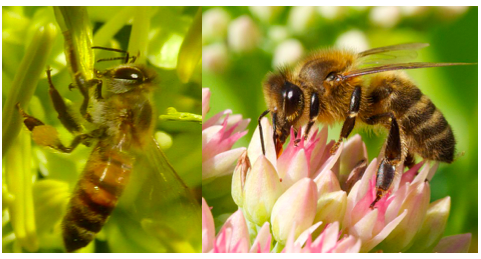


In the 1950s, a researcher in Brazil was attempting to breed a honeybee better suited to tropical climates by crossing African and European subspecies. In 1957, the project took an unexpected turn when a visiting beekeeper accidently released 26 African queen bees into the Brazilian countryside. Those queens ended up interbreeding with local European honeybees, producing hybrids that proved to be highly aggressive and dangerous. The hybridized bees spread rapidly through South America, reaching Mexico and California by 1985 and establishing colonies in Texas by 1990. By 1997, 90% of bee swarms trapped around Tucson, Arizona were hybrids. This example illustrates how quickly gene flow can alter a population’s characteristics.
Natural Selection: Evolution with Direction
Of the four forces of evolution, natural selection is the one most people have heard of and it is the one that gives evolution its apparent direction. While mutation generates random variation and genetic drift changes allele frequencies by chance, natural selection is not random. As you learned in Chapter 3, it is driven by conditions in the environment. Natural selection can be classified as directional, balancing/stabilizing, or disruptive/diversifying depending on how the pressure is applied to the population.
Directional Selection
When the environment consistently favors one extreme of a trait over others, the result is directional selection. Allele frequencies shift steadily in one direction, generation after generation. A recent and still-unfolding example comes from the Africanized honeybee. As discussed in the gene flow section, this hybrid between African and European subspecies spread rapidly through the Americas. Its northward advance into the United States was at first slowed by cold winters since the African bee’s tropical origins left it poorly suited to surviving prolonged cold. For a time, researchers believed the southern part of the country represented the limit to the hybrid’s range.
However, climate change appears to be lifting that limitation. As winters across the southern and southwestern United States have grown milder, Africanized bees have continued pushing farther north than what researchers had predicted. More recent research confirms that over 60% of feral honey bee colonies in San Diego County are Africanized (Kohn, et al. 2015). The traits that make the African bee so successful in warm environments—efficient foraging in heat, rapid colony growth, strong defensive behavior—are being favored by natural selection as the climate shifts in their direction. Interestingly, genomic studies reveal that the adaptive advantage isn’t a matter of one or two key genes, but a whole suite of climate-related traits being selected for simultaneously giving these more aggressive and dangerous hybrids an edge (Corbett-Detig, et al. 2020).
Balancing Selection
Balancing selection, also called stabilizing selection, occurs when intermediate versions of a trait are favored over the extremes. Human birth weight is a frequently cited example. Across human populations, average birth weight tends to cluster in a range that balances the need for babies to be small enough to avoid complications during birth but big enough to maintain a safe body temperature after they are born.
Sickle cell anemia, discussed earlier, provides another strong example. In populations where malaria is common, neither allele is simply “good” or “bad”—it all comes down to how many copies you carry. Two copies of the normal allele (homozygous dominant) means you have a high risk of malaria. Two copies of the sickle cell allele (homozygous recessive) produces sickle cell disease. Inheriting one copy of each allele (heterozygous) provides protection against malaria without the disease. Natural selection maintains both alleles in the population because the heterozygous genotype provides an advantage over either homozygous alternative, which is why the sickle cell allele has persisted in malaria-prone regions rather than being eliminated.
Disruptive Selection
Disruptive selection, also called diversifying selection, is the opposite of balancing selection. In this case, both extremes of a trait are advantaged while intermediate forms are at a disadvantage. Over time, this can split a population into two distinct groups. Darwin observed an example of this in the finches of the Galapagos Islands. Seed-eating finches tended to have either large, powerful beaks capable of cracking big seeds, or small, precise beaks suited for picking up tiny seeds. Plants on the islands offered few medium-sized seeds, so birds with intermediate beak sizes were less efficient at both tasks. Selection favored the extremes. Darwin proposed that this kind of divergent pressure, sustained over many generations, could gradually lead one populations to split into two separate species, called speciation.
Sexual Selection
Sexual selection is a particular form of natural selection in which the selective pressure operates through mate choice, sometimes at the risk of survival. Traits that make an individual more attractive to potential mates will spread in the population, even if those traits carry some survival cost. The peacock’s elaborate tail is a classic example. It is metabolically expensive to grow, makes the bird more visible to predators, and yet it persists because peahens preferentially choose males with more impressive displays.


The túngara frog of Central America is another interesting example, revealing just how sharply natural selection and sexual selection can push against each other. Male túngara frogs produce two types of calls to attract females: a simple whine, and a more complex call that adds a series of short, low-frequency sounds called “chucks”, to the whine. Females consistently prefer the more complex call, and males that produce it enjoy significantly greater reproductive success. Except for one problem: a frog-eating bat that hunts by homing in on frog calls. These bats are just as attracted to the complex whine-chuck call as female frogs are, and preferentially attack males producing it (Akre, et al. 2011).
This means that a male túngara frog faces a genuine dilemma every time he calls. The call most likely to attract females is also the call most likely to attract a predator. Research has shown that males will adjust their calling behavior depending on perceived predation risk. They will shift toward simpler calls when bats are active nearby. This case offers a fascinating look at sexual selection and natural selection operating simultaneously on the same trait yet pulling in opposite directions.
Did You Know?
Got Milk?: The Story of Lactose Tolerance in Humans


The Puzzle
Most people assume lactose intolerance is the exception, but it’s actually the rule. The majority of adults worldwide cannot comfortably digest lactose, the primary sugar found in milk. Lactose tolerance in adulthood is relatively rare globally, and is most common among people of Northern European descent.
As mammals, it makes sense that virtually all humans can digest lactose as infants. The digestive system of a newborn is equipped with an enzyme called lactase, which breaks lactose into simpler sugars that can be absorbed. But in most people, the gene that produces lactase is gradually switched off after weaning. So what happened in populations with high rates of adult lactose tolerance? The answer involves every force of evolution discussed in this chapter.

Mutation Creates the Possibility
The starting point, of course, is a mutation. In most humans, the lactase gene carries a regulatory switch that turns off after childhood. But in some individuals, a mutation in that regulatory regions keeps the gene active throughout adulthood. Like all mutations, this one arose randomly. In fact, it arose separately in multiple populations. Europeans carry one version, several African populations carry different versions, but they all have the same outcome: lactase persistence.

Natural Selection Spreads the Mutation
A mutation that arises by chance will only spread if it provides some advantage in the environment. For most of human history, adult lactose tolerance wouldn’t have provided a particular benefit since most human societies didn’t have access to fresh milk from domesticated animals. That changed with the domestication of cattle and other dairy producing animals, which appears to have begun in the Middle East and parts of Africa roughly 9,000 years ago. Once humans had herds of cows, goats, or sheep producing milk, the ability to consume that milk directly became a genuine advantage. Milk provided calories, protein, and crucially, during droughts, a source of hydration. In populations that depended on dairying, individuals who could digest milk as adults were more likely to survive and reproduce. Natural selection favored the lactase persistence mutation. Its frequency increased steadily through pastoralist based populations.


Gene Flow and Genetic Drift Shape the Distribution
As dairying cultures migrated and interacted with neighboring populations, gene flow spread the lactase persistence gene further. Populations that had not been dairying but came into contact with those that were would have received the allele through interbreeding. The current global distribution of lactose tolerance—high in Northern Europe and some East African and Middle Eastern populations, low elsewhere—reflects the historical geography of cattle domestication and the subsequent movement of people.
Genetic drift also played a role. In small, isolated dairying populations, chance fluctuations could have helped or hindered the spread of the mutation, independent of its adaptive value. The interplay of all four forces shaped the outcome we see today.


The Bigger Picture
The lactose tolerance story carries an important lesson: human culture and human biology do not evolve independently. The way we live shapes the selective environment in which our genes our tested. The shift to dairying introduced a new condition that acted upon the mutation sitting in the genome. This kind of gene-culture co-evolution, in which cultural practices and genetic evolution influence one another is one of the defining features of human evolutionary history.
Source: Got Lactase? (2007). UC Museum of Paleontology Understanding Evolution, www.understandingevolution.org.
Why the Forces of Evolution Matter Today
In today’s modern world, understanding these evolutionary processes is crucial for developing immunizations and antibiotics that can keep up with the rapid mutation rate of viruses and bacteria. This is also relevant to our food supply, which relies in large part on the development of herbicides and pesticides that keep up with rapidly evolving pests and weeds. Viruses, bacteria, agricultural pests, and weeds have all shown great flexibility in adapting to the tools we use to combat them. Billion-dollar industries have specialized in trying to keep our species one step ahead of the next mutation in the pests and infectious diseases that put our food supply and health at risk.
Even gene-editing technologies like CRISPR-Cas9, which allow scientists to alter DNA with remarkable precision, do not change the fundamental rules. The genome remains capable of generating random mutations, and those mutations will continue to be subject to drift, flow and selection. Knowing the forces of evolution gives us the conceptual tools to understand both the possibilities and the limits of genetic intervention.
This page titled 5.2: The Four Forces of Evolution was last modified on Thu, 20 Aug 2026 00:23:06 GMT and is shared under a CC BY-NC 4.0 license and was authored, remixed, and/or curated by Rachel Mitchell.
The book could not be loaded just now.