Opening the book…
Military Alliances – Terrorism
Although terrorists are characterized as non-military, non-state actors, they have a tremendous impact on states around the world and involve allied groups in many countries. Terrorism is the intimidation of a population by violence in order to further political aims. The first terrorist group with global influence is Al Qaeda, formed in 1988 by Osama bin Laden. Although its influence has waned in the past decade, Al Qaeda was responsible for the 9/11 attacks and had several affiliates including Boko Haram in Nigeria and Abu Sayyaf in the Philippines. With the rise of the Islamic State (ISIS/L) in Iraq and Syria in 2013, terrorist groups such as Boko Haram and Abu Sayyaf have consequently declared allegiance to ISIS/L. ISIS/L is an extremist Muslim group that intends to seize as much territory as possible in the Middle East and force their subjects to adhere to their strict version of Islamic fundamentalism. To facilitate their goal, ISIS/L conducts an extensive campaign on social media to recruit fighters to come to Syria and also conduct individual attacks in their home country. Their media campaign has been successful in recruiting numerous militants to come to Syria and to inspire or instigate attacks in the United States, France, Belgium, England, Sweden, Turkey, Afghanistan, Yemen, and Saudi Arabia (Figure 8.3). Furthermore, ISIS/L is conducting regular military operations in Libya and Egypt.
To combat the Islamic State and other terrorist groups, interesting military alliances have developed, and the situation is exceptionally complex. The United States cooperates with numerous NATO allies to train and equip local military forces in Iraq and Syria. Iran, in alliance with Iraq, has provided assistance in driving ISIS/L out of Iraq. Kurdish forces in northern Iraq and Syria, in concert with NATO forces, have conducted much of the military action, and they hope for an independent state because of these efforts. Complicating this situation is the objection of the central governments of Iraq, Syria, and Turkey to an independent Kurdish state. Further clouding the situation is the alliance between Russia and the Syrian central government. Although these two countries do fight against ISIS/L, they are also opposed to other Syrian rebel forces, which the United States supports. The problem of ISIS/L propaganda is being addressed by numerous governments and social media outlets such as Facebook, Twitter, and YouTube. More importantly, though, military success on the ground against ISIS/L forces in Iraq and Syria is decreasing the influx of foreign fighters as well as the proliferation of internet propaganda.
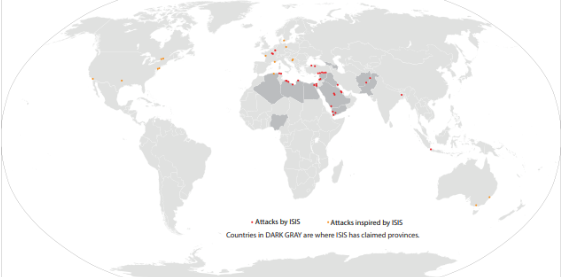
Figure | Map of ISIS/L global influence 1 Author | Corey Parson Source | Original Work License | CC BY SA 4.0
9.2.2: Military Alliances- Terrorism is shared under a CC BY-NC 4.0 license and was authored, remixed, and/or curated by LibreTexts.
The book could not be loaded just now.