From LibreTexts, under CC BY 4.0, as the source states it; its equations are written in TeX, which the PDF shows typeset. This page at LibreTexts.
8.2: Reading Disorders
Opening the book…
Reading models can often be informed by data from people with reading disorders. In studying such disorders, we must differentiate between acquired disorders (those that arise from brain trauma, stroke or injury), and developmental disorders (those that may arise from disruption to the developmental of reading faculties). These dyslexias generally result from injury to the left hemisphere. If the dual-route model is accurately capturing the reading process, then we should be able to find patients who have damaged one route without impairing the other. The evidence for such double disassociations in reading aloud task shows strong support for dual-route models.
Surface Dyslexia
Patients with surface dyslexia have an impairment in reading irregular words. For example, they would have difficulty reading “quay” but can read regularly spelled words such as “dog.” They often over-regularize when reading aloud but can read regular words and regularly spelled non-words easily. In other words, the dual-route model would predict that their lexical route is impaired while the non-lexical route is intact.
Phonological Dyslexia
Patients with phonological dyslexia are unable to read regularly spelled nonwords. However, they are able to read equivalent words. This suggests an impairment with the non-lexical (grapheme-to-phoneme) route.
Deep Dyslexia
Deep dyslexics often resemble phonological dyslexics in that these patients have difficulty with non-words. However, they also make semantic errors where they produce words that are related in meaning with the word they were supposed to read. Coltheart (1980) lists 12 characteristics of this disorder:
Semantic errors
Visual errors
Substitution of incorrect function words
Derivational errors
Inability to pronounce non-words
Imageability effect
Ability to read nouns more easily than adjectives
Ability to read adjectives more easily than verbs
Ability to read content words more easily than function words
Writing impairment
Impaired auditory short-term memory
Context-dependant reading ability
Reading in Other Languages
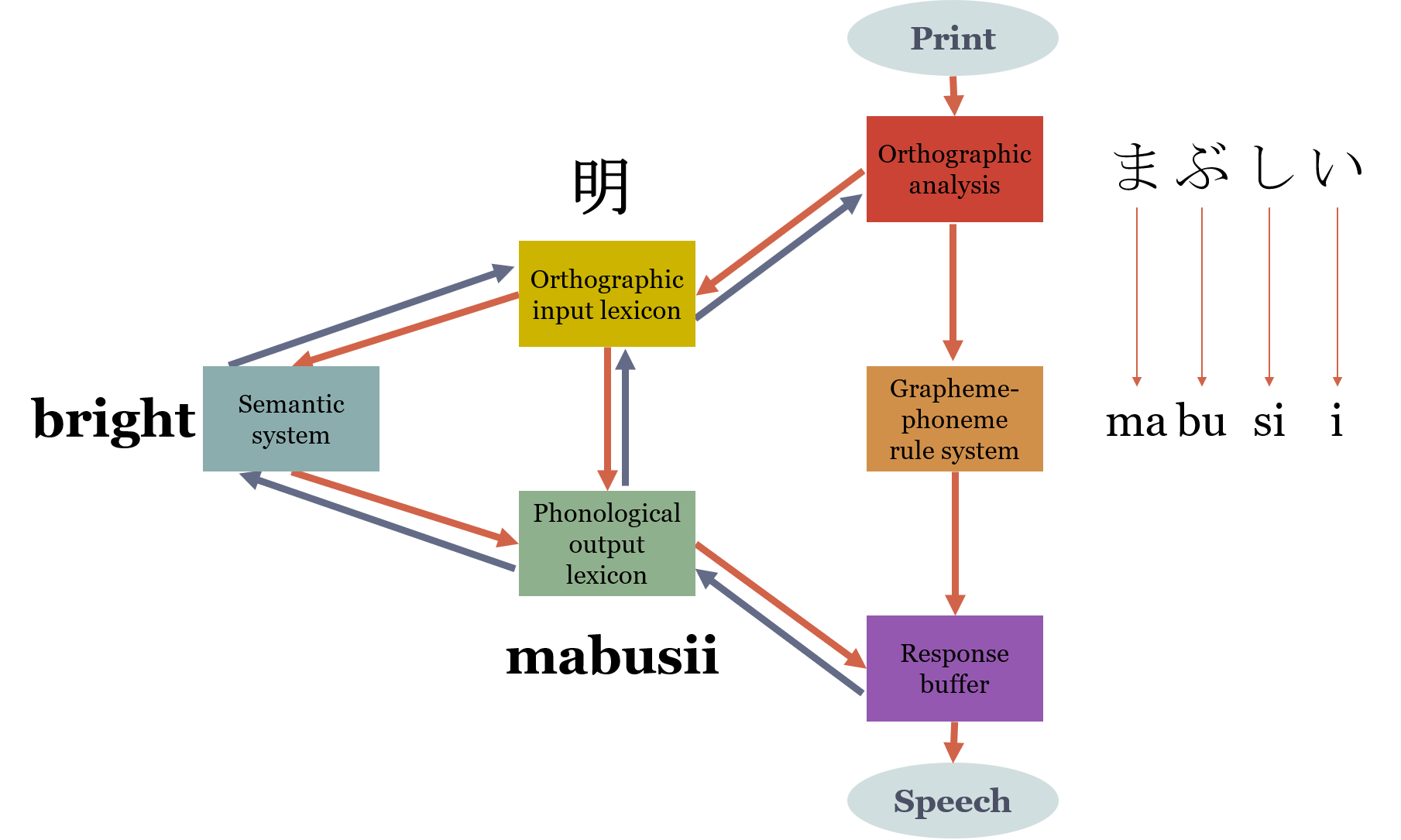
Languages with transparent scripts, such as Italian and Spanish, exhibit phonological and deep dyslexia but not surface dyslexia (Patterson, Marshall, & Coltheart, 1985a, 1985b). However, interesting observations can be made in language that have more than one script. Take Japanese, for instance, which has a syllabary (kana) and a logographic script (kanji). In the latter, no information is available about pronunciation as the symbols stand for the word. As seen in Figure 8.5, while kana can allow for non-lexical grapheme-to-phoneme processing, kanji would only access the lexical route. Therefore, a type of surface dyslexia is found in Japanese where patients cannot read kanji but can process kana. Phonological dyslexia in Japanese results in patients being able to read both kana and kanji but bot able to process non-words written in kana. This suggests that while the neuropsychological mechanisms for reading are common to all human beings, there may be contextual differences brought out by the features inherent in a particular language’s writing system.
Figure 8.5 Using the Dual-route Model in Japanese
Living Language
Canada has its own syllabic writing system used to write languages such as Algonquian and Inuit. In this writing system, the orientation and size of the letters is what modifies the pronunciation rather than other diacritics.
Think of which route would be used to read words and non-words in these languages.
How would you recognize surface and phonological dyslexia in these languages?
What mechanisms may be needed to process size and orientation in the grapheme-to-phoneme system?
Media Attributions
Figure 8.5 Using the Dual-route Model in Japanese by Dinesh Ramoo, the author, is licensed under a CC BY 4.0 licence.
This page titled 8.2: Reading Disorders was last modified on Thu, 18 Dec 2025 08:10:16 GMT and is shared under a CC BY 4.0 license and was authored, remixed, and/or curated by Dinesh Ramoo.