8.4.09: Media Recruitment of Public Sector Workers; Images of Teachers and Teaching
Building Democracy for All · LibreTexts
0%
Contents
Text
Size
From LibreTexts, under not declared, as the source states it; its equations are written in TeX, which the PDF shows typeset. This page at LibreTexts.
8.4.09: Media Recruitment of Public Sector Workers; Images of Teachers and Teaching
Opening the book…
Media Recruitment of Public Sector Workers
The public sector is the part of the United States economy that is owned and operated by federal, state, and local governments. It includes governmental agencies, police and fire departments, public schools and colleges, the military, and other agencies and departments. The U.S. Post Office, National Parks, the Internal Revenue Service (IRS), and the Federal Bureau of Investigation (FBI) are all part of the public sector.
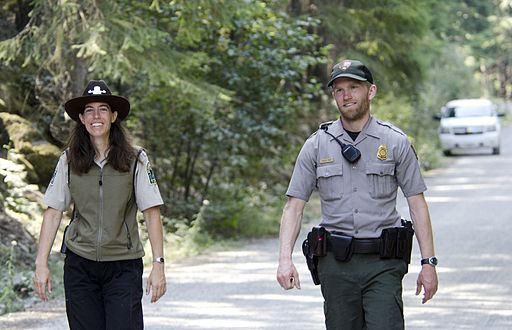
Figure \(\PageIndex{1}\): BC Parks Interpretive Ranger AJ and National Park Service Law Enforcement Ranger Mike work together to keep a bear out of the Hozomeen campground along the United States-Canada Border in Washington State and British Columbia | Public domain
State and local governments are currently experiencing enormous challenges in recruiting workers for public sector jobs. An ongoing "silver tsunami" (the steady retirement of older baby boom-age workers) combined with a decline in job applications due to the COVID-19 pandemic has created a significant number of public sector employment openings throughout the country. Also, the public sector is facing increasingly stiff competition from the private sector organizations for highly talented professional, managerial, and technical workers, especially those with two- and four-year college degrees.
In these activities, you will design a job recruitment commercial and social media post to influence others to pursue careers in the public sector.
Activity 1: Design a Public Sector Job Recruitment Commercial
Imagine you work for a state government that has a significant shortage of workers in a certain public service sector (education, agriculture, postal service, transportation, etc...). In this activity you will create a TV or online commercial to recruit adults to pursue careers in that public sector area.
Start by curating a Wakelet, Padlet, or Google slides collection of TV and online (e.g., YouTube, social media) commercials for public sector and private sector jobs.
Explain the importance of public service and identify career and other opportunities in public service at the local, state and national levels. (Massachusetts Curriculum Framework for History and Social Studies) [8.T4.9]
Over the decades, when children were asked to draw a scientist, nearly every youngster in the 1960s and 1970s, regardless of gender identity, drew a male scientist (Edutopia, May 22, 2019). Gradually, over time, the pattern shifted, and today about 58% of students who identify as female are more likely to draw a woman scientist. Nevertheless, despite progress toward gender equity in many fields, at the high school level across all students and genders, drawings of male scientists outnumber drawings of female scientists 4 to 1. Longstanding educational and career stereotypes about women in science remain entrenched.
Conventional images of teachers also seem resistant to change. In a study comparing the drawings of teachers by college undergraduates, student teaching interns, and practicing teachers, the undergraduates tended to display a teacher at the front of the classroom with students sitting in rows passively listening, while student teaching interns drew students rather than adults at the center of the learning process, and practicing teachers drew more teacher-centered scenes that showed frustration and unhappiness on the part of the adults (Sinclair, et.al., 2013). What is happening that might explain these different visions of teaching and teachers?
In these activities, you will first design an interactive image of a teacher in a 21st century school before evaluating images of teachers taken from different media sources over the past 100 years. As you engage in these activities, consider: "How do you think images of teaching might impact how students in K-12 schools think about teaching and education as a possible career choice?"
Activity 1: Design an Interactive Image of a 21st Century Teacher
Sketch an image of a 21st century teacher teaching.
Add text boxes with more information and/or hyperlinks to external sources (e.g., to sites with information about 21st century teachers).
Go to Insert --> Image --> Search the Web and find Creative Commons/Public Domain images to enrich your drawing. Hyperlink the images to go to external sources (e.g., a Youtube video, article, information about the image).
Next, complete Activity 2 (below).
Then, return to your drawing and determine whether you want to revise it based on what you learned during Activity 2.
Activity 2: Evaluate Images of American Teachers
Curate a digital collection or a digital timeline of images of teachers and teaching. Include at least one image created during each decade from the 1920s to today. Here are some images you might add to your collection:
Based on what you learned from your critical visual analysis of the images:
Return to Activity 1 and consider whether you want to revise your drawing.
Design a TikTok or Snapchat video to inform others about the role of teachers and teaching in present-day society and discuss how media can influence and distort people's perspective of teachers/teaching.
Explain the importance of public service and identify career and other opportunities in public service at the local, state and national levels. (Massachusetts Curriculum Framework for History and Social Studies) [8.T4.9]