Opening the book…
Another extremely important group of functions are the fundamental trignonometric functions \(\sin\), \(\cos\), and \(\tan\). These can be defined in terms of the geometric ratios of the sides of right-angled triangles, as shown below:
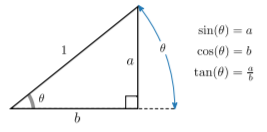
If we use this basic definition, the domain is \(\theta \in [0, \,\pi/2)\), where the input angle \(\theta\) is given in radians.
We can generalize the definition using the following scheme, which allows for negative values of \(a\) and/or \(b\):
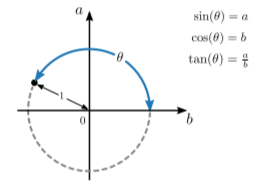
With this, the domain is extended to \(\theta \in [0,\,2\pi)\). We can further extend the domain to all real numbers, \(\theta \in \mathbb{R}\), by treating input values modulo \(2\pi\) as equivalent; in other words, \(f(\theta + 2\pi) = f(\theta)\). With this generalization, the trigonometric functions become many-to-one functions.
According to the Pythagorean theorem, \[\big[\sin(\theta)\big]^2 + \big[\cos(\theta)\big]^2 = 1.\] Using this, we can go on to prove a variety of identities, like the addition identities \[\begin{align} \sin(\theta_1 + \theta_2) &= \sin(\theta_1) \cos(\theta_2) + \cos(\theta_1)\sin(\theta_2) \\ \cos(\theta_1 + \theta_2) &= \cos(\theta_1) \cos(\theta_2) - \sin(\theta_1)\sin(\theta_2)\end{align}\] As you may recall, the trigonometric proofs for these identities involve drawing complicated triangle diagrams, cleverly applying the Pythagorean formula, etc. There are two problems with such proofs: (i) they require some ingenuity in the construction of the triangle diagrams, and (ii) it may not be obvious whether the proofs work if the angles lie outside \([0,\pi/2)\).
Happily, there is a solution to both problems. As we’ll soon see, such trigonometric identities can be proven algebraically by using complex numbers.
This page titled 1.5: 1.5 Trigonometric Functions was last modified on Fri, 30 Apr 2021 15:16:43 GMT and is shared under a CC BY-SA 4.0 license and was authored, remixed, and/or curated by Y. D. Chong via source content that was edited to the style and standards of the LibreTexts platform.
The book could not be loaded just now.