Opening the book…
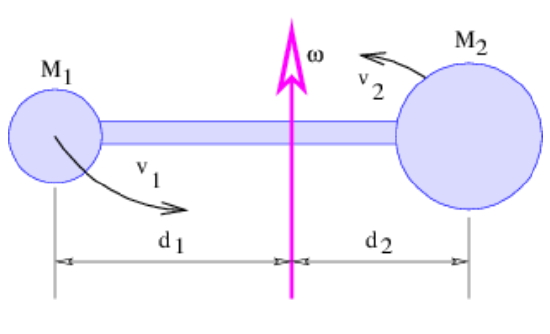
So far we have put no restrictions on the movements of the two particles. An interesting special case occurs when the particles are connected by a lightweight, rigid rod, giving us a dumbbell. In order to further simplify things, we assume that the rod is connected rigidly to a fixed axle at the center of mass of the two particles, as shown in figure 11.6. The masses constituting the ends of the dumbbell are therefore free to revolve in circles about the axle, but they are prevented from executing any other motion. The key effect of this constraint is that both masses rotate about the axle with the same angular frequency \(\omega\).
If the particles are respectively distances d1 and d2 from the axle, then their speeds are \(\mathrm{v}_{1}=\mathrm{d}_{1} \omega \text { and } \mathrm{v}_{2}=\mathrm{d}_{2} \omega\). Thus the kinetic energy of the rotating dumbbell is
\[K_{\text {intern }}=\frac{1}{2} M_{1} v_{1}^{2}+\frac{1}{2} M_{2} v_{2}^{2}=\frac{1}{2} I \omega^{2} \quad \text { (fixed axle) }\label{11.16}\]
where \(I=M_{1} d_{1}^{2}+M_{2} d_{2}^{2}\) is called the moment of inertia. Similarly, the magnitude of the spin angular momentum, which is a vector parallel to the axle, is
\[L_{s p i n}=M_{1} d_{1} v_{1}+M_{2} d_{2} v_{2}=I \omega \quad \text { (fixed axle) }\label{11.17}\]
Finally, Newton’s second law for rotation becomes
\[\tau=\frac{d L_{s p i n}}{d t}=\frac{d I \omega}{d t}=I \frac{d \omega}{d t} \quad(\text { fixed axle })\label{11.18}\]
where \(\tau\) is the component of torque along the rotation axis.
Note that the rightmost expression in equation (\ref{11.18}) assumes that I is constant, which only is true if d1 and d2 are constant – i. e., the dumbbell must truly be rigid.
This page titled 11.4: The Uneven Dumbbell was last modified on Wed, 06 Nov 2024 18:56:54 GMT and is shared under a CC BY-NC-SA 3.0 license and was authored, remixed, and/or curated by David J. Raymond (The New Mexico Tech Press) via source content that was edited to the style and standards of the LibreTexts platform.
The book could not be loaded just now.