Opening the book…
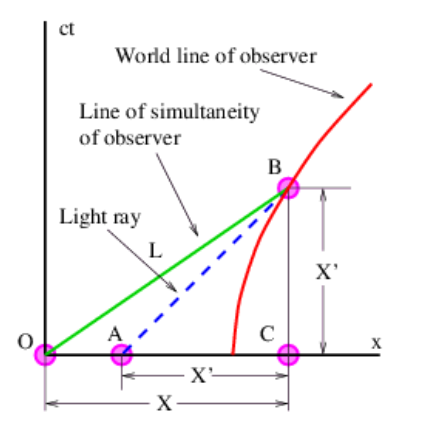
Light emitted at a lower level in a gravitational field has its frequency reduced as it travels to a higher level. This phenomenon is called the gravitational red shift. Figure 6.26 shows why this happens. Since experiencing a gravitational force is equivalent to being in an accelerated reference frame, we can use the tools of special relativity to view the process of light emission and absorption from the point of view of the unaccelerated or inertial frame. In this reference frame the observer of the light is accelerating to the right, as indicated by the curved world line in Figure \(\PageIndex{26}\):, which is equivalent to a gravitational force to the left. The light is emitted at point A with frequency ω by a source which is stationary at this instant. At this instant the observer is also stationary in this frame. However, by the time the light gets to the observer, he or she has a velocity to the right which means that the observer measures a Doppler shifted frequency ω′ for the light. Since the observer is moving away from the source, ω′ < ω, as indicated above.
The relativistic Doppler shift is given by
\[\frac{\omega^{\prime}}{\omega}=\left(\frac{1-U / c}{1+U / c}\right)^{1 / 2}\label{6.25}\]
so we need to compute \(\mathrm{U} / \mathrm{c}\). The line of simultaneity for the observer at point B goes through the origin, and is thus given by line segment OB in Figure \(\PageIndex{26}\):. The slope of this line is \(\mathrm{U} / \mathrm{c}\), where U is the velocity of the observer at point B. From the figure we see that this slope is also given by the ratio \(\mathrm{X}^{\prime} / \mathrm{X}\). Equating these, eliminating \(X\) in favor of \(\mathrm{L}=\left(\mathrm{X}^{2}-\mathrm{X}^{\prime 2}\right)^{1 / 2}=\mathrm{c}^{2} / \mathrm{g}\), which is the actual invariant distance of the observer from the origin, and substituting into equation (\ref{6.25}) results in our gravitational red shift formula:
\[\frac{\omega^{\prime}}{\omega}=\left(\frac{X-X^{\prime}}{X+X^{\prime}}\right)^{1 / 2}=\left(\frac{\left(L^{2}+X^{\prime 2}\right)^{1 / 2}-X^{\prime}}{\left(L^{2}+X^{\prime 2}\right)^{1 / 2}+X^{\prime}}\right)^{1 / 2}\label{6.26}\]
If X′ = 0, then there is no redshift, because the source is collocated with the observer. On the other hand, if the source is located at the origin, so X′ = X, the Doppler shifted frequency is zero. In addition, the light never gets to the observer, since the world line is asymptotic to the light world line passing through the origin. If the source is at a higher level in the gravitational field than the observer, so that X′ < 0, then the frequency is shifted to a higher value, i. e., it becomes a “blue shift”.
Equation (\ref{6.26}) works for more complex geometries than that associated with an accelerated reference frame, e.g., for the gravitational field g associated with a star, as long as \(\left|X^{\prime}\right|<c^{2} / g\). In this case \(L\) is no longer the distance to the center of the star but remains equal to \(\mathrm{c}^{2} / \mathrm{g}\).
This page titled 6.6: Gravitational Red Shift was last modified on Wed, 06 Nov 2024 18:57:00 GMT and is shared under a CC BY-NC-SA 3.0 license and was authored, remixed, and/or curated by David J. Raymond (The New Mexico Tech Press) via source content that was edited to the style and standards of the LibreTexts platform.
The book could not be loaded just now.