Opening the book…
You will build and sketch several models of molecules.

- Molecules that contain carbon may have more than one structure possible.
- Triangle and square structures are usually not valid.
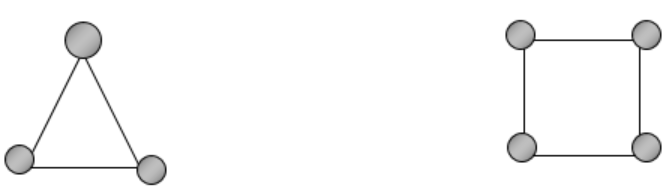
- Draw a table in which to record information about each molecule that contains only single bonds. Do not fill in data until you have read the instructions for obtaining that data.
|
Molecule Name |
Molecular Formula |
Symmetric (yes or no) |
Polar (yes or no) |
|
|---|---|---|---|---|
|
a. |
Hydrogen |
\(\ce{H2}\) |
yes |
no |
|
b. |
Bromine |
\(\ce{Br2}\) |
||
|
c. |
Water |
\(\ce{H2O}\) |
||
|
d. |
Hydrogen Chloride |
\(\ce{HCl}\) |
||
|
e. |
Hydrogen Bromide |
\(\ce{HBr}\) |
||
|
f. |
Hydrogen Peroxide |
\(\ce{H2O2}\) |
||
|
g. |
Iodine Chloride |
\(\ce{ICl}\) |
||
|
h. |
Methane |
\(\ce{CH4}\) |
||
|
i. |
Dichloromethane |
\(\ce{CH2Cl2}\) |
- Build each molecule in the “Single Bonds” table. Sketch the molecule (remember to label it); attempt to show any three dimensional structure. You may use colored pencils, but you should also include the element symbols in your circles. Look at your model and determine whether it is symmetric (yes or no). Analyze the structure to determine whether the molecule would be polar (yes or no). Record your answers in your single bonds data table.
- Draw a table in which to record information for molecules containing double bonds. Repeat the same process for these molecules as you followed for the single bond molecules.
|
Molecule Name |
Molecular Formula |
Symmetric (yes or no) |
Polar (yes or no) |
|
|---|---|---|---|---|
|
j. |
Oxygen |
\(\ce{O2}\) |
||
|
k. |
Ethylene |
\(\ce{C2H4}\) |
||
|
l. |
Nitroxyl |
\(\ce{HNO}\) |
||
|
m. |
Nitrous Acid |
\(\ce{HONO}\) |
||
|
n. |
Formaldehyde |
\(\ce{H2CO}\) |
||
|
o. |
Formic Acid |
\(\ce{HCOOH}\) |
||
|
p. |
Chloroethene (vinyl) |
\(\ce{C2H3Cl}\) |
||
|
q. |
Carbon Monoxide |
\(\ce{CO}\) |
||
|
r. |
Carbon Dioxide |
\(\ce{CO2}\) |
||
|
s. |
CycloPropene |
\(\ce{C3H4}\) |
- Draw a table in which to record information for molecules containing triple bonds, and repeat the process. Also draw a table in which to record information for some common molecules, and repeat the process.
|
Molecule Name |
Molecular Formula |
Symmetric (yes or no) |
Polar (yes or no) |
|
|---|---|---|---|---|
|
t. |
Nitrogen |
\(\ce{N2}\) |
||
|
u. |
Acetylene |
\(\ce{C2H2}\) |
||
|
v. |
Cyanic Acid |
\(\ce{HOCN}\) |
|
Molecule Name |
Molecular Formula |
Symmetric (yes or no) |
Polar (yes or no) |
|
|---|---|---|---|---|
|
w. |
Ozone |
\(\ce{O3}\) |
||
|
x. |
Ammonia |
\(\ce{NH3}\) |
||
|
y. |
Ethanol |
\(\ce{C2H6O}\) |
||
|
z. |
Acetic acid |
\(\ce{C2H4O2}\) |
||
|
Benzene |
\(\ce{C6H6}\) |
This page titled 39.4: Procedures was last modified on Sun, 09 Aug 2026 22:42:23 GMT and is shared under a CC BY 4.0 license and was authored, remixed, and/or curated by Teresa Ciardi via source content that was edited to the style and standards of the LibreTexts platform.
The book could not be loaded just now.