Opening the book…
You will determine which variable affects the period of a pendulum.
- Discuss as a team which variable will affect the period of the pendulum, angle, mass, length, or all of these. Record your prediction.
- Make a bridge with the metal rod and chairs, such that only the ends of the rod are on the chairs. You may want to secure the rods with masking tape.
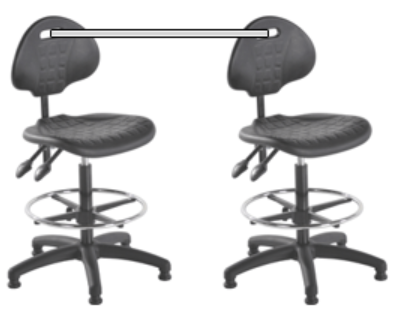
Long Pendulum
- Draw a table in which to record data for your 1st pendulum. Do not fill in data until you have read the instructions for obtaining that data.
|
Length |
Angle |
Time for 5 Cycles 1st Mass |
Period 1st Mass |
Time for 5 Cycles 2nd Mass |
Period 2nd Mass |
|---|---|---|---|---|---|
- The key chain should be tied at the center of the ribbon. Tie the ends of the ribbon in a bow at the middle of the rod, such that the longest possible pendulum hangs from the center of the rod. Measure the length of this pendulum, in meters. You will need to decide your end points of measurement and then be consistent with how you measure the length of each different pendulum during the investigation. Record your length measurement.

- Choose two different angles from which to release the pendulum. Record these angles in your data table.
- Place the protractor at the bottom of the metal rod, and use the protractor to release the pendulum from your first chosen angle; measuring the angle from vertical. Hold the pendulum from the bottom so that the ribbon/string remains straight. Release the pendulum. Measure and record the time for 5 complete cycles. Calculate and record the period for one cycle. Repeat this process for your second angle.

- Add a hooked mass to your pendulum, and repeat the processes in step 6 for this system with the added mass. Record all of your values in your data table. Remove the hooked mass.
Short Pendulum
- Draw a 2nd table in which to record data for your 2nd pendulum.
|
Length |
Angle |
Time for 5 Cycles 1st Mass |
Period 1st Mass |
Time for 5 Cycles 2nd Mass |
Period 2nd Mass |
|---|---|---|---|---|---|
- Re-tie the ribbon in a bow such that your 2nd pendulum is about half the length of what your long pendulum was. Measure and record the length of your 2nd pendulum, in meters.
- Use the same angles as you chose for the long pendulum, and repeat the same processes to acquire your data for the short pendulum. You will also be using the same hooked mass as you used for the long pendulum.
This page titled 20.4: Procedures was last modified on Sun, 09 Aug 2026 22:42:22 GMT and is shared under a CC BY 4.0 license and was authored, remixed, and/or curated by Teresa Ciardi via source content that was edited to the style and standards of the LibreTexts platform.
The book could not be loaded just now.