Opening the book…
Consider a hydrogen atom placed in a uniform \(z\)-directed external magnetic field of magnitude \(|{\bf B}|\). The modification to the Hamiltonian of the system is
\[H_1 = -\bmu\cdot{\bf B}, \nonumber \]
where
\[\bmu = - \frac{e}{2\,m_e}\,({\bf L} + 2\,{\bf S}) \nonumber \]
is the total electron magnetic moment, including both orbital and spin contributions. [See Equations \ref{e10.57}–\ref{e10.59}.] Thus,
\[H_1 = \frac{e\,B}{2\,m_e}\,(L_z+ 2\,S_z). \nonumber \]
Suppose that the applied magnetic field is much weaker than the atom’s internal magnetic field, \ref{e12.124}. Because the magnitude of the internal field is about 25 tesla, this is a fairly reasonable assumption. In this situation, we can treat \(H_1\) as a small perturbation acting on the simultaneous eigenstates of the unperturbed Hamiltonian and the fine structure Hamiltonian. Of course, these states are the simultaneous eigenstates of \(L^2\), \(S^2\), \(J^2\), and \(J_z\). (See the previous section.) Hence, from standard perturbation theory, the first-order energy-shift induced by a weak external magnetic field is
\[\begin{align} \Delta E_{l,1/2;j,m_j} &= \langle l,1/2;j,m_j|H_1|l,1/2;j,m_j\rangle\nonumber\\[4pt] &= \frac{e\,B}{2\,m_e}\,\left(m_j\,\hbar + \langle l,1/2;j,m_j|S_z|l,1/2;j,m_j\rangle\right),\end{align} \nonumber \]
because \(J_z=L_z+S_z\). Now, according to Equations \ref{e11.47} and \ref{e11.48},
\[ \psi^{(2)}_{j,m_j} = \left(\frac{j+m_j}{2\,l+1}\right)^{1/2}\psi^{(1)}_{m_j-1/2,1/2} + \left(\frac{j-m_j}{2\,l+1}\right)^{1/2}\,\psi^{(1)}_{m_j+1/2,-1/2} \label{e12.143} \]
when \(j=l+1/2\), and
\[\psi^{(2)}_{j,m_j} = \left(\frac{j+1-m_j}{2\,l+1}\right)^{1/2}\psi^{(1)}_{m_j-1/2,1/2} - \left(\frac{j+1+m_j}{2\,l+1}\right)^{1/2}\,\psi^{(1)}_{m_j+1/2,-1/2} \nonumber \]
when \(j=l-1/2\). Here, the \(\psi^{(1)}_{m,m_s}\) are the simultaneous eigenstates of \(L^2\), \(S^2\), \(L_z\), and \(S_z\), whereas the \(\psi^{(2)}_{j,m_j}\) are the simultaneous eigenstates of \(L^2\), \(S^2\), \(J^2\), and \(J_z\). In particular,
\[ S_z\,\psi^{(1)}_{m,\pm 1/2} = \pm \frac{\hbar}{2}\,\psi^{(1)}_{m,\pm 1/2}. \label{e12.145} \]
It follows from Equations \ref{e12.143}–\ref{e12.145}, and the orthormality of the \(\psi^{(1)}\), that
\[\langle l,1/2;j,m_j|S_z|l,1/2;j,m_j\rangle = \pm \frac{m_j\,\hbar}{2\,l+1} \nonumber \]
when \(j=l\pm 1/2\). Thus, the induced energy-shift when a hydrogen atom is placed in an external magnetic field—which is known as the Zeeman effect —becomes
\[ \Delta E_{l,1/2;j,m_j} = \mu_B\,B\,m_j\left(1\pm \frac{1}{2\,l+1}\right) \label{e12.147} \]
where the \(\pm\) signs correspond to \(j=l\pm 1/2\). Here,
\[\mu_B = \frac{e\,\hbar}{2\,m_e} = 5.788\times 10^{-5}\,{\rm eV/T} \nonumber \]
is known as the Bohr magnetron. Of course, the quantum number \(m_j\) takes values differing by unity in the range \(-j\) to \(j\). It, thus, follows from Equation \ref{e12.147} that the Zeeman effect splits degenerate states characterized by \(j=l+1/2\) into \(2\,j+1\) equally spaced states of interstate spacing
\[ \Delta E_{j=l+1/2} = \mu_B\,B\left(\frac{2\,l+2}{2\,l+1}\right). \label{e12.149} \]
Likewise, the Zeeman effect splits degenerate states characterized by \(j=l-1/2\) into \(2\,j+1\) equally spaced states of interstate spacing
\[ \Delta E_{j=l-1/2} = \mu_B\,B\left(\frac{2\,l}{2\,l+1}\right). \label{e12.150} \]
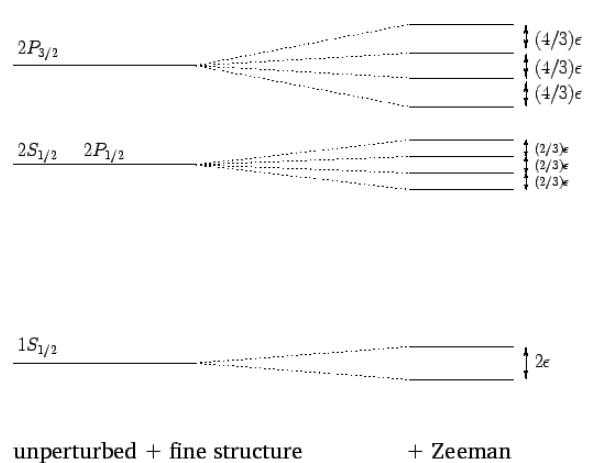
 and
 states of a hydrogen atom. Here, \(\epsilon=\mu_{B} B\). Not to scale.
In conclusion, in the presence of a weak external magnetic field, the two degenerate \(1S_{1/2}\) states of the hydrogen atom are split by \(2\,\mu_B\,B\). Likewise, the four degenerate \(2S_{1/2}\) and \(2P_{1/2}\) states are split by \((2/3)\,\mu_B\,B\), whereas the four degenerate \(2P_{3/2}\) states are split by \((4/3)\,\mu_B\,B\). This is illustrated in Figure [fzee]. Note, finally, that because the \(\psi^{(2)}_{l,m_j}\) are not simultaneous eigenstates of the unperturbed and perturbing Hamiltonians, Equations \ref{e12.149} and \ref{e12.150} can only be regarded as the expectation values of the magnetic-field induced energy-shifts. However, as long as the external magnetic field is much weaker than the internal magnetic field, these expectation values are almost identical to the actual measured values of the energy-shifts.
This page titled 11.8: Zeeman Effect was last modified on Fri, 13 Mar 2026 07:04:02 GMT and is shared under a CC BY-NC-SA 4.0 license and was authored, remixed, and/or curated by Richard Fitzpatrick via source content that was edited to the style and standards of the LibreTexts platform.
The book could not be loaded just now.