Opening the book…
4.4 Magnetic Force
Learning Objectives
- Determine the direction of the magnetic force on moving positive and negative charges.
- Calculate the magnitude of the magnetic force on moving positive and negative charges.
- Determine the magnetic force between current-carrying wires.
4.4.1 Magnetic Force on a Moving Charge
Model

Explore
- Use the model to identify the direction of each vector for each charge. Put zero if the vector quantity is zero.
| Charge | Velocity (x, y, z, 0) | Magnetic Field (x, y, z, 0) | Force (x, y, z, 0) |
|---|---|---|---|
| A | |||
| B | |||
| C | |||
| D |
- Do any of the vectors ever point in the same direction (zero doesn't count)?
Critical Thinking & Concept Invention
- What angle do these vectors make with each other?
- Align your fingers (not your thumb) with the magnetic field and your thumb with the velocity vector. What part of your hand points in the direction of the force? Check with each charge.
4.4.2 Magnetic Force: Positive and Negative Charges
Model
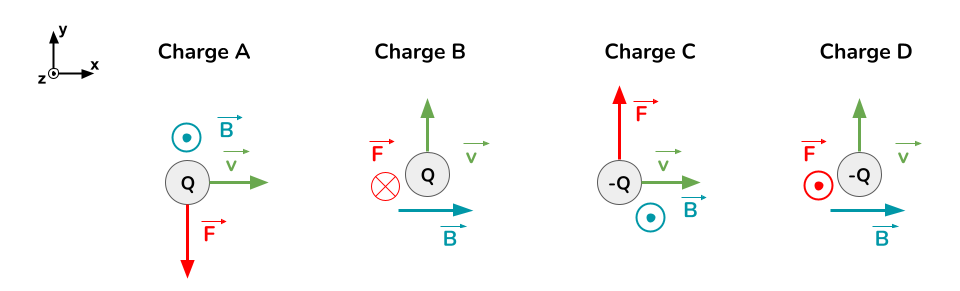
Explore
- Use the model to identify the direction of each vector for each charge. Put zero if the vector quantity is zero.
| Charge | Velocity (x, y, z, 0) | Magnetic Field (x, y, z, 0) | Force (x, y, z, 0) |
|---|---|---|---|
| A | |||
| B | |||
| C | |||
| D |
- Do any of the vectors ever point in the same direction (zero doesn't count)?
Critical Thinking & Concept Invention
- Do negative and positive charges respond to magnetic fields in the same way? If not, describe the difference.
Apply
Identify the direction of the magnetic force on a negative charge that travels through the following fields.
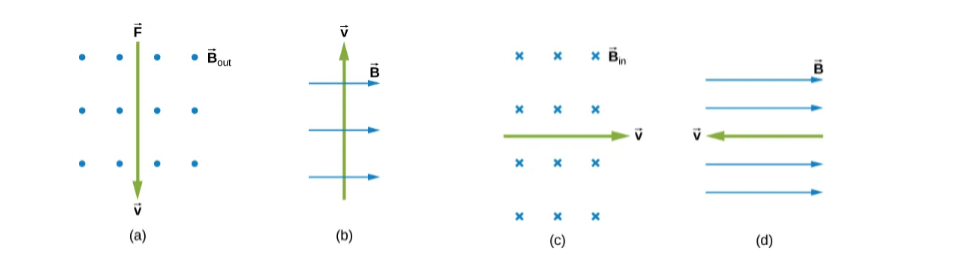
Image Credit: OpenStax University Physics Vol 2 (https://openstax.org/details/books/university-physics-volume-2)
4.4.3 Magnetic Force: Charge and Velocity
Model

Explore
- How does the magnitude of the magnetic force on Charge B compare to Charge A? What else is different about Charge B that might have caused this change in force?
- How does the magnitude of the magnetic force on Charge C compare to Charge A? What else is different about Charge C that might have caused this change in force?
- How does the magnitude of the magnetic force on Charge D compare to Charge A? What else is different about Charge D that might have caused this change in force?
Critical Thinking & Concept Invention
- Identify a proportionality between the magnitude of the magnetic force on charged particles and various quantities:
\[ F_B \propto Q \quad \text{OR} \quad F_B \propto \frac{1}{Q} \]
\[ F_B \propto v \quad \text{OR} \quad F_B \propto \frac{1}{v} \]
\[ F_B \propto B \quad \text{OR} \quad F_B \propto \frac{1}{B} \]
- Predict the single equation that will include these proportional relationships:
\[ F_B= \]
- Based on use of the Right Hand Rule, the equation is likely a cross product. Which of the following cross products aligns with the direction of the force?
\[ \vec{B}\times\vec{v} \quad \text{OR} \quad \vec{v}\times\vec{B} \]
Summary
The magnetic force on a particle is based on the magnetic field, as well as the particle's charge and velocity. The force is proportional to all three and has a direction based on the Right Hand Rule, resulting in the equation:
\[ \vec{F}_B= \]
Apply
Set up a coordinate system and use column vectors to determine the magnetic force on each particle.

\[ \begin{bmatrix} \\ \\ \\ \end{bmatrix} \times \begin{bmatrix} \\ \\ \\ \end{bmatrix} = \begin{bmatrix} \\ \\ \\ \end{bmatrix} \]
\[ \begin{bmatrix} \\ \\ \\ \end{bmatrix} \times \begin{bmatrix} \\ \\ \\ \end{bmatrix} = \begin{bmatrix} \\ \\ \\ \end{bmatrix} \]
4.4.4 Magnetic Force Between Wires
Model
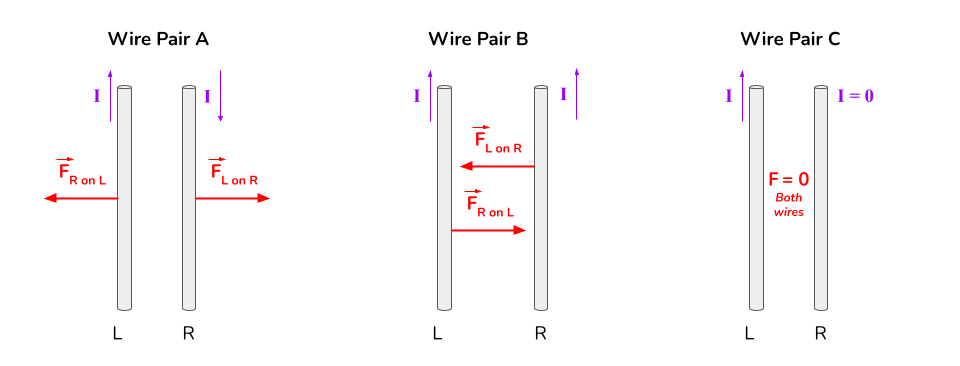
Explore
- In Wire Pair A is the current in each wire the same direction or opposite direction? Do the forces between the wires attract or repel?
- In Wire Pair B is the current in each wire the same direction or opposite direction? Do the forces between the wires attract or repel?
- Describe the direction of the current(s) in Wire Pair C. Is there any force between these wires?
Critical Thinking & Concept Invention
- Generalize to create rules:
- When parallel wires have current in the same direction, the force between the wires . . .
- When parallel wires have current in opposite directions, the force between the wires . . .
- Does there need to be current in wires to experience this force? Explain.
This page titled 4.4: Magnetic Force on a Moving Charge was last modified on Tue, 06 Oct 2026 03:05:22 GMT and is shared under a CC BY 4.0 license and was authored, remixed, and/or curated by Andrew Totah-McCarty.
The book could not be loaded just now.