Opening the book…
5.4 Gauss Law and Electric Potential
Learning Objectives
- Apply Gauss Law to charge distributions.
- Determine electric potential functions from electric fields using integrals.
- Use electric field and potential functions to determine charge density on a conductor.
5.4.1 Electric Field and Potential for a Parallel Plate Capacitor
Model
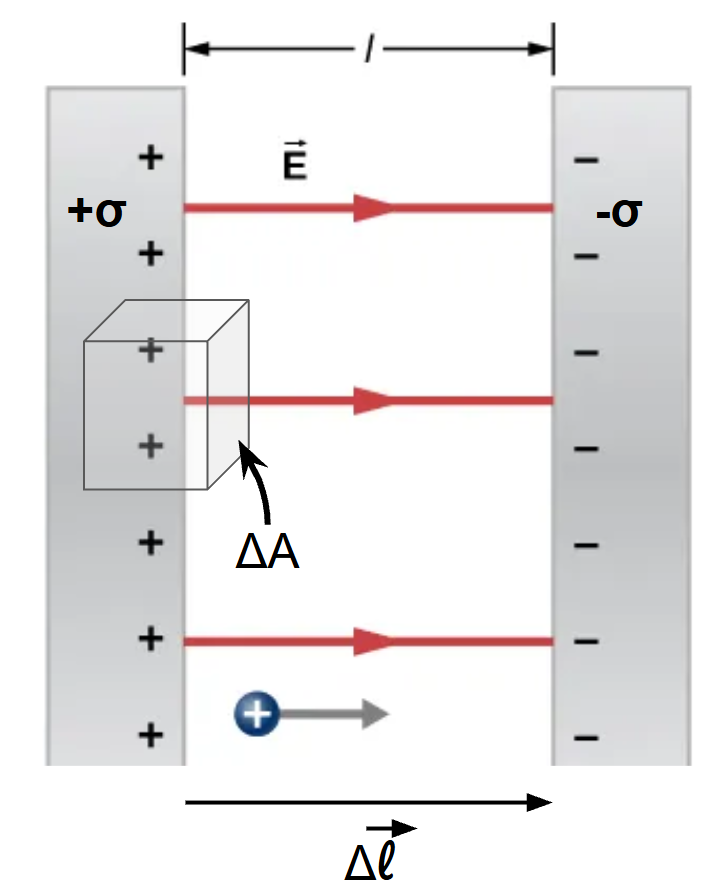
Image Credit: OpenStax University Physics Vol 2 (https://openstax.org/details/books/university-physics-volume-2)
Explore
- What is the electric field inside either of the plates (they are conductors)?
- How many faces of the Gaussian box have a non-zero electric flux? Shade those faces and draw a normal vector.
- Compare the direction of \(\vec{E}\) and \(d\vec{A}\) (parallel, perpendicular, or neither).
- Does the electric field magnitude vary with distance (for example, do the field lines converge or diverge as they leave the plate)?
- Compare the direction of \(\vec{E}\) and \(d\vec{l}\) (parallel, perpendicular, or neither).
Critical Thinking & Concept Invention
- Use Gauss's Law to identify the electric field magnitude created by the charge distribution.
- Identify the enclosed charge.
- Simplify the integral and explain how you were able to simplify it.
- Identify the electric field in terms of \(\sigma\).
- Identify the electric field in terms of capacitor charge \(Q\) if that charge is uniformly distributed over a plate with area \(A\).
\[ Q_{\mathrm{enc}}= \]
\[ \oint \vec{E}\cdot d\vec{A}=\frac{Q_{\mathrm{enc}}}{\varepsilon_0} \]
- Determine the change in electric potential \((\Delta V)\) from the positive plate to the negative plate.
- Simplify the integral and explain how you were able to simplify it.
- Identify the electric potential in terms of \(\sigma\).
- Identify the electric potential in terms of capacitor charge \(Q\) if that charge is uniformly distributed over a plate with area \(A\).
- Using \(\Delta V_C=Q/C\), identify the capacitance \(C\).
\[ \Delta V\equiv-\int\vec{E}\cdot d\vec{l} \]
\[ \Delta V= \]
\[ \Delta V= \]
\[ C= \]
Summary
Electric potential and electric fields are related by the line integral:
\[ \Delta V\equiv-\int\vec{E}\cdot d\vec{l} \]
Gauss's Law relates electric field to charge on a conductor:
\[ \oint\vec{E}\cdot d\vec{A}=\frac{Q_{\mathrm{enc}}}{\varepsilon_0} \]
Combining these relationships allows electric potential to be related to charge. Since capacitance is defined as the ratio of charge to voltage:
\[ C\equiv\frac{Q}{\Delta V} \]
Apply
A cylindrical capacitor is created from a long thin wire (length \(L\)) and an outer conducting cylinder of the same length and radius \(R\). The inner wire has charge \(+Q\) and the outer cylinder has charge \(-Q\). Determine the capacitance.

5.4.2 Electric Potential from Spherical Charge Distributions
Model

Image Credit: OpenStax University Physics Vol 2 (https://openstax.org/details/books/university-physics-volume-2)
Explore
- What is the geometric shape of the charge distribution? What is the equation for its volume?
- What is the shape of the Gaussian surface shown? What is the equation for its surface area?
- Can Gauss's Law be reduced as shown below for this charge distribution and Gaussian surface? Explain why or why not.
\[ \Phi_E\equiv\iint\vec{E}\cdot d\vec{A}\longrightarrow \Phi_E=EA \]
Critical Thinking & Concept Invention
\[ \vec{E}= \]
- Use Gauss's Law to identify the electric field magnitude created by the charged sphere if its total net charge is \(+Q\).
\[ \oint\vec{E}\cdot d\vec{A}=\frac{Q_{\mathrm{enc}}}{\varepsilon_0} \]
- What coordinate system (Cartesian, cylindrical, or spherical) best aligns with the direction of this electric field?
- Identify a vector equation for the electric field by including an appropriate unit vector.
- Determine the change in electric potential between:
- The radius of the charged sphere and a point on the Gaussian surface.
- A point at infinity and a point on the Gaussian surface.
\[ \Delta V\equiv-\int\vec{E}\cdot d\vec{l} \]
\[ \Delta V\equiv-\int\vec{E}\cdot d\vec{l} \]
- Use the result referenced to infinity to identify the capacitance of the charged sphere.
\[ \Delta V_C=\frac{Q}{C} \]
\[ C= \]
5.4.3 Electric Fields Inside and Outside of Charged Dielectrics
Model
A sphere of radius \(R\) has a total net charge \(Q\) that is uniformly distributed throughout its volume. Two Gaussian surfaces are shown: one inside the sphere and one outside the sphere.

Image Credit: OpenStax University Physics Vol 2 (https://openstax.org/details/books/university-physics-volume-2)
Explore
- For constant charge density, \(\rho=Q/V\), where \(V\) represents volume, what is the charge density of the sphere?
- What is the volume enclosed by each Gaussian sphere?
- For which Gaussian surface (inside or outside) is the entire charge \(Q\) enclosed?
- For the surface that does not enclose all of \(Q\), what is the enclosed charge? Use the charge density relationship and geometric variables.
Critical Thinking & Concept Invention
- Use Gauss's Law to identify the electric field magnitude created by the charge distribution.
- Identify the enclosed charge in each case.
- Simplify the integral and explain your reasoning.
- Express the electric field in terms of \(Q\).
\[ Q_{\mathrm{enc}}= \qquad Q_{\mathrm{enc}}= \]
\[ \oint\vec{E}\cdot d\vec{A}=\frac{Q_{\mathrm{enc}}}{\varepsilon_0} \]
\[ \oint\vec{E}\cdot d\vec{A}=\frac{Q_{\mathrm{enc}}}{\varepsilon_0} \]
- Identify how the electric field depends on distance \(r\):
- Inside the sphere: \(E\propto\)
- Outside the sphere: \(E\propto\)
Summary
Changes in electric potential relate to changes in energy for charged objects. A specific electric potential value has meaning only relative to another reference point. Choosing infinity as the zero reference defines the Coulomb potential for a point charge or uniformly charged sphere:
\[ V(r)= \]
Apply
Suppose the spherical charge distribution has charge density
\[ \rho(r)=\frac{\rho_0r}{R} \]
within the object and zero for \(r>R\). Find the electric field as a function of \(r\) both inside and outside the charge distribution.
5.4.4 Surface Charge Density
Model
Two conducting spheres of different sizes are connected by a wire.

Explore
- Choose a color to represent the wire voltage in the model. Color the spheres using the same code.
- Compare the two spheres by writing greater than, less than, or equal for:
Quantity Sphere 1 vs. Sphere 2 Radius Charge
Critical Thinking & Concept Invention
- Because the spheres are connected by a conducting wire, how should their voltages compare? Add a voltage column to the table and indicate greater than, less than, or equal.
- Determine how charge \(Q\) and surface charge density \(\sigma\) compare for each sphere.
- Write an expression for the voltage of each sphere using the equations derived with infinity as the reference point.
- Use the equation to identify the charge ratio \(\frac{Q_1}{Q_2}\), then solve for \(Q_1\).
- Using \(\sigma=Q/A\), identify the surface charge density ratio \(\frac{\sigma_1}{\sigma_2}\).
\[ V_1=V_2= \]
\[ \frac{Q_1}{Q_2}= \qquad Q_1= \]
\[ \frac{\sigma_1}{\sigma_2}= \qquad \sigma_1= \]
- How does surface charge density compare to radius of curvature for a conductor?
A greater radius of curvature results in a surface charge density __________________.
This page titled 5.4: Electric Potential from Gauss Law was last modified on Tue, 06 Oct 2026 03:05:22 GMT and is shared under a CC BY 4.0 license and was authored, remixed, and/or curated by Andrew Totah-McCarty.
The book could not be loaded just now.