Opening the book…
4.7.1 Impact Cratering
The model below shows snapshots of the same planet at different moments in time. The dark circles represent impact craters on the surface of the planet.

- In each image, circle the impact craters that are new
- Write the number of new craters and total craters underneath each image
- Identify a pattern and provide reasoning for why the pattern makes sense:
As time goes on, the number of impact craters ...
This makes sense because ...
4.7.2 Volcanism
The model below shows three different planets (or the same planet at different times) with different proportions of solid/liquid interior layers.
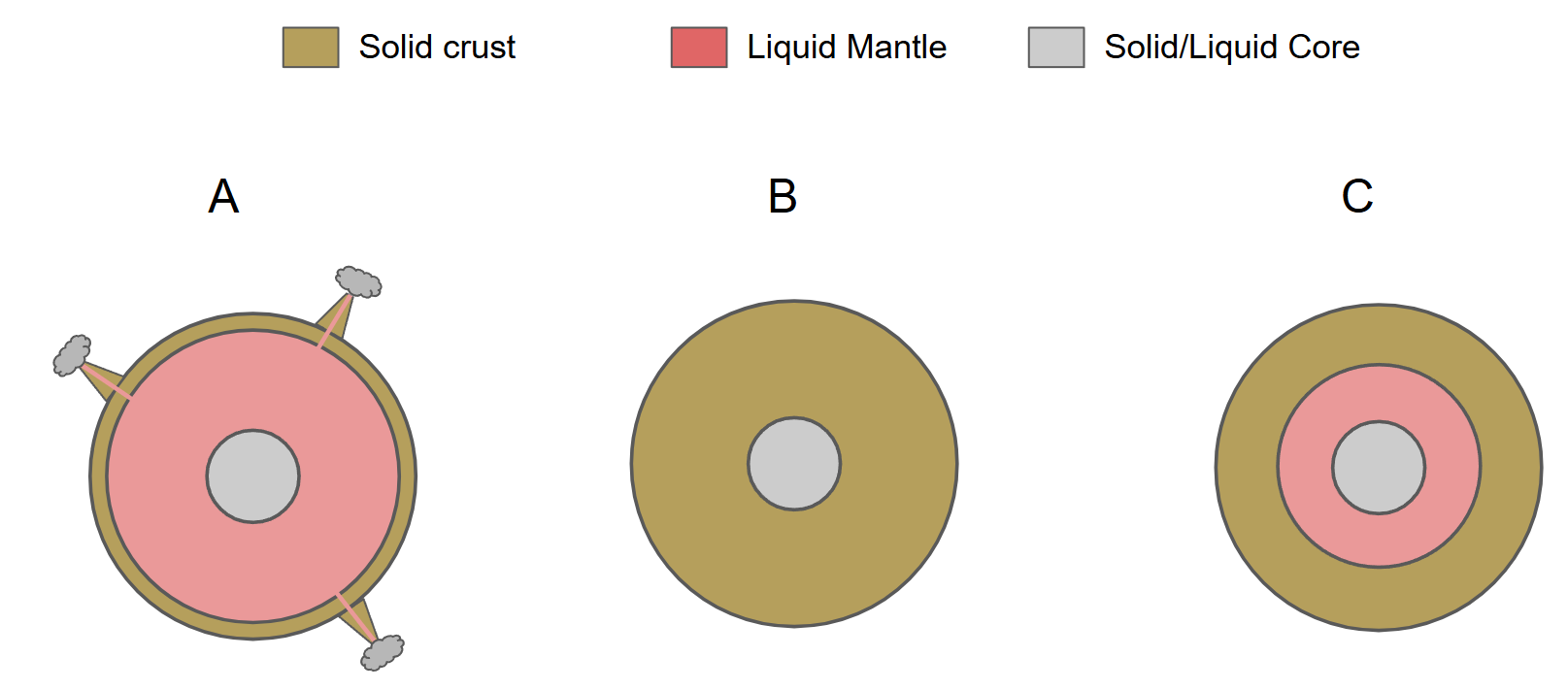
- Compare planet A and B: What is different about planet A that might be the reason it has volcanic activity?
- Compare planet A and C: What is different about planet A that might be the reason it has volcanic activity?
- Summarize: What needs to be true about a planet for volcanic activity to occur?
- Recall that planets are initially nearly all liquid and solidify as they cool down. What is more likely? Make a claim and provide evidence and reasoning:
- A planet has volcanic activity in the past but loses that volcanic activity.
- A planet did not have volcanic activity in the past but will gain it in the future.
- Suppose a planetary system has two planets, a large planet and a small planet.
- If the small planet has active volcanoes, will the large planet necessarily also have active volcanoes? Explain your reasoning.
- If the large planet has active volcanoes, will the small planet necessarily also have active volcanoes? Explain your reasoning.
4.7.3 Volcano vs Crater

- Imagine the volcano and crater in the model are near each other. What might happen to the crater after many eruptions?
- If we look at the planet after many eruptions, which will we most likely see evidence of, volcanism or impacts?
- Lava flows create a smooth surface that can look like oceans. For this reason, they are called “Mares” (which means oceans) on some bodies. Identify the mares (circle or label them) on the model image on the right.
- Which parts of the image on the mare and crater landscape do you think represent older rock (ie, rock that formed/solidified a long time ago) and which part represent newer rock (rock that formed/solidified more recently)? Label these parts “older” and “younger”
- Make a claim and back it up with evidence and reasoning: Does volcanism lead to older or younger surfaces?
- Examine the circled crater in the flat mare in the image below. Do you think that impact occurred before or after the mare was created? Explain your reasoning.

Image Credit: OpenStax Astronomy 2e (https://openstax.org/details/books/astronomy-2e)
Note: Mares are often from lava seeping up out of the ground as areas of the crust are broken up by impact craters. They are not always caused by mountainous volcanoes with eruptions like the model picture.
This page titled 4.7: Planetary Surface Changes was last modified on Sat, 01 Aug 2026 14:55:42 GMT and is shared under a CC BY 4.0 license and was authored, remixed, and/or curated by Andrew Totah-McCarty.
The book could not be loaded just now.