Opening the book…
1. Electromagnetic Radiation
1.1 Wavelength Model
Model
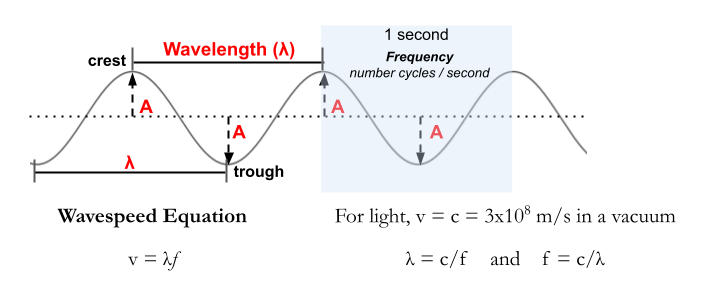
Wave diagram showing wavelength, amplitude, and frequency for comparing wave properties.
- What is the difference between wavelength (\(\lambda\)) and amplitude (\(A\))?
- How would a wave look if it had a higher frequency?
- Two waves are traveling at the same speed, but one has a higher frequency. Will it have a longer or shorter wavelength? Explain your reasoning and then draw both waves.
Student Drawing Area
1.2 Colors of Light
Model
Image needed here with Alt Text: Visible light spectrum showing colors arranged by wavelength and frequency.
- What is different about the different colors of light?
- Compare violet (purple) light and red light: Which has a longer wavelength and which has a shorter wavelength?
- If violet and red light travel past you at the same speed, which color will have more crests pass by you in a given amount of time (frequency)?
- Identify a pattern: For light, when wavelength increases, frequency:
1.3 Blackbody Radiation
Model
The model below shows different size hotplates. The hotplates that are a lighter color are hotter. Imagine you place a pot with the same amount of water on each burner and heat it up until it boils.
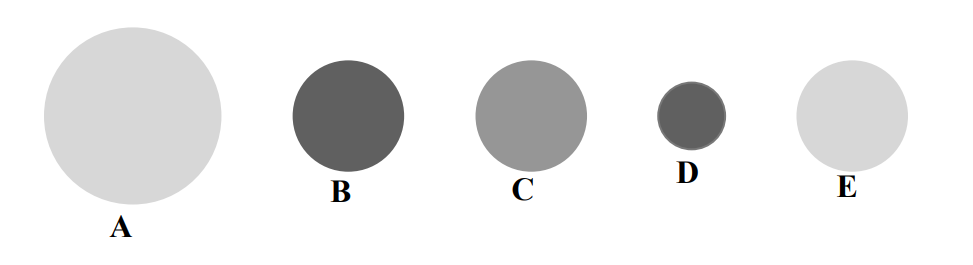
Hotplates of different sizes and temperatures used to compare heating and luminosity.
Image Credit: Astronomy Interactives from the Astronomy Education Department at the University of Nebraska-Lincoln (https://astro.unl.edu/interactives/)
- Which burner will boil the water fastest? Explain your reasoning.
- Which burner will boil the water slowest? Explain your reasoning.
- If two burners are the same size, what determines which burner will boil a pot of water faster? Explain your reasoning.
- If two burners are the same temperature, what determines which burner will boil a pot of water faster? Explain your reasoning.
- If you use two burners of different sizes, can you assume that the burner that boils water faster is at a higher temperature? Explain your reasoning.
Summary
Luminosity is based on temperature and size. Overall luminosity follows the pattern:
\(L \propto AT^{4}\)
This is equivalent to:
\(L \propto A \times T \times T \times T \times T\)
Apply
- Compare the luminosity of the stars shown below. Explain your reasoning.

Stars of different sizes and temperatures used to compare luminosity.
Image Credit: Astronomy Interactives from the Astronomy Education Department at the University of Nebraska-Lincoln (https://astro.unl.edu/interactives/)
This page titled 3.1: Electromagnetic (EM) Radiation was last modified on Sat, 01 Aug 2026 14:37:30 GMT and is shared under a CC BY 4.0 license and was authored, remixed, and/or curated by Andrew Totah-McCarty.
The book could not be loaded just now.