Opening the book…
4.3.1 Planetesimal Formation
Model
Early Protoplanetary Disk

As time goes on...

- What are the two types of matter in the protoplanetary disk?
- Which type of matter sticks together?
- If the protoplanetary disk is a higher percent dust than gas, are planets more or less likely to form?
- If the protoplanetary disk is a higher percent dust than gas, are planets more or less likely to form?
4.3.2 Temperature and Types of Material
Model
The models below provide some data on the temperature at the time of formation at the location of several planets in a planetary system. This planetary system has 8 planets, A-H, with Planet A the closest to the star (smallest distance).
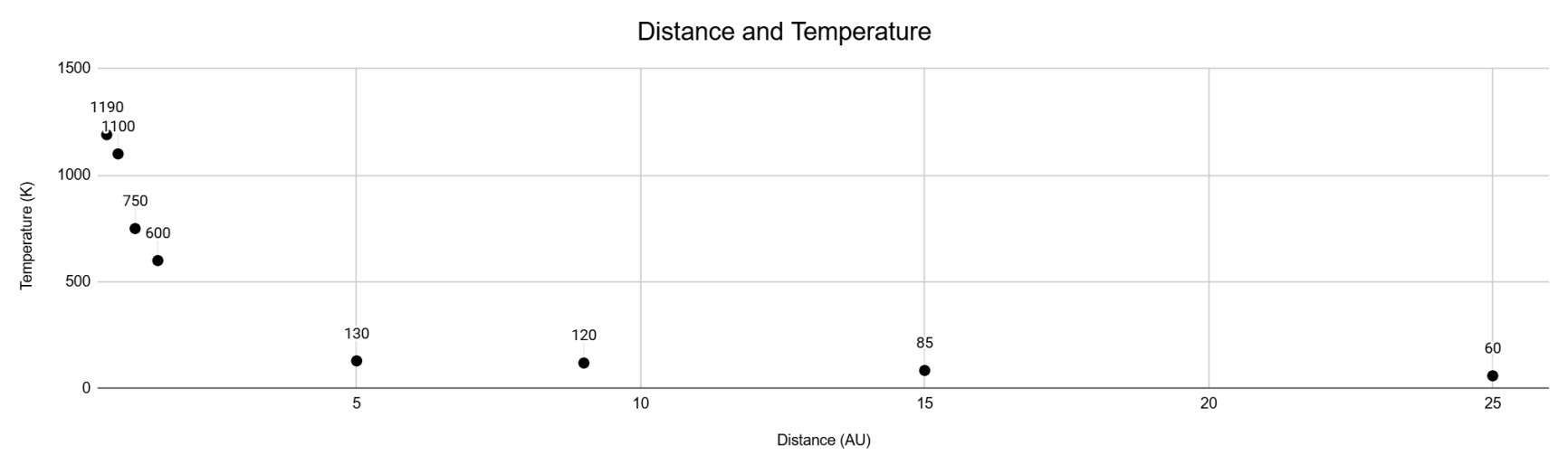
| Material | Condensation Temperature |
| Metal | 1300K |
| Rock | 1200K |
| Water | 140K |
| Methane/Ammonia | 90K |
| Hydrogen | N/A - Always gas in space |
- Based on the temperature of each planet, decide which substance(s) that planet it made up of. For each type of material that each planet is made up, draw a dot and stack them on top of each other to make a vertical column for each planet. Use a different color for each different substance. Start with metal on the bottom and work up to lower condensation temperature substances.
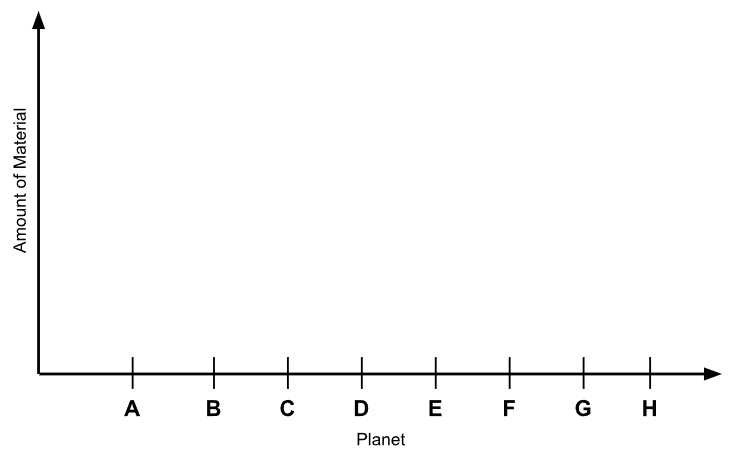
- Identify patterns between planetary formation location (ie, proximity to the star) and diversity of planet material.
- According to these data, which planet(s) should be the largest (most mass) and which should be the smallest (least mass)? Why?
4.3.3 Types of Materials + Relative Abundance
Model
The Relative Abundance chart tells you how the amount of metal, rock, water, and methane/ammonia compare in the protoplanetary disk.

- For each type of material that each planet is made up, draw dots to make a new set of vertical columns. This time, draw as many dots as match the relative abundance (eg, if the planet is formed from water, place 5 water dots). Start with metal on the bottom and work up to lower condensation temperature substances.
- According to these data, which planet(s) should be the largest (most mass) and which should be the smallest (least mass)? Why?
- Generalize a pattern: Where in this solar system do small, medium, and large planets form? Why does this happen?
- What separates the big planets from the small planets? Where in space would this line separating the two groups of planets be?
4.3.4 Types of Materials + Total Abundance
Model
The Total Abundance chart tells you how the amount of metal, rock, water, and methane/ammonia compare in the protoplanetary disk at different distances in that disk.

- Take the amount of dots you used in the Types of Materials + Relative Abundance activity and multiply by the total abundance value at the location of each planet. Round answers to the nearest integer. Draw dots to match those numbers. Start with metal on the bottom and work up to lower condensation temperature substances.
- According to these data, which planet(s) should be the largest (most mass) and which should be the smallest (least mass)? Why?
- Generalize a pattern: Where in this solar system do small, medium, and large planets form? Why does this happen?
This page titled 4.3: Planetary Formation 1- Planetesimals was last modified on Sat, 01 Aug 2026 14:55:41 GMT and is shared under a CC BY 4.0 license and was authored, remixed, and/or curated by Andrew Totah-McCarty.
The book could not be loaded just now.