Opening the book…
The solution to Schrödinger's equation in three dimensions is quite complicated in general. Fortunately, nature lends us a hand, since most physical systems are "rotationally invariant", i.e., \(V(x)\) depends on the size of \(x\), but not its direction! In that case it helps to introduce spherical coordinates, as denoted in Fig. \(\PageIndex{1}\).
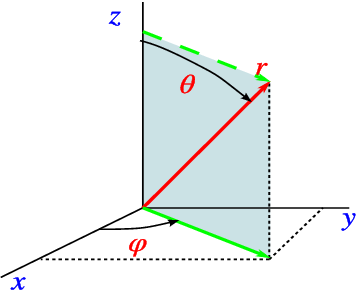
The coordinates \(r, \theta\) and \(\phi\) are related to the standard ones by
\[\begin{aligned}x & =r \cos \varphi \sin \theta \\
y & =r \sin \varphi \sin \theta \\
& =r \cos \theta\end{aligned}\]
where \(0<r<\infty, 0<\theta<\pi\) and \(0<\phi<2 \pi\). In these new coordinates we have
\[\Delta f(r, \theta, \varphi)=\frac{1}{r^2} \frac{\partial}{\partial r}\left(r^2 \frac{\partial}{\partial r} f(r, \theta, \varphi)\right)-\frac{1}{r^2}\left[\frac{1}{\sin \theta} \frac{\partial}{\partial \theta}\left(\sin \theta \frac{\partial}{\partial \theta} f(r, \theta, \varphi)\right)+\frac{\partial^2}{\partial \varphi^2} f(r, \theta, \varphi)\right] .\]
This page titled 11.2: Spherical Coordinates was last modified on Mon, 04 Nov 2024 01:29:25 GMT and is shared under a CC BY-NC-SA 2.0 license and was authored, remixed, and/or curated by Niels Walet via source content that was edited to the style and standards of the LibreTexts platform.
The book could not be loaded just now.