Opening the book…

Decimal notation is based on powers of \(10\): \(0.1\) is one tenth, \(0.01\) is one hundredth, \(0.001\) is one thousandth, and so on.
| thousands | hundreds | tens | ones/units | . | tenths | hundredths | thousandths |
Write each number.
1. ninety and twenty-three hundredths
2. seven and fifty-six thousandths
- Answer
-
1. 90.23
2. 7.056
Adding & Subtracting Decimals
Before you add or subtract decimals, you must line up the decimal points.
Add each pair of numbers.
3. \(3.75+12.8\)
4. \(71.085+112.93\)
- Answer
-
3. \(16.55\)
4. \(184.015\)
When subtracting, you may need to add zeros to the first number so you can borrow correctly.
Subtract each pair of numbers.
5. \(46.57-38.29\)
6. \(82.78-67.024\)
- Answer
-
5. \(8.28\)
6. \(15.756\)
Multiplying Decimals
To multiply decimal numbers:
- Temporarily ignore the decimal points.
- Multiply the numbers as though they are whole numbers.
- Add the total number of decimal digits in the two numbers you multiplied. The result will have that number of digits to the right of the decimal point.
Note: You do NOT need to line up the decimal points when you are multiplying.
Multiply each pair of numbers.
7. \(13.5\cdot2.9\)
8. \(4.18\cdot3.7\)
9. Evie worked \(37.5\) hours at a pay rate of $ \(17.50\) per hour. How much did she earn in total?
- Answer
-
7. \(39.15\)
8. \(15.466\)
9. $ \(656.25\)
Dividing Decimals
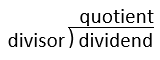
Let’s review everyone’s favorite topic, long division. The three parts of a division are named as follows: dividend \(\div\) divisor = quotient. When this is written with a long division symbol, the dividend is inside the symbol, the divisor is on the left, and the quotient is the answer we create on top.
To divide by a decimal:
- Write in long division form.
- Move the decimal point of the divisor until it is a whole number.
- Move the decimal point of the dividend the same number of places to the right.
- Place the decimal point in the quotient directly above the decimal point in the dividend. Divide the numbers as though they are whole numbers.
- If necessary, add zeros to the right of the last digit of the dividend to continue.
Divide each pair of numbers.
10. \(97.4\div0.4\)
11. \(9.74\div0.04\)
- Answer
-
10. \(243.5\)
11. \(2,435\)
Rounding Numbers
It is often necessary to round a number to a specified place value. We will discuss this in much more depth in a future module, but let’s practice rounding now.
Rounding a number:
- Locate the rounding digit in the place to which you are rounding.
- Look at the test digit directly to the right of the rounding digit.
- If the test digit is 5 or greater, increase the rounding digit by 1 and drop all digits to its right. If the test digit is less than 5, keep the rounding digit the same and drop all digits to its right.
Round each number to the indicated place value.
12. \(6,473\) (thousands)
13. \(6,473\) (hundreds)
14. \(6,473\) (tens)
15. \(0.7049\) (tenths)
16. \(0.7049\) (hundredths)
17. \(0.7049\) (thousandths)
- Answer
-
12. \(6,000\)
13. \(6,500\)
14. \(6,470\)
15. \(0.7\)
16. \(0.70\)
17. \(0.705\)
If a decimal answer goes on and on, it may be practical to round it off.
18. Jerry drove \(257\) miles using \(11\) gallons of gas. How many miles per gallon did his car get? Round your result to the nearest tenth.
- Answer
-
18. \(23.4\) miles per gallon
2.2.3: Decimals is shared under a CC BY-NC-SA 4.0 license and was authored, remixed, and/or curated by LibreTexts.
The book could not be loaded just now.