Opening the book…
A.1.1 Trigonometry — Graphs


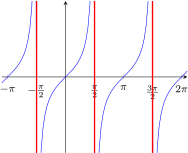
A.1.2 Trigonometry — Special Triangles

From the above pair of special triangles we have
\[\begin{align*} \sin \frac{\pi}{4} &= \frac{1}{\sqrt{2}} & \sin \frac{\pi}{6} &= \frac{1}{2} & \sin \frac{\pi}{3} &= \frac{\sqrt{3}}{2}\\ \cos \frac{\pi}{4} &= \frac{1}{\sqrt{2}} & \cos \frac{\pi}{6} &= \frac{\sqrt{3}}{2} & \cos \frac{\pi}{3} &= \frac{1}{2}\\ \tan \frac{\pi}{4} &= 1 & \tan \frac{\pi}{6} &= \frac{1}{\sqrt{3}} & \tan \frac{\pi}{3} &= \sqrt{3} \end{align*}\]
A.1.3 Trigonometry — Simple Identities
- Periodicity
\[\begin{align*} \sin(\theta+2\pi) &= \sin(\theta) & \cos(\theta+2\pi) &= \cos(\theta) \end{align*}\]
- Reflection
\[\begin{align*} \sin(-\theta)&=-\sin(\theta) & \cos(-\theta) &=\cos(\theta) \end{align*}\]
- Reflection around \(\pi/4\)
\[\begin{align*} \sin\left(\tfrac{\pi}{2}-\theta\right)&=\cos\theta & \cos\left(\tfrac{\pi}{2}-\theta\right)&=\sin\theta \end{align*}\]
- Reflection around \(\pi/2\)
\[\begin{align*} \sin\left(\pi-\theta\right)&=\sin\theta & \cos\left(\pi-\theta\right)&=-\cos\theta \end{align*}\]
- Rotation by \(\pi\)
\[\begin{align*} \sin\left(\theta+\pi\right)&=-\sin\theta & \cos\left(\theta+\pi\right)&=-\cos\theta \end{align*}\]
- Pythagoras
\[\begin{align*} \sin^2\theta + \cos^2 \theta &=1\\ \tan^2\theta + 1 &= \sec^2\theta\\ 1 + \cot^2 \theta &=\csc^2\theta \end{align*}\]
- \(\sin\) and \(\cos\) building blocks
\[\begin{gather*} \tan\theta=\frac{\sin\theta}{\cos\theta}\quad \csc\theta=\frac{1}{\sin\theta}\quad \sec\theta=\frac{1}{\cos\theta}\quad \cot\theta=\frac{\cos\theta}{\sin\theta}=\frac{1}{\tan\theta} \end{gather*}\]
A.1.4 Trigonometry — Add and Subtract Angles
- Sine
\[\begin{align*} \sin(\alpha \pm \beta) &= \sin(\alpha )\cos(\beta) \pm \cos(\alpha )\sin(\beta) \end{align*}\]
- Cosine
\[\begin{align*} \cos(\alpha \pm \beta) &= \cos(\alpha )\cos(\beta) \mp \sin(\alpha )\sin(\beta) \end{align*}\]
- Tangent
\[\begin{align*} \tan(\alpha +\beta)&=\frac{\tan\alpha +\tan\beta}{1-\tan\alpha \tan\beta}\\ \tan(\alpha -\beta)&=\frac{\tan\alpha -\tan\beta}{1+\tan\alpha \tan\beta} \end{align*}\]
- Double angle
\[\begin{align*} \sin(2\theta) &= 2\sin(\theta)\cos(\theta)\\ \cos(2\theta) &= \cos^2(\theta) - \sin^2(\theta)\\ &= 2\cos^2(\theta) - 1\\ &= 1 - 2\sin^2(\theta)\\ \tan(2\theta) &= \frac{2\tan(\theta)}{1-\tan^2\theta}\\ \cos^2\theta&=\frac{1+\cos(2\theta)}{2}\\ \sin^2\theta&=\frac{1-\cos(2\theta)}{2}\\ \tan^2\theta&=\frac{1-\cos(2\theta)}{1+\cos(2\theta)} \end{align*}\]
- Products to sums
\[\begin{align*} \sin(\alpha )\cos(\beta)&= \frac{\sin(\alpha +\beta) + \sin(\alpha -\beta)}{2}\\ \sin(\alpha )\sin(\beta)&= \frac{\cos(\alpha -\beta) - \cos(\alpha +\beta)}{2}\\ \cos(\alpha )\cos(\beta)&= \frac{\cos(\alpha -\beta) + \cos(\alpha +\beta)}{2} \end{align*}\]
- Sums to products
\[\begin{align*} \sin\alpha +\sin\beta &= 2 \sin\frac{\alpha +\beta}{2}\cos\frac{\alpha -\beta}{2}\\ \sin\alpha -\sin\beta &= 2 \cos\frac{\alpha +\beta}{2}\sin\frac{\alpha -\beta}{2}\\ \cos\alpha +\cos\beta &= 2 \cos\frac{\alpha +\beta}{2}\cos\frac{\alpha -\beta}{2}\\ \cos\alpha -\cos\beta &= -2 \sin\frac{\alpha +\beta}{2}\sin\frac{\alpha -\beta}{2} \end{align*}\]
A.1.5 Inverse Trigonometric Functions

\[ \arcsin x \nonumber \]
Domain: \(-1 \leq x \leq 1\)
Range: \(-\frac{\pi}{2} \leq \arcsin x \leq \frac{\pi}{2}\)

\[ \arccos x \nonumber \]
Domain: \(-1 \leq x \leq 1\)
Range: \(0 \leq \arccos x \leq \pi\)

\(\arctan x \nonumber\)
Domain: all real numbers
Range: \(-\frac{\pi}{2} \lt \arctan x \lt \frac{\pi}{2}\)
Since these functions are inverses of each other we have
\[\begin{align*} \arcsin(\sin \theta) &= \theta & -\frac{\pi}{2} \leq \theta \leq \frac{\pi}{2}\\ \arccos(\cos \theta) &= \theta & 0 \leq \theta \leq \pi\\ \arctan(\tan \theta) &= \theta & -\frac{\pi}{2} \leq \theta \leq \frac{\pi}{2} \end{align*}\]
and also
\[\begin{align*} \sin(\arcsin x) &= x & -1 \leq x \leq 1\\ \cos(\arccos x) &= x & -1 \leq x \leq 1\\ \tan(\arctan x) &= x & \text{any real } x \end{align*}\]

\[ \textrm{arccsc} x \nonumber \]
Domain: \(|x|\ge 1\)
Range: \(-\frac{\pi}{2} \leq \textrm{arccsc} x \leq \frac{\pi}{2}\)
\[ \textrm{arccsc} x \ne 0 \nonumber \]

\[ \textrm{arcsec} x \nonumber \]
Domain: \(|x|\ge 1\)
Range: \(0 \leq \textrm{arcsec} x \leq \pi\)
\[ \textrm{arcsec} x \ne \frac{\pi}{2} \nonumber \]

\[ \textrm{arccot} x \nonumber \]
Domain: all real numbers
Range: \(0 \lt \textrm{arccot} x \lt \pi\)
Again
\[\begin{align*} \textrm{arccsc}(\csc \theta) &= \theta & -\frac{\pi}{2} \leq \theta \leq \frac{\pi}{2},\ \theta\ne 0\\ \textrm{arcsec}(\sec \theta) &= \theta & 0 \leq \theta \leq \pi,\ \theta\ne \frac{\pi}{2}\\ \textrm{arccot}(\cot \theta) &= \theta & 0 \lt \theta \lt \pi \end{align*}\]
and
\[\begin{align*} \csc(\textrm{arccsc} x) &= x & |x|\ge 1\\ \sec(\textrm{arcsec} x) &= x & |x|\ge 1\\ \cot(\textrm{arccot} x) &= x & \text{any real } x \end{align*}\]
This page titled A.1: Trigonometry was last modified on Sat, 26 Feb 2022 13:50:13 GMT and is shared under a CC BY-NC-SA 4.0 license and was authored, remixed, and/or curated by Joel Feldman, Andrew Rechnitzer and Elyse Yeager via source content that was edited to the style and standards of the LibreTexts platform.
The book could not be loaded just now.