Opening the book…
In the following, \(x\) and \(y\) are arbitrary real numbers that are strictly bigger than 0, and \(p\) and \(q\) are arbitrary constants that are strictly bigger than one.
- \(q^{\log_q x}=x, \qquad \log_q \big(q^x\big)=x\)
- \(\log_q x=\frac{\log_p x}{\log_p q}\)
- \(\log_q 1=0, \qquad \log_q q=1\)
- \(\log_q(xy)=\log_q x+\log_q y\)
- \(\log_q\big(\frac{x}{y}\big)=\log_q x-\log_q y\)
- \(\log_q\big(\frac{1}{y}\big)=-\log_q y\text{,}\)
- \(\log_q(x^y)=y\log_q x\)
- \(\lim\limits_{x\rightarrow\infty}\log_q x=\infty, \qquad \lim\limits_{x\rightarrow0}\log_q x=-\infty\)
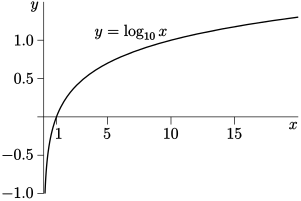
- The graph of \(\log_{10} x\) is given below. The graph of \(\log_q x\text{,}\) for any \(q \gt 1\text{,}\) is similar.
This page titled A.13 Logarithms was last modified on Wed, 17 Nov 2021 20:23:10 GMT and is shared under a CC BY-NC-SA 4.0 license and was authored, remixed, and/or curated by Joel Feldman, Andrew Rechnitzer and Elyse Yeager via source content that was edited to the style and standards of the LibreTexts platform.
The book could not be loaded just now.