Opening the book…
Let \(f(x)\) be a continuous function and let \(a_1\lt b_1\) with \(f(a_1)\) and \(f(b_1)\) being of opposite sign.
As we have seen, the bisection method generates a sequence of intervals \(I_n=[a_n,b_n]\text{,}\) \(n=1,2,3,\cdots\) with, for each \(n\text{,}\) \(f(a_n)\) and \(f(b_n)\) having opposite sign (so that, by continuity, \(f\) has a root in \(I_n\)). Once we have \(I_n\text{,}\) we choose \(I_{n+1}\) based on the sign of \(f\) at the midpoint, \(\frac{a_n+b_n}{2}\text{,}\) of \(I_n\text{.}\) Since we always test the midpoint, the possible error decreases by a factor of 2 each step.
The false position method tries to make the whole procedure more efficient by testing the sign of \(f\) at a point that is closer to the end of \(I_n\) where the magnitude of \(f\) is smaller. To be precise, we approximate \(y=f(x)\) by the equation of the straight line through \(\big(a_n,f(a_n)\big)\) and \(\big(b_n,f(b_n)\big)\text{.}\)
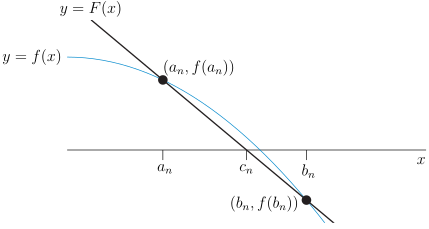
The equation of that straight line is
\[ y = F(x) = f(a_n) + \frac{f(b_n)-f(a_n)}{b_n-a_n}(x-a_n) \nonumber \]
Then the false position method tests the sign of \(f(x)\) at the value of \(x\) where \(F(x)=0\text{.}\)
\begin{align*} & F(x) = f(a_n) + \frac{f(b_n)-f(a_n)}{b_n-a_n}(x-a_n) =0 \\ & \iff x= a_n - \frac{b_n-a_n}{f(b_n)-f(a_n)} f(a_n) = \frac{a_n f(b_n) - b_n f(a_n) }{f(b_n)-f(a_n)} \end{align*}
So once we have the interval \(I_n\text{,}\) the false position method generates the interval \(I_{n+1}\) by the following rule.1
Set \(c_n=\frac{a_n f(b_n) - b_n f(a_n) }{f(b_n)-f(a_n)}\text{.}\) If \(f(c_n)\) has the same sign as \(f(a_n)\text{,}\) then
\[ I_{n+1}=[a_{n+1},b_{n+1}]\quad\text{with}\quad a_{n+1}=c_n,\ b_{n+1}=b_n \nonumber \]
and if \(f(c_n)\) and \(f(a_n)\) have opposite signs, then
\[ I_{n+1}=[a_{n+1},b_{n+1}]\quad\text{with}\quad a_{n+1}=a_n,\ b_{n+1}=c_n \nonumber \]
This page titled C.3 The false position (regula falsi) method was last modified on Wed, 24 Nov 2021 08:55:47 GMT and is shared under a CC BY-NC-SA 4.0 license and was authored, remixed, and/or curated by Joel Feldman, Andrew Rechnitzer and Elyse Yeager via source content that was edited to the style and standards of the LibreTexts platform.
The book could not be loaded just now.