Opening the book…
a diagram for the graph for a partial order on a finite set \(A\text{,}\) omitting reflexive loops and transitive “composite” edges, and placing “smaller” elements lower on the diagram instead of using arrows
Let \(A = \{2,4,6,8,10,12\}\text{.}\) The Hasse diagram of the partial order \(\mathord{\mid}\) (i.e. “divides”) on \(A\) appears in Figure \(\PageIndex{1}\). Notice that \(2\) is not joined directly to either \(8\) or \(12\text{,}\) since we can use transitivity and the facts that \(2 \mid 4\) and \(2 \mid 6\) to infer \(2 \mid 8\) and \(2 \mid 12\text{,}\) respectively, from the diagram.
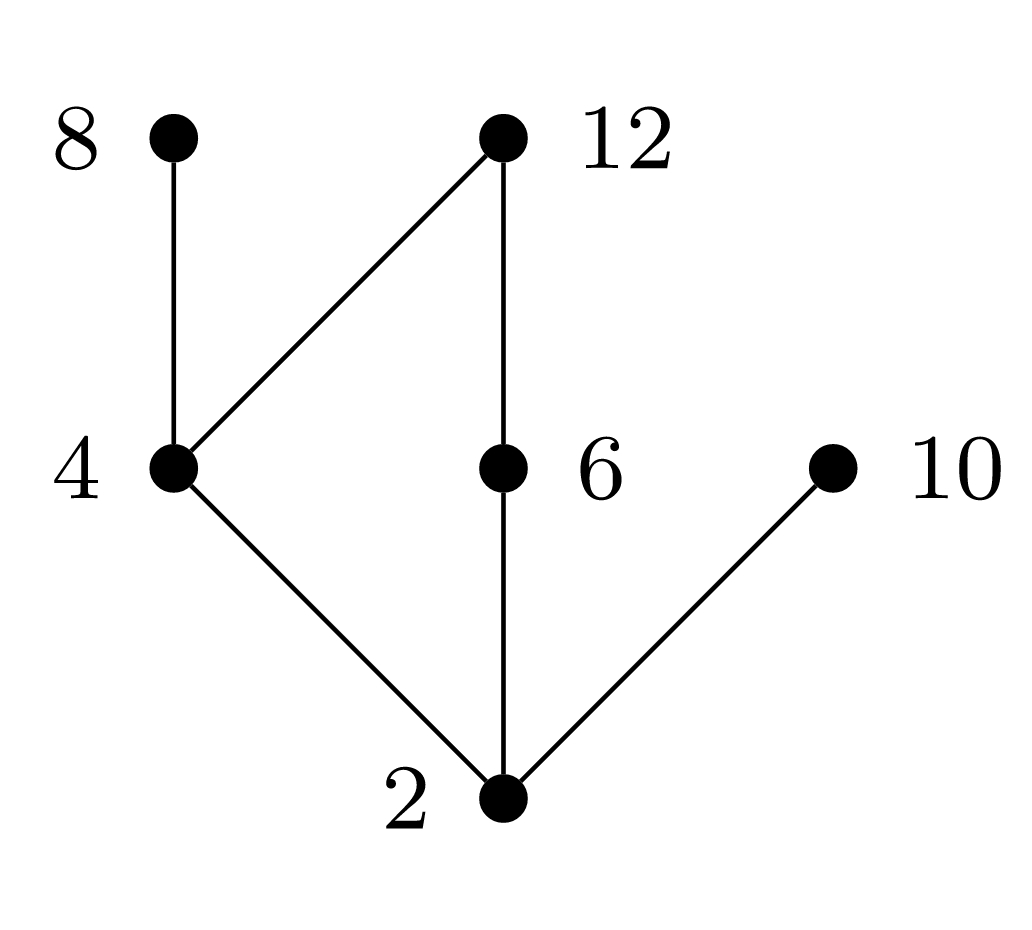
See Example 14.4.2 for another example of a graph for the “divides” relation.
The graph from Example 14.4.1 has been reproduced in Figure \(\PageIndex{2}\) as a Hasse diagram, and represents the partial order \(\mathord{\subseteq}\) on \(\mathscr{P}(\{a,b,c\})\text{.}\)
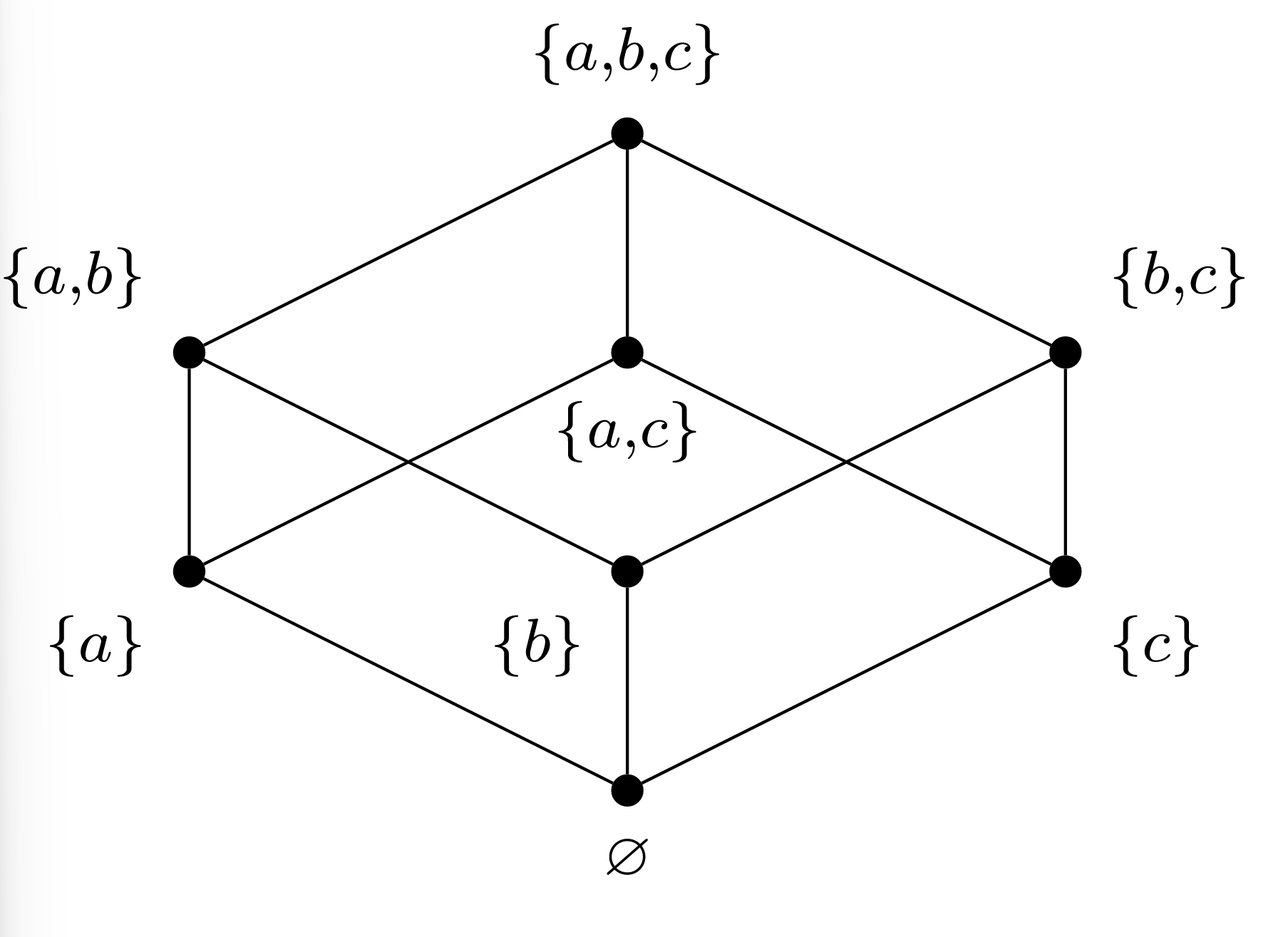
This page titled 19.3: Graph for a partial order was last modified on Tue, 01 Sep 2026 03:36:00 GMT and is shared under a GNU Free Documentation License 1.3 license and was authored, remixed, and/or curated by Jeremy Sylvestre via source content that was edited to the style and standards of the LibreTexts platform.
The book could not be loaded just now.