Opening the book…
- Draw two different connected graphs with five vertices each in which every edge is a bridge.
- How many edges are in each of the examples that you drew in Task a?
- Would it be possible to add an edge to either of the examples that you drew in Task a without creating a cycle?
- Draw two different simple graphs with \(5\) vertices in which every pair of vertices has a single path between them.
- How many edges are in each of the examples that you drew in Task a?
- Would it be possible to add an edge to either of the examples that you drew in Task a without creating a cycle?
Suppose that \(G\) is a connected graph that consists entirely of a proper cycle. (See Figure \(\PageIndex{1}\).)
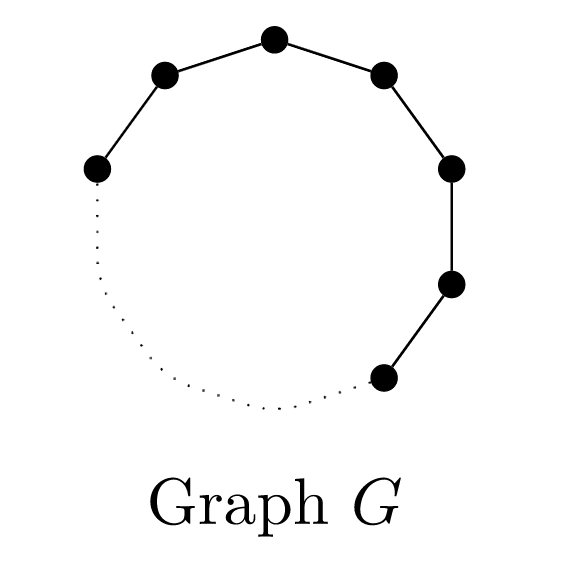
Let \(G'\) represent the subgraph of \(G\) that results by removing a single edge. Argue that \(G'\) remains connected.
Suppose that \(H\) is a connected graph that contains a proper cycle. Let \(H'\) represent the subgraph of \(H\) that results by removing a single edge from \(H\text{,}\) where the edge removed is part of the proper cycle that \(H\)contains. Argue that \(H'\) remains connected.
Notes.
- Your argument here needs to be (slightly) different from your argument in Activity 16.7.3.
- Make sure you are using the technical definition of connected graph in your argument. What are you assuming about \(H\text{,}\) and what do you need to verify about \(H'\text{?}\)
This page titled 16.7: Activities was last modified on Tue, 01 Sep 2026 03:35:29 GMT and is shared under a GNU Free Documentation License 1.3 license and was authored, remixed, and/or curated by Jeremy Sylvestre via source content that was edited to the style and standards of the LibreTexts platform.
The book could not be loaded just now.