Opening the book…
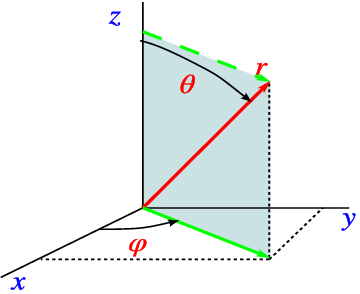
Spherical coordinates are defined from Cartesian coordinates as
\[\begin{aligned} r &= \sqrt{x^2+y^2+z^2} \\[4pt] \phi &= \arctan(y/x) \\[4pt] \theta &=\arctan\left(\frac{\sqrt{x^2+y^2}}{z}\right)\end{aligned} \nonumber \]
or alternatively
\[\begin{aligned} x &= r \cos\phi\sin\theta,\\[4pt] y &= r \sin\phi\sin\theta \\[4pt] z &=r \cos\theta\end{aligned} \nonumber \]
as indicated schematically in Fig. \(\PageIndex{1}\).
Using the chain rule we find
\[\begin{aligned} \frac{\partial}{\partial x}{~} &= \frac{\partial r}{\partial x}\frac{\partial}{\partial r}{~} + \frac{\partial \phi}{\partial x}\frac{\partial}{\partial \phi}{~} + \frac{\partial \theta}{\partial x}\frac{\partial}{\partial \theta}{~}\nonumber\\[4pt] &= \frac{x}{r} \frac{\partial}{\partial r}{~}-\frac{y}{x^2+y^2}\frac{\partial}{\partial \phi}{~} +\frac{xz}{r^2\sqrt{x^2+y^2}}\frac{\partial}{\partial \theta}{~} \nonumber\\[4pt] &= \sin\theta\cos\phi\frac{\partial}{\partial r}{~}-\frac{\sin\phi}{r\sin\theta} \frac{\partial}{\partial \phi}{~} +\frac{\cos\phi\cos\theta}{r} \frac{\partial}{\partial \theta}{~},\\[4pt] \frac{\partial}{\partial y}{~} &= \frac{\partial r}{\partial y}\frac{\partial}{\partial r}{~}+\frac{\partial \phi}{\partial y}\frac{\partial}{\partial \phi}{~}+\frac{\partial \theta}{\partial y}\frac{\partial}{\partial \theta}{~}\nonumber\\[4pt] &= \frac{y}{r} \frac{\partial}{\partial r}{~}+\frac{x}{x^2+y^2}\frac{\partial}{\partial \phi}{~} +\frac{yz}{r^2\sqrt{x^2+y^2}}\frac{\partial}{\partial \theta}{~} \nonumber\\[4pt] &= \sin\theta\sin\phi\frac{\partial}{\partial r}{~}+\frac{\cos\phi}{r\sin\theta} \frac{\partial}{\partial \phi}{~} +\frac{\sin\phi\cos\theta}{r} \frac{\partial}{\partial \theta}{~},\\[4pt] \frac{\partial}{\partial z}{~} &= \frac{\partial r}{\partial z}\frac{\partial}{\partial r}{~}+\frac{\partial \phi}{\partial z}\frac{\partial}{\partial \phi}{~}+\frac{\partial \theta}{\partial z}\frac{\partial }{\partial \theta}{~}\nonumber\\[4pt] &= \frac{z}{r} \frac{\partial }{\partial r}{~} -\frac{\sqrt{x^2+y^2}}{r^2}\frac{\partial }{\partial \theta}{~} \nonumber\\[4pt] &= \cos\theta\frac{\partial }{\partial r}{~}-\frac{\sin\theta}{r} \frac{\partial }{\partial \theta}{~}.\\[4pt]\end{aligned} \nonumber \]
once again we can write \({\nabla}\) in terms of these coordinates.
\[\begin{aligned} {\nabla} &=& \hat{e}_r \frac{\partial}{\partial r}{~}+\hat{e}_\phi \frac{1}{r\sin\theta}\frac{\partial}{\partial \phi}{~} + \hat{e}_\theta \frac{1}{r}\frac{\partial}{\partial \theta}{~}\end{aligned} \nonumber \] where the unit vectors \[\begin{aligned} \hat{e}_r &=& (\sin\theta\cos\phi,\sin\theta\sin\phi,\cos\theta), \nonumber\\[4pt] \hat{e}_\phi &=& (-\sin\phi,\cos\phi,0), \nonumber\\[4pt] \hat{e}_\theta &=& (\cos\phi\cos\theta,\sin\phi\cos\theta,-\sin\theta).\end{aligned} \nonumber \]
are an orthonormal set. We say that spherical coordinates are orthogonal.
We can use this to evaluate \(\Delta={\nabla}^2\),
\[\Delta = \frac{1}{r^2}\frac{\partial}{\partial r}{~}\left(r^2 \frac{\partial}{\partial r}{~}\right) +\frac{1}{r^2} \frac{1}{\sin\theta} \frac{\partial}{\partial \theta}{~} \left( \sin\theta\frac{\partial}{\partial \theta}{~} \right) + \frac{1}{r^2}\frac{\partial^2}{\partial \phi^2}{~} \nonumber \]
Finally, for integration over these variables we need to know the volume of the small cuboid contained between \(r\) and \(r+\delta r\), \(\theta\) and \(\theta + \delta\theta\) and \(\phi\) and \(\phi+\delta\phi\).
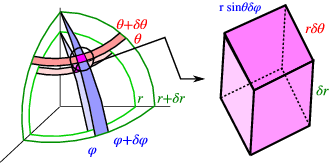
The length of the sides due to each of these changes is \(\delta r\), \(r \delta \theta\) and \(r \sin \theta \delta \theta\), respectively (these are the Jacobians for the conversion of Cartesian coordinates to polar and spherical coordinates, respectively). We thus conclude that
\[\int_V f(x,y,z) dx dy dz = \int_V f(r,\theta,\phi) r^2\sin\theta \,dr \,d\theta \,d\phi. \nonumber \]
Contributors and Attributions
This page titled 7.2: Spherical Coordinates was last modified on Wed, 22 Oct 2025 17:58:03 GMT and is shared under a CC BY-NC-SA 2.0 license and was authored, remixed, and/or curated by Niels Walet via source content that was edited to the style and standards of the LibreTexts platform.
The book could not be loaded just now.