Opening the book…
Imagine placing a plant in the ground one day and finding that it has doubled its height just a few days later. Although it may seem incredible, this can happen with certain types of bamboo species. These members of the grass family are the fastest-growing plants in the world. One species of bamboo has been observed to grow nearly 1.5 inches every hour.1 In a twenty-four hour period, this bamboo plant grows about 36 inches, or an incredible 3 feet! A constant rate of change, such as the growth cycle of this bamboo plant, is a linear function.
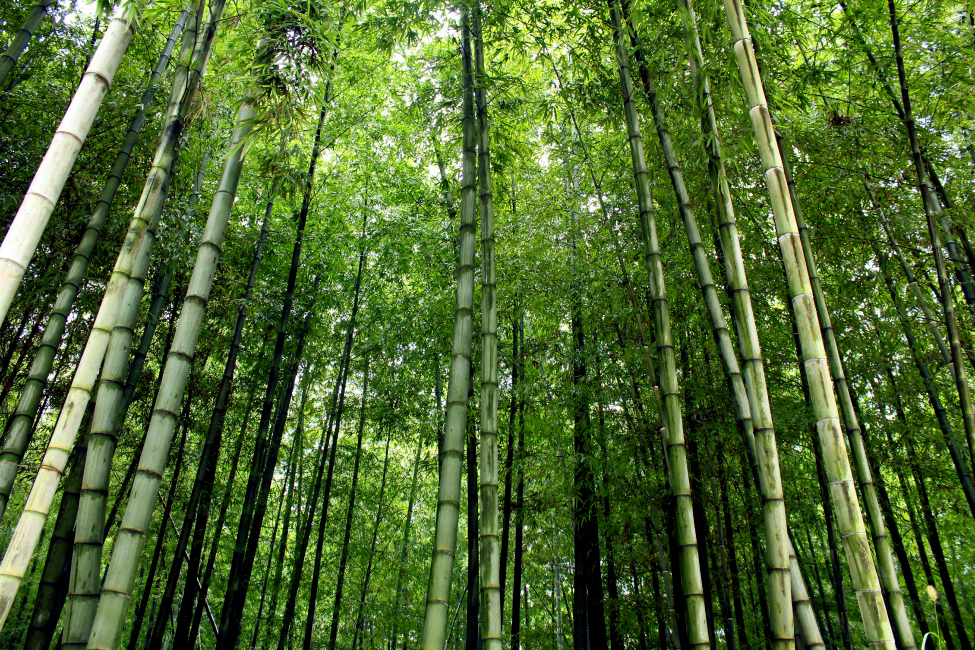
Figure \(\PageIndex{1}\): A bamboo forest in China (credit: “JFXie”/Flickr)
Recall from Functions and Function Notation that a function is a relation that assigns to every element in the domain exactly one element in the range. Linear functions are a specific type of function that can be used to model many real-world applications, such as plant growth over time. In this chapter, we will explore linear functions, their graphs, and how to relate them to data.
Footnotes
1 www.guinnessworldrecords.com/...growing-plant/
This page titled 3.8.0: Introduction to Linear Functions was last modified on Tue, 01 Sep 2020 18:26:00 GMT and is shared under a CC BY 4.0 license and was authored, remixed, and/or curated by OpenStax via source content that was edited to the style and standards of the LibreTexts platform.
The book could not be loaded just now.