Opening the book…
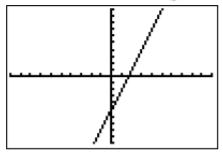
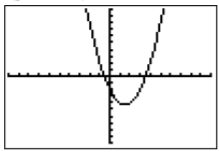
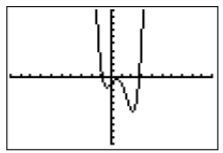
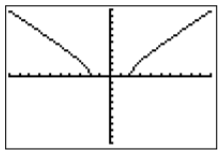
Graph the equation in the standard window.
- \(y=3x-5\)
- \(y=x^2-3x-2\)
- \(y= x^4-3x^3+2x-1\)
- \(y=\sqrt{x^2-4}\)
- \(y=\dfrac 1 {x+2}\)
- \(y=|x+3|\)
For the last exercise, the absolute value is obtained by pressing \(\boxed {\text{math}}\boxed {\triangleright } \boxed {\text{enter}}\).
- Answer
-
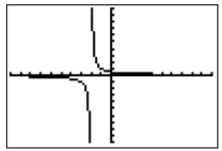
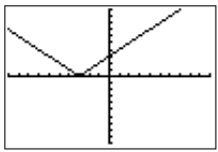
Solve the equation for \(y\) and graph all branches in the same window.
- \(x^2+y^2=4\)
- \((x+5)^2+y^2=15\)
- \((x-1)^2+(y-2)^2 = 9\)
- \(y^2+x^2-8x-14=0\)
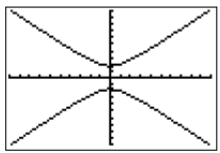
- \(y^2=x^2+3\)
- \(y^2=-x^2+77\)
- Answer
-
- \(y_{1}=\sqrt{4-x^{2}}\), \(y_{2}=-\sqrt{4-x^{2}}\),
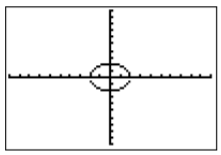
- \(y_{1}=\sqrt{15-(x+5)^{2}}\), \(y_{2}=-\sqrt{15-(x+5)^{2}}\),
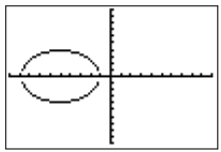
- \(y_1=2+\sqrt{9-(x-1)^{2}}\), \(y_{2}=2-\sqrt{9-(x-1)^{2}}\),
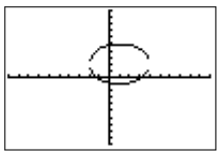
- \(y_{1}=\sqrt{-x^{2}+8 x+14}\), \(y_2=-\sqrt{-x^{2}+8 x+14}\),
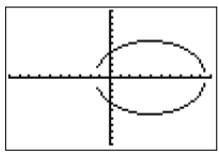
- \(y_{1}=\sqrt{x^{2}+3}\), \(y_{2}=-\sqrt{x^{2}+3}\),
- \(y_{1}=\sqrt{-x^{2}+77}\), \(y_{2}=-\sqrt{-x^{2}+77}\),
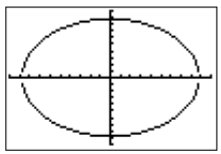
- \(y_{1}=\sqrt{4-x^{2}}\), \(y_{2}=-\sqrt{4-x^{2}}\),
Find all zeros of the given function. Round your answer to the nearest hundredth.
- \(f(x)=x^2+3x+1\)
- \(f(x)=x^4-3x^2+2\)
- \(f(x)=x^3+2x-6\)
- \(f(x)=x^5-11x^4+20x^3+88x^2-224x+1\)
- \(f(x)=x^3-5x^2+2x+3\)
- \(f(x)=\sqrt{2^x-3}-2x+3\)
- \(f(x)=0.04 x^3-0.02x^2-0.5174x+0.81\)
- \(f(x)=0.04 x^3-0.02x^2-0.5175x+0.81\)
- \(f(x)=0.04 x^3-0.02x^2-0.5176x+0.81\)
- Answer
-
- \(x \approx-2.62, x \approx-0.38\)
- \(x=\pm 1, x=\pm \sqrt{2} \approx \pm 1.41\)
- \(x \approx 1.46\)
- \(x \approx-2.83, x \approx 0.01, x \approx 2.82, x \approx 4.01, x \approx 7.00\)
- \(x \approx-0.578, x \approx 1.187, x \approx 4.388\)
- \(x \approx 1.61, x=2, x \approx 6.91\)
- \(x \approx-4.00\)
- \(x=-4, x=2.25\)
- \(x \approx-4.00, x \approx 2.22, x \approx 2.28\)
Find all solutions of the equation. Round your answer to the nearest thousandth.
- \(x^3+3=x^5+7\)
- \(4x^3+6x^2-3x-2=0\)
- \(\dfrac{2x}{x-3}=\dfrac{x^2+2}{x+1}\)
- \(5^{3x+1}=x^5+6\)
- \(x^3+x^2=x^4-x^2+x\)
- \(3x^2=x^3-x^2+3x\)
- Answer
-
- \(x \approx-1.488\)
- \(x \approx-1.764, x \approx-0.416, x \approx 0.681\)
- \(x \approx 5.220\)
- \(x \approx-1.431, x \approx 0.038\)
- \(x \approx-1.247, x=0, x \approx 0.445, x \approx 1.802\)
- \(x=0, x=1, x=3\)
Graph the equation. Determine how many maxima and minima the graph has. To this end, resize the graphing window (via the zoom-in, zoom-out, and zoom-box functions of the calculator) to zoom into the maxima or minima of the graph.
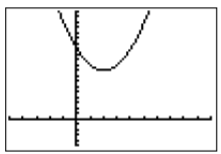
- \(y=x^2-4x+13\)
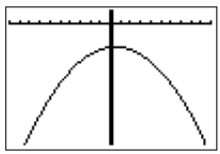
- \(y=-x^2+x-20\)
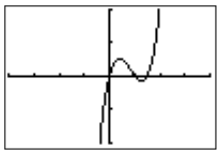
- \(y=2x^3 -5x^2+3x\)
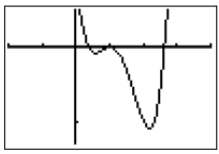
- \(y=x^4-5x^3+8x^2-5x+1\)
- Answer
-
- There is one minimum. Zoom out for the graph.
- There is one maximum. Resize the window to Ymin= −100.
- There is one local maximum and one local minimum. The graph with Xmin=−4, Xmax= 4, Ymin= −2, Ymax= 2 is below.
- Zooming into the graph reveals two local minima and one local maximum. We graph the function with Xmin=−2, Xmax= 4, Ymin= −1.3, Ymax= 0.5.
- There is one minimum. Zoom out for the graph.
Approximate the (local) maxima and minima of the graph. Round your answer to the nearest tenth.
- \(y=x^3+2x^2-x+1\)
- \(y=x^3-5x^2+8x-3\)
- \(y=-x^4+3x^3+x^2+2\)
- \(y=x^4-x^3-4x^2+6x+2\)
- \(y=x^4-x^3-4x^2+8x+2\)
- \(y=x^4-x^3-4x^2+7x+2\)
- Answer
-
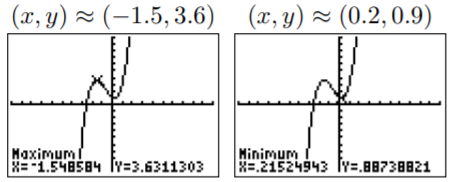
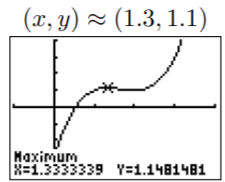
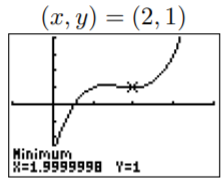
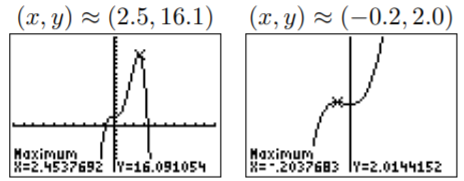
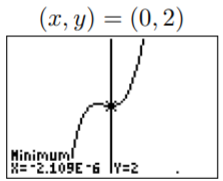

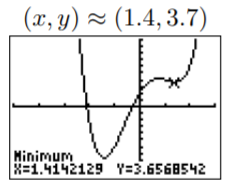
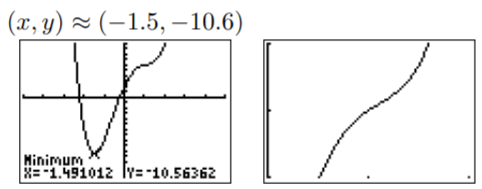 (there is only one minimum and no maximum in part (e))
This page titled 4.3: Exercises was last modified on Mon, 02 May 2022 15:49:58 GMT and is shared under a CC BY-NC-SA 4.0 license and was authored, remixed, and/or curated by Thomas Tradler and Holly Carley (New York City College of Technology at CUNY Academic Works) via source content that was edited to the style and standards of the LibreTexts platform.
The book could not be loaded just now.